Insight,

SOCI update: Exposure draft enhancements to CIRMP Rules and consultation on proposed amendments to Ministerial Directions Powers

AU | EN
Current site :    AU   |   EN
Australia
Singapore

Tell me in 30 seconds

As foreshadowed in our earlier insight here, the Department of Home Affairs (Department) has now released an exposure draft of proposed enhancements to the Security of Critical Infrastructure (Critical Infrastructure Risk Management Program) Rules 2023 (CIRMP Rules), and a separate consultation paper on proposed amendments to the Ministerial Directions Powers in Part 3 of the Security of Critical Infrastructure Act 2018 (SOCI Act).  Together, these initiatives form part of the Government’s broader work to uplift the security of Australia’s critical infrastructure. 

The Ministerial Directions powers consultation paper canvases five proposed reforms

  1. Amendments to the existing Section 32 Directions Power.
  2. A New Conditions Power
  3. A Vendor-risk Directions Power
  4. A Potential Mechanism to delay continuous disclosure in certain high risk cyber incidents
  5. Higher civil penalties for non-compliance

The independent review of the SOCI Act was also recently tabled in parliament. While we wait for the Government’s response to this review, some of the proposed amendments align with those recommendations (in terms of increasing penalties) and others may not be considered entirely consistent with that review (such as the more detailed requirements proposed by the proposed Enhanced CIRMP Rules, which some may say increases uncertainty and complexity of compliance).    

What you need to do?

Consultation on the exposure draft and the proposed reforms to the Ministerial Directions powers closes on 1 May 2026. A town hall on the exposure draft was held on 8 April 2026, and a town hall on the consultation paper for the Ministerial Directions powers was held on 7 April 2026 and another will be held on 20 April 2026. Recordings will be available on the CISC website for those unable to attend. Entities planning to provide feedback should note that separate submissions are required for each initiative.

Exposure Draft: Proposed enhancements to the CIRMP Rules

Who is affected?

Under the exposure draft, the enhanced CIRMP requirements apply to the following nine specified asset classes:
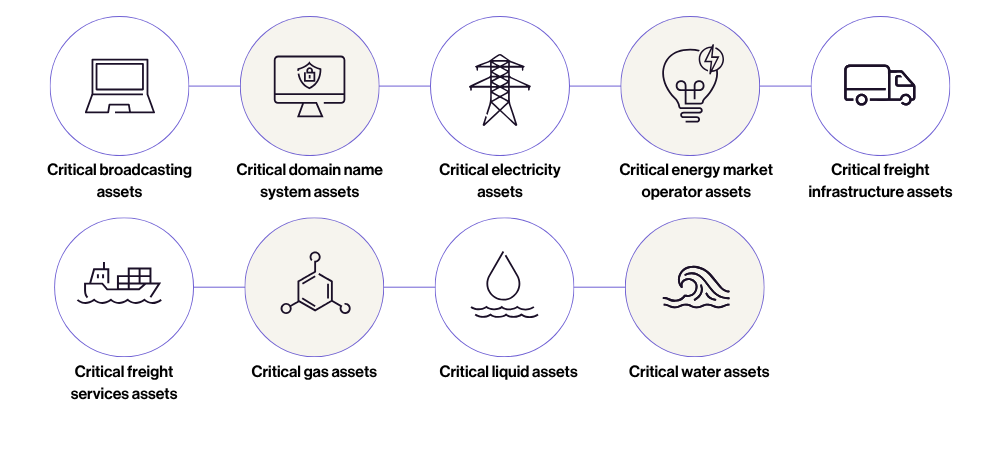
Key enhanced requirements

The table below summarises what responsible entities would be required to do to comply with the enhanced requirements under the exposure draft if they were implemented: 

Enhancement requirements
What responsible entities must do to comply

All-Hazards Material Risk (s 6A)

  • Consider, in the CIRMP, risks that could impair the asset’s functions in a way that prejudices Australia’s social stability, economic stability, national security or defence, including relevant government risk advice on those matters.
  • Consider compromise or impairment of the asset’s functions arising from, or in connection with, foreign ownership, control or influence (FOCI).

The consultation paper proposed a requirement to consider ‘specified risk advice’ issued by the Department as part of the CIRMP which has not expressly been included (the broad all hazards risk above being proposed instead). This should also be considered in the context of the proposed ministerial directions powers in respect of vendor risks described below.

Cyber and Information Security Uplift (s 8A)

  • Establish and maintain processes to minimise or eliminate specified cyber material risks, including risks associated with unsupported or legacy systems, delayed patching, advanced and emerging technology, and offshore remote access to operational technology control systems and business-critical data.
  • Comply with a listed cyber framework, or an equivalent framework, and implement more detailed controls around phishing-resistant MFA, authentication logging and review, critical system identification, network segregation, and recovery and restoration capability.

The exposure draft broadly implements the proposals in the consultation paper. In doing so, the Department has adopted terminology used in APRA standards around maximum tolerable outage for the management of these risks.

Personnel Access Management and Critical Worker Suitability (s 9A)

  • Maintain controls to manage access-related risks for critical systems and the asset more broadly, including unauthorised or unsupervised access, compromise or misuse of credentials and privileged access, and access by persons other than critical workers.
  • Assess, monitor and manage the ongoing suitability of critical workers with access to critical systems and their components, including risks associated with incoming and outgoing personnel.
  • Require onshore critical workers to satisfy prescribed suitability requirements before access is granted, being either an AusCheck background check plus suitability assessment or an existing AGSVA NV1 clearance.
  • Require offshore critical workers to satisfy those same suitability requirements before access is granted, and if they are unable to do so, record in the CIRMP the relevant employment risks and mitigation steps.
  • Where an AusCheck background check is required, repeat it at least every five years for workers requiring ongoing access, and reassess NV1-cleared workers before that clearance lapses or expires.

The exposure draft focuses more on worker suitability, ongoing monitoring and access related controls. The Department resisted requests for greater clarity around the definition of critical workers.

Supply Chain Mapping and Vendor Assessment (s 10A)

  • Map major suppliers and critical systems across physical and cyber supply chains, identify vulnerabilities and risks, and determine the maximum tolerable outage for the asset and relevant systems, components, suppliers or providers.
  • Assess existing and proposed major suppliers by reference to factors such as legal requirements, jurisdictional constraints, supplier access, influence and control, and include mitigation measures so far as reasonably practicable.

The exposure draft broadly reflects the approach proposed in the consultation paper, again adopting terminology from APRA Standards. 

Physical Security and Natural Hazards (s 11A)

  • Centrally manage physical security and natural hazards, including the physical-security consequences that may arise from cyber, personnel and supply-chain hazards.
  • Ensure the CIRMP addresses matters such as site characteristics, critical components, sensitive areas, access controls, surveillance and response measures for unauthorised access.

These requirements have been added. The consultation paper did not propose any additional physical security and national hazard amendments.

Timing and implementation

The exposure draft does not require all enhanced obligations to apply immediately, but instead stages them through 6, 18 and 24 month grace periods. Some of these periods have been extended slightly following consultation.

For assets already captured, those periods expire after commencement, and for assets captured later, they expire after the asset first becomes a critical infrastructure asset.

Time from commencement
Key requirement
Relevant provision

6 months

Enhanced all-hazards material risk requirement

S 6A

18 months

Initial enhanced cyber risk minimisation and personnel access-management requirements, plus enhanced supply chain and physical security requirements

ss 8A(2), 9A(2), 10A and 11A

24 months

Remaining enhanced cyber and personnel requirements

s 8A (other than s 8A(2)); s 9A (other than s 9A(2))

Consultation on Ministerial Directions reforms

Alongside the CIRMP exposure draft, the Department has released a separate consultation on proposed amendments to the Ministerial Directions powers in Part 3 of the SOCI Act. 

The paper includes illustrative scenarios for the key proposed reforms and targeted consultation questions seeking feedback on matters such as feasibility, implementation steps, timing, costs, legal interfaces and cumulative regulatory burden. 

As some of powers conferred on these reforms are significant and could have material cost and implementation consequences for affected entities if exercised, readers should review those examples and questions carefully, and if appropriate make submissions to ensure that Government properly takes into account industry’s concerns with the consequences of the exercise of these powers.

Proposed measure
Proposed measure

Amendments to the existing section 32 directions power

  • The Minister would no longer need an Adverse Security Assessment before issuing a direction and would instead obtain and have regard to tailored ASIO advice.
  • The paper also proposes recalibrating the current “regulatory exhaustion” test so the Minister would consider whether other regulatory mechanisms could address the risk more effectively, while retaining negotiation, consultation and judicial review safeguards. 

New conditions power

  • The Minister could impose targeted conditions on reporting entities where ownership, control or governance arrangements create a material risk to national security that cannot be sufficiently mitigated through existing obligations or voluntary measures.  
  • The paper indicates this power is intended to sit alongside, rather than duplicate, the FATA regime. In the foreign investment context, FATA conditions would continue to address national security risks identified at the transaction stage, while the proposed SOCI power would allow conditions to be imposed where ownership, control or governance risks emerge, persist or intensify after the acquisition, or arise outside the foreign investment approval process altogether.

Vendor-risk direction power

  • The vendor-risk direction power would allow coordinated action where a vendor, or its products, equipment, services or technologies, presents a material risk to national security.  
  • The proposed power could support directions to responsible entities individually or by class, including to cease using specified products, restrict future procurement, remove or remediate technologies, or implement compensating controls where immediate removal is not feasible. 

Delayed continuous disclosure mechanism

  • The introduction of a limited, time-bound mechanism to delay disclosure obligations in rare high-risk cyber incidents where public disclosure would threaten national security or public safety. 
  • The paper proposes either using ASIC’s existing exemption power under section 111AT of the Corporations Act or creating a new SOCI-based directions power under which the Minister could direct an entity not to publicly disclose the existence of the cyber incident for a prescribed period.

Increased civil penalties

  • Increasing the civil penalty for non-compliance with a Ministerial direction under Part 3 from 250 penalty units to 2,000 penalty units.  
  • The paper says this is intended to create a more credible deterrent, align Part 3 more closely with the enforcement framework already operating in Part 2D of the SOCI Act, and preserve the courts’ discretion to calibrate penalties to the seriousness of the misconduct.   
Latest Thinking
Insight
Global unrest. Interest rates. Policy uncertainty. Compound these with planning delays and capex blowouts. None of these make it easy to invest in the energy transition.

03 June 2026

Insight
In today’s market, capital is chasing certainty – and developers are chasing capital. Co-development arrangements have emerged as the meeting point.

03 June 2026

Insight
Policy certainty and market accessibility continue to be critical for investors looking at the energy transition as a fertile source of opportunity – especially in capital-intensive generation projects.

03 June 2026