Singapore is the leading data centre hub in Asia, a title it has held for some time. It offers a stable, well-regulated and highly connected environment.
To explore settings in other jurisdictions visit our APAC Regulatory Guide.
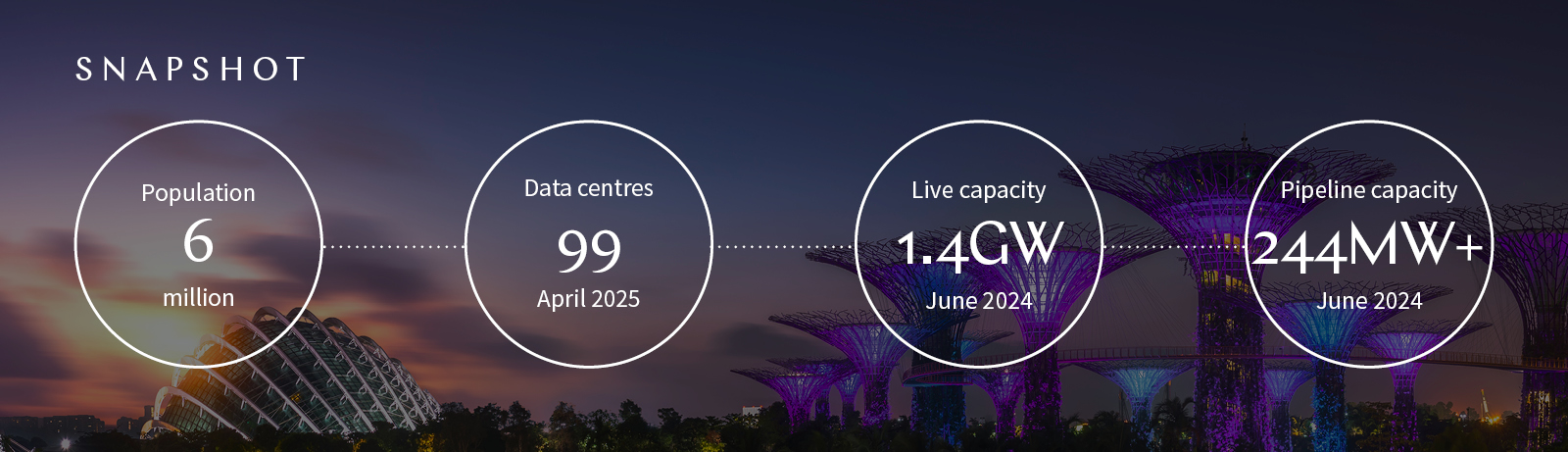
Sources: Worldometer, Statista, CBRE, Cushman & Wakefield
With strong submarine cable infrastructure, 100% foreign ownership permitted and targeted tax incentives, Singapore remains a preferred regional base for hyperscalers and enterprise operators serving Asia. The government supports cross-border data flows and aligns closely with international standards, reinforcing its position as a top-tier digital infrastructure market.
However, any new development is tightly controlled under the Data Centre Call for Application (DC-CFA) scheme, with no rounds launched since 2023. Projects must meet strict sustainability criteria, including energy and water efficiency. Despite limited capacity, major operators continue to invest: Google completed its fourth Singapore facility in 2024 (US$5 billion total investment) and Equinix has committed US$260 million to a sixth site opening in early 2027.

Spotlight on key drivers
Limited Entry, High Standards
Following the lifting of Singapore’s 2019 moratorium, the government introduced the DC-CFA scheme to regulate growth based on sustainability, strategic value and economic contribution.
However, since the pilot DC-CFA closed in 2023, no new rounds have launched, creating a temporary supply constraint. While the scheme ensures only high-impact, efficient projects proceed, it also limits new market entry. The next round is expected this year, and investors will need to act quickly when applications reopen.
Deal, or no deal? Sustainability as the decider
Singapore has made sustainability a strategic priority for data centres, requiring green certifications under its Green Data Centre Roadmap.
Operators must meet strict energy efficiency, decarbonisation and water usage standards, aligned with national environmental goals. Certification under frameworks like the BCA-IMDA Green Mark for Data Centres (GMDC) is increasingly expected, and green energy procurement is becoming a competitive differentiator. While these requirements may raise upfront costs, they position operators to align with both regulatory expectations and the ESG priorities of global tenants and investors.
Power and land constraints
Despite Singapore’s advanced infrastructure, data centre growth is constrained by limited land availability and tight power allocations.
These factors result in long lead times for approvals and grid connections - particularly for high-capacity facilities. Investors must plan for competition in securing resources and may increasingly look to nearby regions like Johor and Batam for spillover capacity.
Singapore remains the hyperconnected data centre hub for Asia. While its capacity grow as fast as Johor, Sydney, Tokyo or Seoul, the allure of Singapore endures as the ‘square mile’ for data centre finance and capability.
Its geographical limitations are being addressed with spillover options in the ‘Singapore Plus’ regions of Johor and Batam, while sustainability and network security are focal points for mainland Singapore."
KWM Partner Daryl Cox
Download the Singapore chapter below

Unlocking opportunities and navigating challenges