

South Korea, Asia’s fourth-largest economy and the world’s 13th-largest, is moving fast to reshape its energy and industrial base. Offshore wind, solar and hydrogen are attracting investments and companies are scaling up innovation in green batteries and electric vehicles.
A post-pandemic rebound saw GDP reach an estimated US$1.8 trillion in 2024 (up 2.2%), primarily driven by robust exports, particularly semiconductors. South Korea has shown economic resilience with inflation stabilising at around 1.9%.
However, the nation’s heavy reliance on fossil fuels exposes it to vulnerability, including global energy price shocks. Renewables constituted just 10% of total energy generation in 2024 and the country is among the world’s top greenhouse gas emitters, responsible for approximately 1.3% of global CO₂ emissions.
To address this, South Korea has committed to a legally binding 40% reduction in emissions by 2030 compared to 2018 levels, aiming for net-zero by 2050 through the Framework Act on Carbon Neutrality and Green Growth enacted in 2021.
The next decade will be shaped by how South Korea navigates these shifts.

Sources: IEA, Worldometer
Read on for more – and reach out to your KWM Contact.
South Korea’s climate transition is creating new growth sectors while exposing hurdles to overcome. The transition is creating strong growth in sectors like clean technology, grid upgrades, smart buildings and energy storage, while exposing challenges including grid bottlenecks and land constraints." – Bohyoung Kim, KWM Partner
Download the full publication or click the following to read each section:
Energy Transition | Carbon Markets | Financing | Region Focus: Seaweed Farming
Investment opportunities and challenges: Our Top 5

The evolving regulatory and corporate landscape
Sector-based roadmap to a low-carbon economy
South Korea’s climate strategy is anchored by the Carbon Neutrality Act (Framework Act on Carbon Neutrality and Green Growth). Enacted in 2021 and effective since March 2022, this Act made Korea’s 2050 carbon-neutral goal legally binding and set an interim target of −40% GHG emissions by 2030 (vs. 2018).
The Framework Act established robust governance mechanisms:
- Presidential Carbon Neutrality Commission
This Commission sits at the heart of climate policy, bringing together government, business, experts and the community. It sets national climate targets, reviews sectoral plans and checks on progress, reporting directly to the President. - Mandatory national climate plans every five years
The law requires the government to set a new national carbon neutrality and green growth plan every five years. In 2023, the first National Carbon Neutrality and Green Growth Plan was adopted, detailing sector-by-sector roadmaps to 2030. The government tracks progress and updates targets as needed. - A dedicated Climate Response Fund to finance the transition.
Roadmap to a low-carbon economy in South Korea
The National Carbon Neutrality and Green Growth Plan of 2023 outlines detailed strategies and emission reduction targets across various sectors, setting the stage for comprehensive climate action.

South Korea’s targets set to change after court ruling
South Korea is one of the first Asian nations where courts have weighed in on climate policy. In August 2024, the Constitutional Court ruled that the Carbon Neutrality Act lacked adequate long-term targets beyond 2030 and thus fell short of the state’s duty to protect citizens’ rights, prompting the government to craft more detailed 2031 - 2050 climate targets.

Renewable energy, environmental protections and mandatory disclosures have emerged
South Korea’s regulatory environment has rapidly evolved following the setting of the 2023 roadmap. Recent significant reforms include:
- Energy infrastructure laws (2025): Special Acts for offshore wind and national grid upgrades, improving project approval processes.
- Environmental enforcement (2025): Stricter penalties for environmental violations, incentivising voluntary compliance.
- ESG disclosure standards (2024): Mandatory ESG and climate disclosures aligned with international standards.
- Plan for used battery industry (2024): Promoting recycling and reuse, particularly of EV batteries, aligning with global sustainability practices.
Evolving laws and policies are driving Korean businesses and institutions to integrate climate considerations into core decision-making. Here are some notable examples.
- ESG bond market growth: Expansion of ESG bond issuance by major corporations such as Hanhwa Energy and Hyundai Capital, enhancing transparency and boosting green finance.
- Busan Eco-Delta Smart City: Located in South Korea’s second largest city, the national pilot smart city project integrates climate adaptation strategies. This includes energy-efficient buildings and flood-resistant infrastructure in the coastal trading hub and tourist destination. The smart city is due for completion by 2027 and will serve as a demonstration.
What does the climate challenge mean for the digital revolution?
South Korea is attracting strong interest from investors, developers and operators, as a burgeoning hub for data centres. Yet there are significant ESG implications – including power constraints. Find out more in KWM’s Guide to data centre opportunities across APAC - South Korea.
Energy Transition
South Korea is scaling up renewables and nuclear power, while legal reforms are opening new channels for private investment and innovation.
South Korea’s energy transition strategy is centered on reducing its heavy reliance on fossil fuels, particularly coal and liquified natural gas (LNG), which accounted for more than half of its . Nuclear power contributed just over 30% - the single largest source - while renewables (solar, wind, biomass, hydro) comprised almost 11%.
To meet its 2030 and 2050 emissions targets, the government has adopted a multifaceted approach that includes expanding renewables, increasing nuclear capacity, enhancing energy efficiency and developing new energy sources like hydrogen, all under the umbrella of green growth policies.

Regulatory settings and government efforts
South Korea’s energy transition is guided by several key legislative acts. The Framework Act on Carbon Neutrality and Green Growth, enacted in 2021, legally establishes a binding commitment to achieve net-zero emissions by 2050, along with an interim goal of reducing greenhouse gas emissions by 40% by 2030.
In addition to the National Carbon Neutrality and Green Growth Plan of 2023, targeted policies are encouraging the expansion of the grid and stimulating renewables and hydrogen projects..
A trio of laws were passed in February 2025. The so-called Energy Trifecta Bill consisted of
- the Special Act on the Expansion of the National Electricity Network (the Power Grid Act),\
- the Special Act on Promotion of Offshore Wind Power Distribution and Industry Development (the Offshore Wind Act); and
- and the Special Act on High-Level Radioactive Waste Management (the HLRW Act). More details are below.
The government plans to continue to support the growth of our economy with stable and economical energy supply for AI data centers and high-tech industries along with carbon neutrality." - Ministry of Industry energy policy officer Cho Ik-no, May 2025
Opening the energy market
The monopoly previously held by KEPCO on electricity sales was loosened in 2021 with the amendment of the Electric Utility Act, enabling corporate power purchase agreements (PPAs).

South Korea is home to landmark projects that are normalising the use of wind power and hydrogen – including some that are reaching world-first milestones in the shift away from fossil fuels.
- Large-scale projects like SK E&S’s Incheon liquefied hydrogen plant (₩700 billion, completed 2024) showcase opportunities in hydrogen production and storage - the world’s largest such facility, able to fuel 5,000 buses yearly
- Cutting -edge technology examples, like POSCO’s pilot hydrogen-based steelmaking (HyREX) to produce green steel, and CCUS (carbon capture, utilisation, storage) projects at steel and cement plants
- Hydrogen fueling infrastructure such as the 9MW hydrogen fuel cell power plant in Gyeongju
- An enormous 2 GW offshore wind project in Sinan launched in 2025

The Yokji Offshore Wind Project, initiated in 2025 by Singapore-based renewable energy developer Vena Energy, represents a significant private sector contribution to South Korea’s energy transition.
The project involves a substantial investment of approximately ₩292.9 billion (c. US$200 million) to develop a 384 MW offshore wind farm near Yokji Island in Gyeongsang Province.
Its implementation has been notably facilitated by regulatory improvements introduced through the 2025 Special Act on Offshore Wind Power and supported financially by the Renewable Portfolio Standard (RPS), which provides stable revenues via fixed-price contracts.
Vena Energy has actively engaged with local stakeholders to mitigate opposition and ensure tangible community benefits, underscoring effective public-private partnerships crucial for overcoming barriers and accelerating renewable energy development. This case exemplifies how private sector initiatives can significantly advance South Korea’s ambitious climate objectives.
Carbon Markets
South Korea’s carbon market is the first of its kind in East Asia. The K-ETS is driving emission reductions and integrating with global markets.
South Korea operates the Korea Emissions Trading System (K-ETS), established in 2015 as East Asia’s first mandatory nationwide cap-and-trade program. Covering 816 major emitters from sectors like energy, industry, transportation and waste, K-ETS regulates companies through emission permits such as Korean Allowance Unit Allocation Rights (KAUs) distributed annually under a government-set cap. Companies must surrender allowances equivalent to their emissions each year.
Voluntary carbon trading remains limited, although South Korea actively develops international mechanisms aligned with Article 6 of the Paris Agreement, facilitating global carbon credit trading.

Legal Frameworks Encouraging Carbon Trading
The legal foundation for Korea’s carbon markets lies primarily in the Emission Trading Act and the Framework Act on Carbon Neutrality and Green Growth. These statutes:
- mandate participation
- outline emission permit distribution and trading, and
- allow for limited offsetting through verified credits from domestic and international projects.
The legislation also integrates biodiversity and natural resource conservation, promoting nature-based solutions and sustainable land management. Recent legal reforms encourage Korean participation in international forestry projects (REDD+) to secure carbon credits and biodiversity protection.
Compliance Issues
Companies face several compliance challenges within South Korea’s carbon market framework:
- Market liquidity and volatility
Early phases showed misalignment between permit supply and demand timing, causing volatile market conditions near compliance deadlines. Regulators responded by adjusting permit banking and compliance timelines to stabilise the market. - Monitoring, reporting and verification (MRV)
Rigorous standards for accurate emissions data collection and reporting place significant compliance burdens on companies, requiring continual updates to operational and administrative processes. - Complex offset credit approval
The bureaucratic approval process for converting external offset credits into K-ETS allowances involves multiple agencies, creating delays and uncertainty for firms relying on offsets for compliance. - Alignment with global standards
Korean firms must also navigate international compliance requirements, notably the EU’s Carbon Border Adjustment Mechanism. The Korean government is actively ensuring international recognition of the robustness of its carbon pricing.
A notable example of South Korea’s carbon credit initiatives is the 2024 landfill gas-to-energy project developed under an Article 6 partnership with Malaysia.
Capturing landfill methane emissions and converting them to biomethane energy, this project generates internationally recognised tradable carbon credits (ITMOs). South Korea intends to utilise approximately 37.5 million ITMOs from such international projects towards achieving its 2030 climate targets.
Concurrently, Korea has expanded its investment in forestry conservation projects (REDD+) in Latin America and Africa, emphasising carbon credit generation alongside biodiversity protection.
These initiatives illustrate Korea’s integrated approach to carbon market activities, combining domestic regulation with international collaboration to meet national climate objectives effectively.
Financing
Finance is pivotal in Korea’s net zero push. The government and private sector are mobilising capital at an unprecedented scale, guided by clear standards and new green finance tools.
South Korea has a Korean Green Taxonomy (K-Taxonomy) to classify environmentally sustainable activities and guide green investment. Introduced in 2021, the K-Taxonomy provides clear criteria for what counts as ‘eco-friendly’ economic activity.
In 2023 it was revised to include nuclear power generation as a green activity. The taxonomy underpins the sustainable finance market by promoting credible green projects and deterring greenwashing.
The government aims to mobilise ₩450 trillion (c. US$309 billion) in green financing by 2030 and has rolled out policy incentives to spur private investment. This includes:
- Financial incentives: interest subsidies and concessional loans for green bond issuers and clean energy projects.
- Guidance for banks: in 2024, regulators issued Green Finance Guidelines defining ‘green’ loans/investments (based on the K-Taxonomy) and requiring internal controls to prevent greenwashing.

Legal Framework
South Korea has no single ‘green finance law’; instead, regulators use guidelines and existing regulations to support climate finance.
- Green bonds follow standard market rules, but official Green Bond Guidelines (issued 2020, updated 2022) impose additional requirements.
These guidelines - jointly developed by the Ministry of Environment and Financial Services Commission - align with the K-Taxonomy and mandate external verification, transparent use-of-proceeds reporting and post-issuance audits for labeled green bonds.
- Various financing programs and structures are employed for climate projects.
The government’s Expansion Plan for Green Investment to Accelerate the Transition to a Low-Carbon Economy initiative offers interest subsidies for green bonds and Green Asset-backed Securities to encourage green investments.
State-owned policy banks (such as KDB and KEXIM) have been early leaders in green bond issuance, providing green loans for renewable energy infrastructure.
An emerging tool is green asset-backed securities (green ABS), which securitise cash flows from renewable energy assets - a market the government is keen to grow through incentives. Large renewable projects often use public–private project financing models.
Disclosure and Reporting
ESG disclosure requirements in South Korea are currently limited. Consultations on mandatory ESG disclosure requirements are underway, but timing is uncertain. The latest official update from the Financial Services Commission has postponed a decision until after 2026.
- Large listed companies with assets exceeding ₩1 trillion (c. US$721 million) must include some ESG information (such as corporate governance practices) in their annual reports.
- Certain firms, such as thosedesignated as ‘green companies,’ must disclose environmental data (for example, greenhouse gas emissions) under existing laws.
However, there is no comprehensive sustainability reporting mandate - the stock exchange only provides voluntary ESG disclosure guidance.
A more robust regime is imminent
In April 2024, the Korea Sustainability Standards Board (KSSB) released draft sustainability reporting standards aligned with international benchmarks, including detailed climate-related disclosures modeled on the TCFD framework.
Regulators plan to phase in mandatory ESG disclosure based on these standards starting after 2026. A pending amendment to the Capital Markets Act will give these requirements legal force.
The Industrial Bank of Korea (IBK) exemplifies leadership in green finance. In 2022, IBK launched Korea’s first ESG-linked loans (tying loan pricing to borrowers’ sustainability performance) and created dedicated green funds:
- ₩200 billion (c. US$144 million) for companies transitioning to renewable energy, and
- ₩100 billion (c. US$72 million) for clean-energy SMEs.
By 2023, IBK was involved in 81% of all ESG bond issuance in South Korea (₩6.9 trillion), demonstrating how a proactive bank can drive market growth. IBK’s efforts earned it recognition by the Global Finance Magazine as 2024’s ‘Best Bank for ESG-Related Loans’.
Region Focus: Seaweed Farming
Sequestering hundreds of thousands of tons of CO2 a year – reaching more than a million in the next few decades - seaweed farming is becoming a key part of national carbon strategies and export growth.
South Korea’s extensive seaweed farming industry, producing approximately 1.8 million tons annually, has emerged as a pivotal force in achieving national climate targets. Seaweed cultivation plays a significant role in carbon sequestration through its natural absorption of CO₂, known as blue carbon.
The 2050 Carbon Neutrality Plan explicitly highlights coastal ecosystems, including seaweed, as critical components for carbon reduction, aiming to sequester around 1.36 million tons of CO₂ by 2050. Seaweed farms absorb about 111,300 tons of CO₂ annually, a figure projected to grow with scaling and innovation in the sector.
Legal and Regulatory Landscape
The legal framework governing South Korea’s seaweed farming includes:
- the Aquaculture Industry Development Act, mandating licenses and environmental compliance
- the 2021 Framework Act on Carbon Neutrality and Green Growth, integrating blue carbon strategies into national policy.
In late 2024, the Ministry of Oceans and Fisheries (MOF) introduced the Blue Carbon Certification system for farmed seaweeds and a pilot Blue Credit carbon trading scheme. These initiatives provide measurable and verifiable pathways for farmers and investors to monetise carbon sequestration. Regulatory reforms, including streamlined licensing processes and relaxed coastal use restrictions, are being considered to support expansion and innovation.
What is the ‘blue economy’ – and what efforts are under way globally to unlock opportunities?
Find out in Blue Finance – Unlocking the Power of the Blue Economy.
Opportunities and Challenges
The seaweed industry offers substantial opportunities, notably through export markets and sustainable product innovations such as bioplastics, biofuels and animal feed additives.
In 2024, South Korea exported worth of dried seaweed (gim), a record high for the country, representing a 25.8% increase compared to the previous year.
With the US, Japan, and China as major importers, Korea accounts for over 70 percent of the global seaweed market. Rising ESG investments globally further amplifies the sector’s commercial potential, especially as new markets for sustainable materials emerge.

The rise of ‘gim’ - and the role of the K-food wave
Korea’s seaweed industry is highly diversified. But the crown jewel – culturally and economically – is gim.
Part of the red seaweed group, gim is experiencing phenomenal demand growth as the appetite for these thin sheets – often toasted with sesame oil and salt and consumed as a snack or rice topper – soars. And this is in part thanks to a global culinary movement as part of the wider Korean wave, alongside K-pop. Korea leads in global production of gim.
Besides red – which is also used to make nori (dominated by Japan) and zicai (common in China) - there is also brown and green seaweed. Brown is used in skincare, fertilisers and food additives. Green – a softer variety used in salads, supplements and animal feed - has the smallest market, albeit one that is growing with the popularity of health foods.
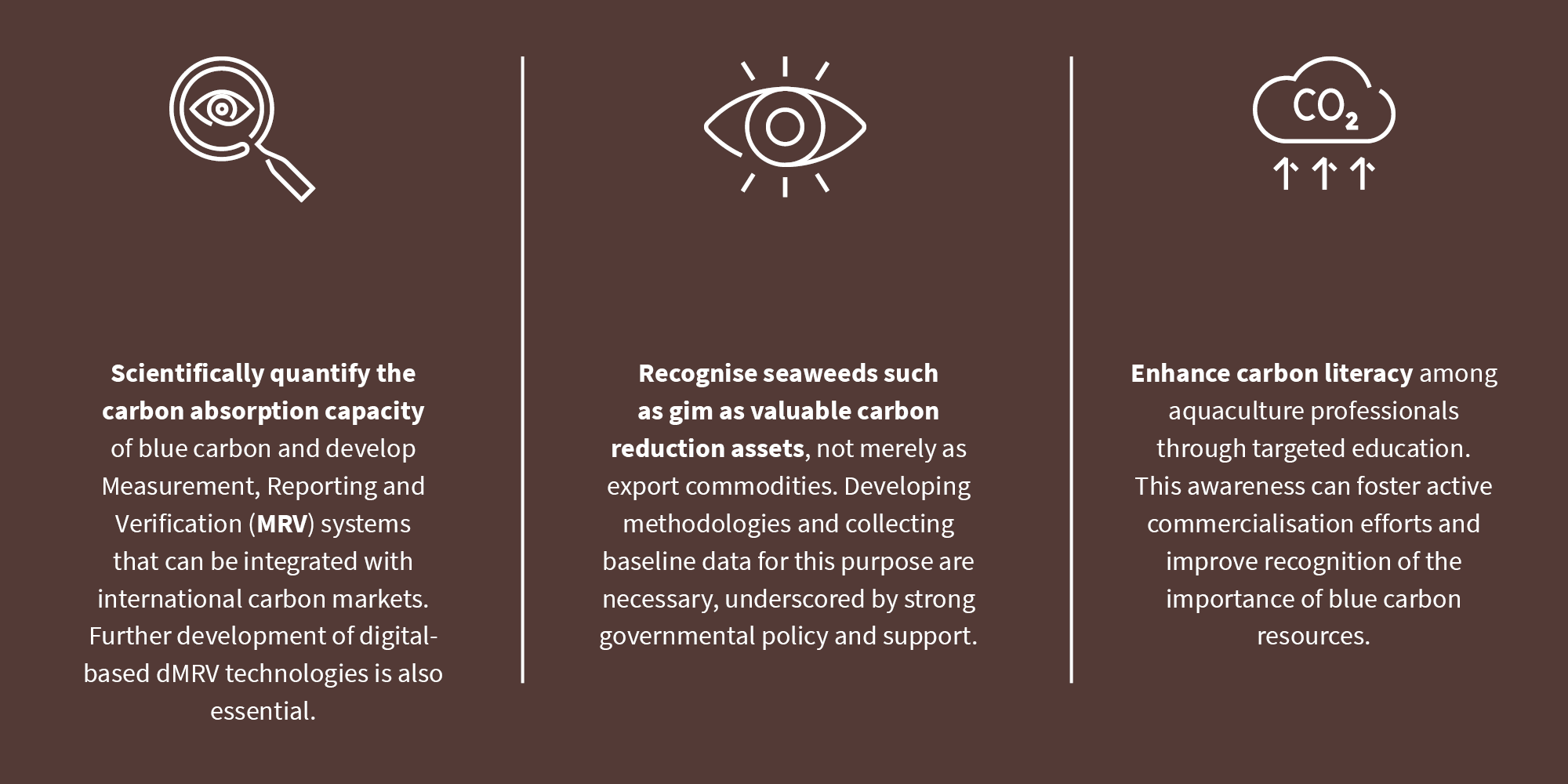
To fully realise the potential of blue carbon resources and maximize their role in carbon reduction, several critical challenges must be addressed, including the need to:
A notable example of public-private collaboration is the Pohang seaweed marine forest initiative launched in 2024. Led by POSCO in partnership with the MOF and local authorities, this project established a 2.3 km² kelp forest utilising innovative reef structures made from concrete and steel-slag. POSCO’s investment of ₩1 billion, matched by government funding, enabled the deployment of over 200 reef units to foster marine biodiversity and seaweed growth.
The project targets dual benefits:
- significant carbon sequestration, and
- improved local fishery resources.
Thousands of juvenile fish have been released into these revitalised habitats, enhancing marine biodiversity and local fishing economies. The initiative aims to secure international blue carbon certification, positioning itself to participate actively in carbon credit markets.
The Pohang project illustrates effective regulatory coordination, achieving alignment with national climate policies through a formal Memorandum of Understanding under South Korea’s Sea Forest Initiative.
This case underscores how collaborative governance and targeted investments can successfully integrate environmental restoration with climate mitigation and commercial growth.
Discover the trends shaping tomorrow's markets. Stay ahead in Asia.