

Malaysia is moving towards a more sustainable energy future as it chases ambitious renewables targets, with increasing initiatives and the gradual rolling out of a liberalised electricity market. Corporate power purchase agreements (PPAs) have emerged as a game-changing solution within this framework.
Corporate PPAs enable businesses to directly procure renewable energy from private generators, bypassing traditional utility models and accelerating the nation’s transition. In this insight, the latest in our Transforming energy landscapes: Corporate PPAs in APAC series, we unpack the evolution under way and the opportunities it brings.
Malaysia’s energy mix is changing – and private players are key
Malaysia’s energy mix remains dominated by fossil fuels, particularly natural gas and coal. Yet renewable energy sources, including solar, hydro, and biomass, are steadily gaining traction. They accounted for approximately 23% of the more than 27GW of installed electricity generation capacity as of 2023. Independent Power Producers (IPPs) play a crucial role, contributing around 70% of the country’s electricity generation.
As part of its clean energy transition, Malaysia is targeting 70% renewable energy (RE) installed capacity by 2040 and net zero by 2050. In pushing for the increased generation and consumption of RE, the Malaysian Government has rolled out various RE-focused initiatives, such as a feed-in tariff scheme and a net energy metering scheme (enabling users to sell excess onsite solar electricity generation).
New RE-initiatives such as virtual PPAs and procurement of green electricity via third party access to the grid were recently introduced to further drive RE generation and consumption.
The development of Corporate PPAs in Malaysia
Malaysia’s grid system is divided into regional monopolies, with Peninsular Malaysia served by Tenaga Nasional Berhad (TNB), while Sabah and Sarawak are managed by Sabah Electricity Sdn Bhd (SESB) and Sarawak Energy Berhad (SEB), respectively.
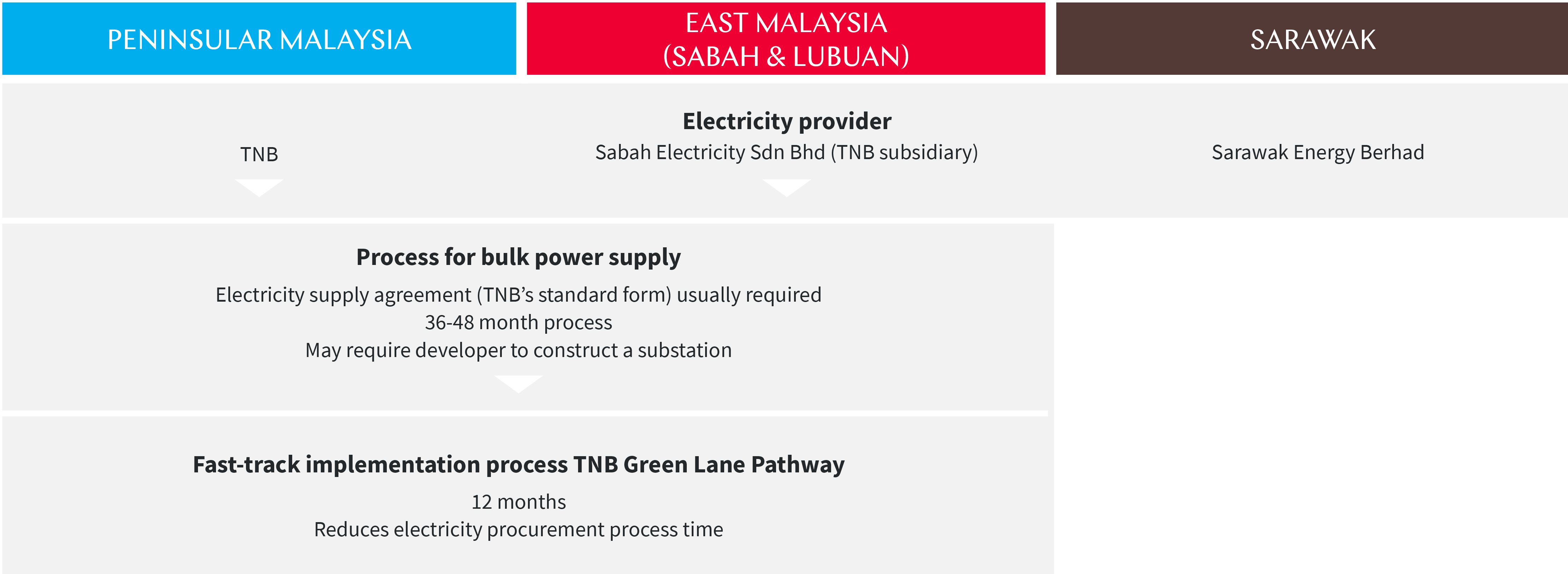
While there are independent electricity producers in Malaysia, TNB, SESB and SEB largely rely on standardised contracts to purchase electricity from them (that is, long term concession agreements for fossil fuel and large-scale solar projects and short form standard PPA for RE projects selling electricity under feed-in tariff programmes).
As a result, from a legal perspective, PPAs in Malaysia have long been limited to ‘electricity supply agreements’ entered between customers with TNB, SESB or SEB (on their respective standard terms and conditions at tariffs fixed by the Government) or the standardised concession and PPAs mentioned above.
For generators, the introduction of feed-in tariff projects under the Renewable Energy Act 2011 (RE Act 2011), which involves small-scale electricity generation using RE sources such as solar, biomass, biogas and hydropower, allowed for power producers to sell electricity to licensed distributors which extended the purchaser pool beyond TNB.
However, this was still a relatively small pool. The PPA that RE generators must use to sell to the grid under the feed-in tariff programme is a prescribed form under the RE Act 2011 known as the Renewable Energy Power Purchase Agreement (REPPA) and accordingly the terms and conditions of the PPA are standard terms from which there is minimal deviation.
The Government’s increased focus on promoting the development of RE sources and enhancing generation capacity is gradually changing this and has led to the authorisation of Corporate PPAs enabling consumers to purchase electricity directly from generators.
Use of Corporate PPAs in the Malaysian market
A key point to note is that currently, Corporate PPAs can only be used in Malaysia for projects that are being developed under the following RE programmes:
- Net Energy Metering Programme (NEM)
- Corporate Green Power Programme (CGPP)
- Corporate Renewable Energy Supply Scheme (CRESS)
All require the submission and approval of an application before the relevant corporate PPA can be implemented.
Case study of a corporate PPA in action
DayOne Data Centers signed Malaysia’s first Bilateral Energy Supply Contract (BESC) under the CRESS with TNB on 11 June 2025, based on public information. The contract reportedly secures up to 500MW of solar-backed renewable energy for its data centres over 21 years.
This agreement demonstrates how corporate PPAs are becoming a practical tool for large energy users in Malaysia to meet sustainability goals and access green power directly from the grid.
Key features of Corporate PPAs
|
NEN
|
CGPP
|
CRESS
|
|
|
Territory
|
Peninsular Malaysia and Sarawak |
Peninsular Malaysia Only |
Peninsular Malaysia Only |
|
Status in June 2025
|
Open until 30 June 2025 [2] or quota runs out (NEM 3.0) |
Closed in 2023 |
Open |
|
Quota
|
NEM Rakyat for domestic consumers 700MW [3] NEM GoMEn for government entities 100MW NEM NOVA for commercial and industrial consumers 1700MW Note – NEM Rakyat and NEM GoMEn close to fully subscribed as at late June 2025 |
800MW (fully subscribed) |
No quota |
|
Type of project
|
Rooftop solar |
Large-scale solar (ground mounted) with capacity between 5MW and 30MW |
Renewable energy plant with capacity of at least 30MW |
|
Type of electricity sale
|
Direct purchase and sale of electricity through private connection line (between generator and user) and sale by user of excess electricity to TNB (through grid connection) |
Electricity trading through the national grid |
Electricity trading through the national grid |
|
Type of contract
|
Physical PPA |
Synthetic / virtual PPA (referred to as Corporate Green Power Agreement) |
Hybrid synthetic / virtual PPA and sleeved PPA |
|
Key contract between generator and user
|
Power purchase agreement - no prescribed form |
Corporate Green Power Agreement - no prescribed form or terms |
Bilateral Energy Supply Contract - no prescribed form [but needs to address the terms prescribed in the guidelines] |
|
Pricing
|
Freely agreed between the parties |
Freely agreed between the parties |
Freely agreed between the parties |
|
Transfer of environmental attributes
|
Transfer of environmental attributes to user is mandatory |
Transfer of environmental attributes as agreed between generator and user |
Transfer of environmental attributes as agreed between generator and user |
|
Other key terms
|
Transfer of green attributes to consumer is mandatory. |
|
|
|
Other contracts
|
Net Energy Metering (NEM) Contract Terms between user and TNB, based on standard form published by TNB |
|
|
Limitations
Corporate PPAs can only be utilised in the NEM programme, CGPP and CRESS. Accordingly, outside of these programmes, users will only be able to buy electricity from their territorial retailer on its standard terms.
What’s ahead for Malaysia’s renewable energy landscape?
As for a number of jurisdictions in Asia, Malaysia’s renewable energy is changing in a way that enables direct interaction between electricity consumers and generators.
Changes are also taking place in the field of RE generation – for example, the recent launch of the Community Renewable Energy Aggregation Mechanism (CREAM) in April 2025 now provides an avenue for generators to aggregate distributed solar generation from rooftop PV systems and sell the aggregated electricity to TNB.
In addition, it was announced that the development of energy storage systems was in the pipeline. The bidding round should commence by the third quarter of 2025. This initiative is intended to strengthen the national grid as well as address the issue of intermittency of RE. We anticipate that the development of such projects will be tendered out on a competitive bidding basis by the Energy Commission.
Large electricity consumers are closely following all of these changes. Some are actively trying to source ‘green’ electricity.
Our teams at KWM and Skrine are also watching the space. Subscribe to KWM’s View from Asia to remain updated on developments in green energy and more.
Explore corporate PPAs in other jurisdictions:
