

Malaysia is rapidly emerging as one of the most dynamic data centre markets in Southeast Asia. In the first 10 months of 2024 alone, the country recorded an astounding US$32 billion in digital sector investments, tripling the total investments for 2023.
To explore settings in other jurisdictions visit our APAC Regulatory Guide.
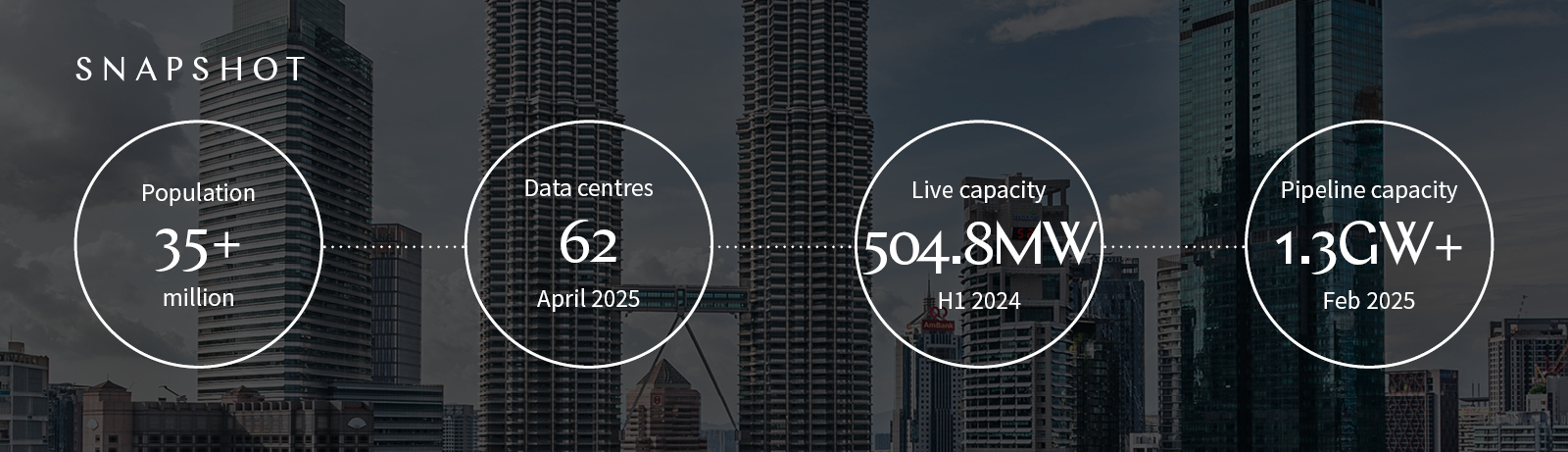
Sources: Worldometer, Statista, Cushman & Wakefield, Cushman & Wakefield
This surge is largely driven by hyperscalers such as Microsoft, Amazon Web Services, Google and Oracle, which have collectively invested US$23.3 billion to date.
With its strategic proximity to Singapore, particularly Johor, and favourable policies and economic incentives, Malaysia has become a regional data centre hub. Yet with such rapid growth comes sustainability pressures. Malaysian federal and state governments are seeking to tackle these head-on.

Spotlight on key drivers
Location, location, location
Investment into Johor is exploding as a proximate, cost-effective and attractive alternative to Singapore.
Singapore’s moratorium on new data centre developments from 2019 to 2022, imposed due to concerns over land availability and high energy consumption, led to spillover demand from global hyperscalers and data centre operators into nearby Johor. Despite Singapore lifting the moratorium by adopting a selective and sustainability-focused approval process for new developments, the trend continues.
It is not all about Johor. Klang Valley remains the largest data centre market in Malaysia.
Government incentives
Strong government support and strategic initiatives have helped to attract investment and foster growth. Developers and operators can take advantage of various deep incentives.
This includes:
- Malaysia Digital Status (MDS) offering tax and other incentives
- Digital Ecosystem Acceleration Scheme (DESAC) providing tax allowances and reduced tax rates
- The recently formed Johor-Singapore SEZ introducing further benefits for developers including special corporate tax rates, cross-border process improvements and other customised incentives.
Sustainability challenges
Malaysia remains heavily dependent on fossil fuels with limited renewable capacity. Power costs are relatively low, but explosive growth in the industry poses energy supply and grid stability issues.
Energy efficiency and sustainable growth are the key focus of a range of reforms introduced by the Malaysian government, particularly in energy-intensive industries like data centres.
Water usage limits for data centre operations are part of proposed planning reforms by Malaysia’s National Water Services Commission (SPAN).
'Malaysia is rapidly emerging as Southeast Asia’s next data centre powerhouse, driven by a surge in AI and cloud computing investments. Johor Bahru, in particular, is transforming into the region’s fastest-growing data centre market, attracting tech giants like Microsoft, Google and Nvidia.'
Skrine Partner Tan Wei Xian
Download the Malaysia chapter below
Unlocking opportunities and navigating challenges