

China has built one of the largest public-private partnership (PPP) markets in the world. Private and foreign investors are now encouraged, provided they follow the rules and respect sector limits. With a large pipeline of infrastructure projects, China offers real opportunities - but careful navigation is key.
A new set of rules has reset the sector, the culmination of a decade of rapid development. This aims for greater transparency and stronger market discipline. The government is actively launching new projects under the rules, especially in central and western regions and in key sectors like transport and water.
China’s PPP market is open to those who can commit for the long term, manage risks and deliver value.
Key features of China's PPP landscape
- Projects must generate real user income. The government does not guarantee returns or cover losses.
- The concession model is mandatory for all PPPs. The country’s main economic planning agency, the NDRC, leads and sets clear rules for compliance.
- Open, competitive bidding or negotiation is required for every PPP. The government does not allow direct appointments or non-competitive negotiations.
- Private and foreign investors can join. They must follow sector-specific rules and pass national security checks.
- Project terms can last up to 40 years. Early exits and changes in ownership need government approval.
The evolution of PPPs in China
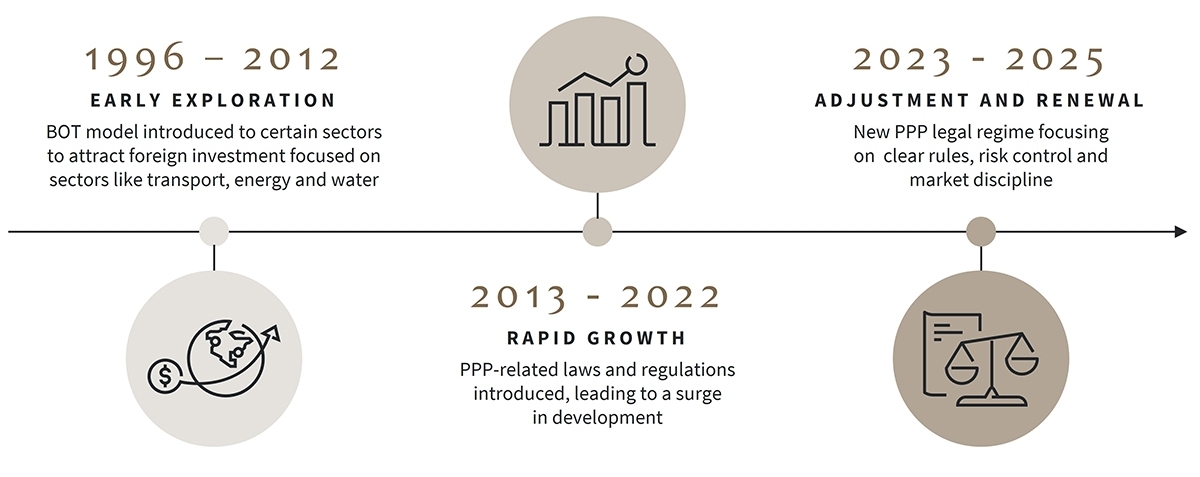
Three decades of change: more detail on China’s PPP journey
As early as 1995, China started introducing the Build-Operate-Transfer (BOT) model into sectors of infrastructure (such as transportation and energy) that were relatively less-developed at that time, to attract foreign investment. From then on, through various regulations, and industry and region development policies, China continued to encourage foreign investors to participate in infrastructure projects in China via the BOT model.
In 2002, the Ministry of Construction of China (now renamed as the Ministry of Housing and Urban-Rural Development of China) issued the Opinions on Accelerating the Marketization Process of the Municipal Public Utilities Industry, which stated the establishment of a concession system for the municipal public utilities sector. In 2004, the Ministry of Construction of China further issued the Measures for the Administration of Concession in Municipal Public Utilities, which provided the legal framework for concession projects in this sector.
In 2008, the central government of China launched the ‘Four Trillion Investment Plan’, which further expanded the application of the PPP model in infrastructure and public services sectors.
During this early phase, many foreign investors made investments in China's infrastructure and public services sectors, particularly in the water industry[1].
Overview of Utility Reform, Comprehensive Department of Institutional Reform of NDRC, July 12, 2010, https://www.ndrc.gov.cn/fggz/tzgg/ggkx/201007/t20100712_1049892.html.
On September 23, 2014, the Ministry of Finance of China (MOF) issued the Notice on Issues Related to Promoting the Use of the Public-Private Partnership Model, which marked the beginning of the rapid development phase of PPP projects in China.
Since then, the State Council, the MOF, the China National Development and Reform Commission (NDRC) and other government departments have released a series of PPP-related laws and regulations. As a result, PPP projects in China entered a period of rapid growth, with the number and scale of the PPP projects peaking in 2017.
The PPP model in China enhanced the quality and efficiency of public services, stimulated market vitality and created new economic growth opportunities for the country, among other benefits.
Features of the PPP model at this phase:
- Leading regulatory authorities: MOF and NDRC
- Models: concession model, viability gap funding/availability payment model (a model primarily relying on fiscal expenditure for debt repayment or construction costs recovery), governments’ procurement of services model, and others
- Arrangements: BOT, BOO, BOOT, BTO, DBFOT, DBFO, TOT, TOO, ROT, O&M, MC, and others
- Return mechanisms: government payments, viability gap funding, and the user charge
- Duration of the project: In principle not exceeding 30 years.
To address challenges encountered during the implementation of PPP projects, from February 2023, China initiated a comprehensive review on and adjustment to the existing PPP projects.
On November 3, 2023, the State Council issued the Guiding Opinions on Regulating the Implementation of the New Mechanism for Public-Private Partnership, which set up a new PPP legal regime. This made significant changes to the previous PPP legal regime and marked the start of a new phase of the PPP projects in China.
Since then, in order to implement the new PPP legal regime, the MOF repealed a number of existing PPP regulations and policy documents issued by it, and the NDRC issued new supporting regulations and policy documents (collectively referred to as the ‘New PPP Regulations’).
Features of the PPP model at this new phase:
- Leading regulatory authorities: NDRC
- Models: concession model
- Arrangements: Includes BOT, BOO, BOOT, DBFOT, DBOT, TOT, ROT
- Return mechanisms: user charge; in addition, the government may provide investment support during the construction period and provide operation subsidy which are generally applicable to relevant industry during the operation period
- Duration of the project: In principle not exceeding 40 years.
Understanding the general framework and procedures
The core laws and regulations of the New PPP Regulations are set out in the table below. In addition, the entire lifecycle of a concession project (for example, the selection of the concessionaire, project initiation, investment, construction, operation and maintenance of PPP projects) is governed by a range of other relevant laws and regulations. These include, but are not limited to, laws and regulations related to the bidding and tendering, urban planning, investment management, land management, environmental protection, construction quality supervision, workplace safety and state-owned asset management.
|
Title of regulation
|
Effective date
|
Issuing authority
|
|
Guiding Opinions on Regulating the Implementation of the New Mechanism for Public-Private Partnership (Serial No. Guo Ban Han [2023] 115) |
November 3, 2023 |
General Office of the State Council |
|
Notice of the NDRC General Office on the Establishment of a National Information System for Public-Private Partnership Projects (Serial No. Fa Gai Ban Tou Zi [2024] 151) |
March 2, 2024 |
The General Office of the NDRC |
|
Outline for the Preparation of Concession Plans for Public-Private Partnership Projects (Trial Version 2024)(Serial No. Fa Gai Ban Tou Zi [2024] 227) |
March 20, 2024 |
The General Office of the NDRC |
|
Administration Measures for Concession for Infrastructure and Public Utilities (Order No. 17 of the NDRC, the MOF, the Ministry of Housing and Urban-Rural Development of China, the Ministry of Transport of China, the Ministry of Water Resources of China, and the People’s Bank of China) |
May 1, 2024 |
NDRC The Ministry of Transport of China The Ministry of Water Resources of China The People’s Bank of China |
|
Model Concession Agreement for Public-Private Partnership Projects (Trial Version 2024) |
May 21, 2024 |
The General Office of the NDRC |
|
Notice of the NDRC General Office on Further Improving the Compliance and Implementation of Projects under the New Public-Private Partnership Mechanism (Serial No. Fa Gai Ban Tou Zi [2024] 1013) |
December 12, 2024 |
The General Office of the NDRC |
|
Notice of the General Office of the State Council to Issue the Guiding Opinions on Regulating the Construction and Operation of Existing Public-Private Partnership Projects from the Ministry of Finance (Serial No. Guo Ban Han [2025] 84) |
August 16, 2025 |
The General Office of the State Council |
Regulatory authorities
1. Development and Reform Commissions
- The NDRC is responsible for leading the implementation of the New PPP Regulations and providing policy guidance.
- Provincial development and reform commissions are responsible for overseeing and regulating all PPP projects within their provinces (autonomous regions and municipalities).
- Local development and reform departments at all levels are responsible for coordinating relevant parties, reviewing the project concession plans, and granting approvals for PPP projects.
2. .Relevant industry authorities
(including Ministry of Natural Resources, Ministry of Ecology and Environment, Ministry of Housing and Urban-Rural Development, Ministry of Transport, Ministry of Water Resources, National Energy Administration, National Financial Regulatory Administration, Ministry of Emergency Management)
- Local industry authorities at all levels shall carry out PPP-related supervisory and regulatory work in accordance with government authorisation as well as their respective responsibilities as prescribed by law.
- Relevant industry authorities of the State Council shall perform their industry supervision functions in accordance with their respective responsibilities. Matters involving PPP policies should be submitted to the NDRC for consultation to ensure the consistency with overall policy directions of NDRC.
3. Financial departments
- The MOF, together with relevant industry authorities, are responsible for strengthening overall control and guidance and formulating detailed implementation rules for existing PPP projects that commenced construction prior to the end of 2024.
- Financial departments at all levels are responsible for the administration of the budgets and local government debts, and conducting financial and accounting supervision.
4. Local people's governments
- Local people's governments bear primary responsibility for promoting PPP projects within their administrative areas according to law.
- Local people's governments at all levels may authorize relevant industry authorities, public institutions, etc., to act as PPP project implementation entities.
- These implementation entities are responsible for preparing concession plans, selecting concessionaires, executing concession agreements, overseeing the implementation of PPP projects, and accepting the handover of PPP projects upon the expiration of the cooperation period, etc.
Typical features of PPP projects
|
Type of return mechanisms
|
|
|
|
|
Applicable model and implementation methods
|
|
|
|
|
Industry sectors where the PPP model applies
|
|
|
|
|
Requirements for private party
|
|
|
|
|
Selection method for concessionaires
|
|
|
|
Main implementation steps
Include:
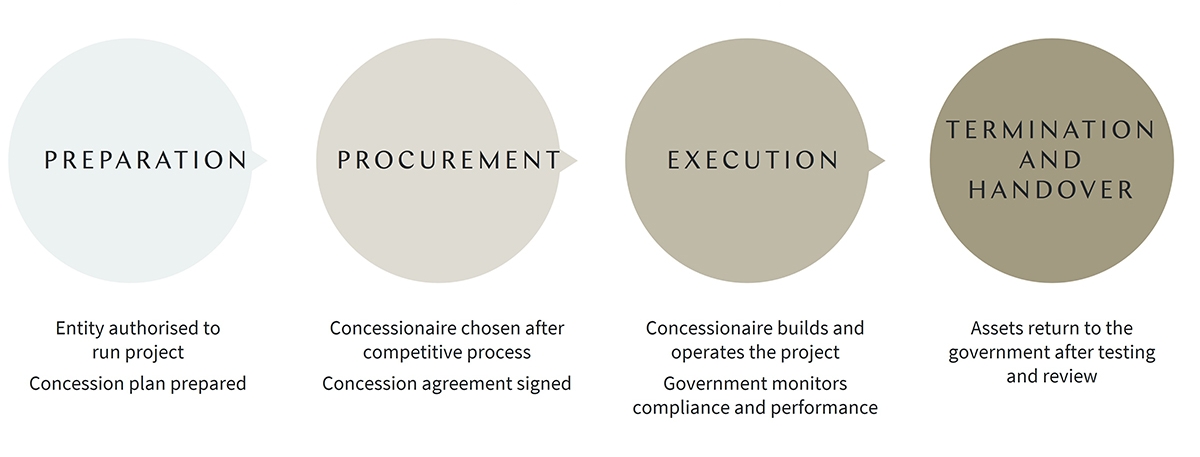
- Project preparation
Local people's governments authorise an entity – such as a relevant industry authority or public institution - to act as PPP project implementation entities in accordance with laws and regulations.
Implementation entities, based on the above authorisation, organise the preparation of the concession plan (including project feasibility and concession feasibility studies) and submit such plan to the competent investment authority or other relevant departments for review and approval.
- Project procurement
Implementation entities select the concessionaire through open competition methods such as bidding and competitive negotiation.
The implementation entity shall enter into the concession agreement with the selected concessionaire. If a project company needs to be established, the implementation entity should enter into a preliminary agreement with the concessionaire, requesting that the project company should be registered within a specified time period. The implementation entity will then enter into the concession agreement with the project company after its establishment.
- Project execution
The implementation entity handles the project legal person change procedure for approvals and permits that have already been obtained, and assists the concessionaire in completing other necessary approvals, verification or filing procedures.
The concessionaire shall provide public products and services in accordance with the concession agreement and fulfill other obligations provided therein.
- Early termination
During the concession period, if the concessionaire is unable to fulfill its obligations under the agreement due to a material breach by one party or force majeure, or if conditions for early termination as provided in the concession agreement occur, the agreement may be early terminated upon reaching consensus with the creditors.
If the concession agreement is early terminated due to government reasons, the government should provide fair and reasonable compensation to the concessionaire based on the actual situation and the terms of the agreement. If the concession agreement is early terminated due to the concessionaire's reasons, the concessionaire should bear liability for breach of contract.
Upon the expiration or early termination of the concession period, the parties to the concession agreement shall conduct performance testing, assessment, handover, takeover, and acceptance of relevant facilities, materials and archives in accordance with the concession agreement and relevant laws and regulations.
Market snapshot
As of the end of 2022, China had implemented a total of 15,163 PPP projects, with a total investment of RMB24.41 trillion. The number and investment scale of China's PPP projects grew rapidly from 2014 to 2017, and peaked in 2017. From 2017 to 2021, the number and investment scale of PPP projects declined. In 2022, the PPP market picked up again, with increases in both the number of projects and investment scale.
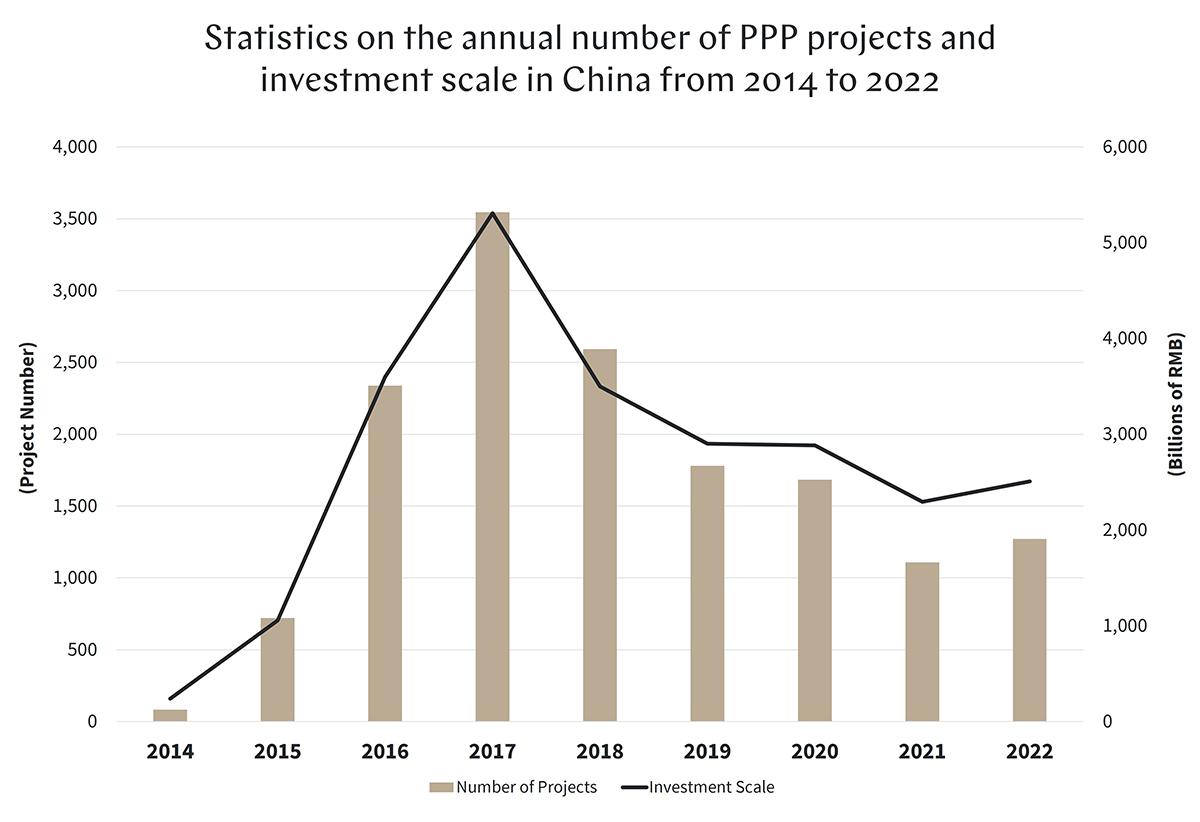
Source: Industry Forecast for Public-Private Partnership (PPP)(2023), Academy for Governmental Credit at CUFE (Central University of Finance and Economics), and Beijing Mingshu Data Technology Co. Ltd.

Following the implementation of the New PPP Regulations, as of February 10, 2025, data from the National Public-Private Partnership Project Information System (PPP Information System, hosted by the National Confidence Center) shows that China has implemented a total of 222 PPP projects under the New PPP Regulations.
Based on the PPP project information posted in the PPP Information System, as of February 10, 2025, there are significant differences in the distribution of PPP projects under the New PPP Regulations across regions, methods and industries. In general:
- The number of PPP projects in the western and central regions is relatively high, while the number in the eastern and northeastern regions is relatively low.
- BOT and TOT are the primary implementation methods used in PPP projects, while other methods account for a relatively small proportion.
- The proportion of PPP projects in the transportation, urban construction, environmental protection and water conservancy industries is relatively high, while the proportion in other industries is relatively low.
Key issues for international investors
1. Foreign investment access restrictions and national security review
Under China's New PPP Regulations, foreign-invested enterprises participating in PPP projects should comply with both foreign investment laws and regulations and PPP regulations. For projects subject to national security review, the national security regulations should be complied with as well[2].
According to the Foreign Investment Law, China ‘implements a national treatment plus negative list management system for foreign investment’. When reviewing PPP projects for investment, foreign investors need to pay attention to the Special Administrative Measures for Foreign Investment (Negative List) in force at the time, to find out whether the industry sector of the project is subject to any foreign investment restrictions.
In addition, pursuant to the Measures for Security Review of Foreign Investments, foreign investors or relevant domestic entities shall file with the Foreign Investment Security Review Office before proceeding with an investment related to ’important infrastructure’ or ‘important transportation services’ concerning national security, where the foreign investor will obtain actual control of the companies to be invested. Therefore, if a foreign investor plans to invest in a PPP project involving key industries related to national security and obtain actual control of the project company, filings with foreign investment security review office should be made in advance.
2. The government must not provide viability gap funding, availability payments, or guaranteed minimum returns for PPP projects
China's New PPP Regulations strictly prohibit imposing additional fiscal expenditure obligations on local governments. Under the New PPP Regulations, the government may, in accordance with laws and regulations and on a non-discriminatory basis, provide investment support during the construction period and operational subsidies during the operation period for PPP projects. The government is prohibited from using fiscal funds to cover the construction and operating costs of the project through means such as viability gap funding, guaranteed minimum return, availability payments or any other means.
Therefore, foreign investors need to conduct thorough assessments of project costs, estimated revenue and service demand before investing in PPP projects.
3. Prepare for long-term investment
Under China's New PPP Regulations, the maximum concession period is 40 years, or even longer for PPP projects with large investment scales and long recovery periods.
Although the Administration Measures for Concession for Infrastructure and Public Utilities only require that the ‘transfer of equity’ should be promptly notified in writing to ‘relevant industry authorities’, in practice, implementation entities usually refer to the terms of Model Concession Agreement for Public-Private Partnership Projects (Trial Version 2024) to impose certain restrictions on the transfer of equity in the project company by the concessionaire. These restrictions usually include, but are not limited to:
- Prohibiting any change to the shareholding of the project company or the exit of main investors in the project company, without the consent of the implementation entity
- Imposing an equity lock-up period, during which the shareholding of the project company shall not be changed without the consent of the implementation entity
- After the expiration of the equity lock-up period, any change in the shareholding of the project company should be reported to the implementation entity. The implementation entity has the right to raise objections if such change unreasonably reduce the project company's obligations or its ability to perform the concession agreement. The project company has to address such objections first before the shareholding change may proceed.
Considering the above potential restrictions on equity transfers by concessionaires, foreign investors considering investing in PPP projects in China may need to be prepared for a long-term investment if they are not able to negotiate and obtain an early exit clause.
4. Uncertainty brought by PPP dispute resolution methods
Article 54 of the Administration Measures for Concession for Infrastructure and Public Utilities provides that, ‘If the concessionaire believes that an administrative authority fails to conclude or perform the concession agreement according to law, or fails to fulfill the concession agreement in accordance with its terms or modifies or terminates the concession agreement according to law, the concessionaire has the right to make a statement and defense and apply for administrative reconsideration or bring an administrative lawsuit in accordance with law. Civil and commercial disputes between the parties arising from the rights and obligations provided in the agreement may be resolved through arbitration or civil litigation in accordance with the law.’
In judicial practice, because concession agreements are deemed as having both administrative law terms and civil law terms, we have seen courts and arbitration institutions diverge apart on the choice of dispute resolution methods in many cases. This casts uncertainties and complicates the resolution of PPP project disputes in China.
5. Risks of investing in existing PPP projects implemented before the new PPP regulations came into force
The New PPP Regulations apply to PPP projects that have not completed the bidding and procurement process by February 2023, as well as to new PPP projects implemented thereafter.[3]
In August 2025, the Notice of the General Office of the State Council to Issue the Guiding Opinions on Regulating the Construction and Operation of Existing Public-Private Partnership Projects from the Ministry of Finance (Guiding Opinions) was issued to regulate PPP projects that commenced construction prior to the end of 2024 (Existing PPP Projects). The Guiding Opinions requires local governments, among others, to ensure the completion of ongoing projects and procure the stable operation of those already in service (including but not limited to, implementation entities will be guided to conduct performance assessment the result of which shall link to the government payment, and relevant entities are encouraged to optimize scientifically the key terms of the project based on equal negotiation and mutual benefits and concessions, so as to reasonably reduce operation costs and increase efficiency).
In addition to the above guiding opinions that encourage renegotiation of key terms of project, from legal perspective, although Existing PPP Projects are not explicitly required to be subject to New PPP Regulations and shall still be subject to the laws and regulations governing PPPs that were in place when such projects were conducted. From practical perspective, the practical risks cannot be excluded that such existing PPP projects may be required to comply with requirements under the New PPP Regulations as well.
Therefore, foreign investors considering investing in existing PPP projects through acquisition, among others, are advised to pay attention to such risks.
The way forward
The New PPP regulations encourage private and foreign-invested enterprises to participate in PPP projects in China.
They aim to build a disciplined, transparent, and competitive market. The focus is on quality projects, genuine user demand and fair competition.
For investors who can adapt to and comply, the new regime brings opportunities.
To explore other jurisdictions, visit our Guide to PPPs in Asia.
Article 64 of the Administration Measures for Concession for Infrastructure and Public Utilities provides that ’Where infrastructure and public utility concessions involve national security reviews, they shall be carried out in accordance with the relevant national regulations.’
Article 1 (6) of the Guiding Opinions on Regulating the Implementation of the New Mechanism for Public-Private Partnership, and article 64 of the Administration Measures for Concession for Infrastructure and Public Utilities.