A year of… capacity expansion beyond Jakarta, targeted incentives and rising data sovereignty
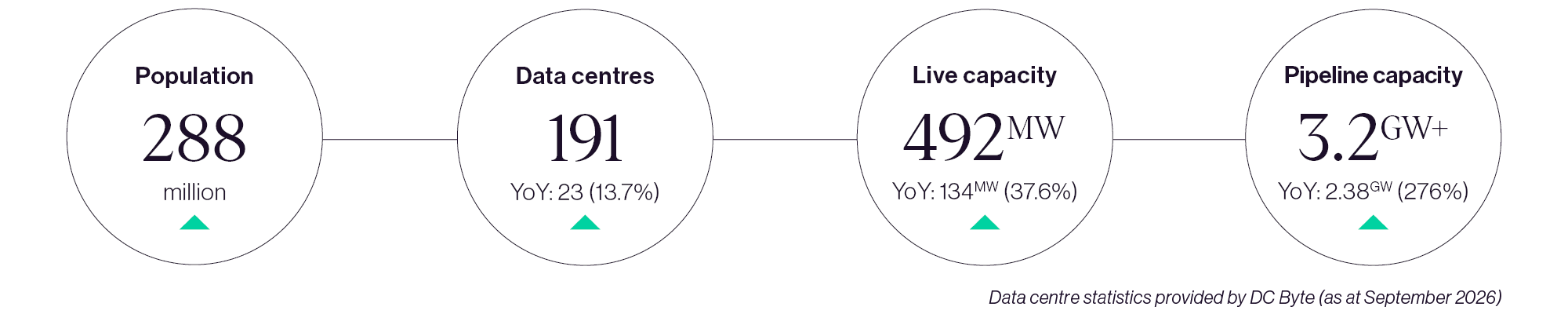
Indonesia is one to watch in the APAC region for data centre growth. The draw of tax incentives and special economic zones, coupled with low barriers to foreign investment, has made it an attractive destination for investment from big global players.
Tencent Cloud, to give one prominent example, has pledged to funnel US$500 million into infrastructure in Indonesia by 2030. Its third data centre in the country became fully operational in June 2025, in what it celebrated as ‘one of the largest and most complex cloud relocations ever undertaken in Southeast Asia’.
Rapid growth presents challenges, but the Indonesian government and industry leaders are collaborating on solutions. The government’s digital infrastructure push aligns with Indonesia Emas 2045 (or ‘Golden Indonesia’), its vision for a prosperous and advanced nation by 2045.
As Indonesia transforms into a hub for data centres, it is poised to drive economic growth and technological advancement.
Data centre statistics provided by DC Byte.
Spotlight on key drivers
Indonesia previously required data centres to be located in designated industrial estates, which are supported by essential infrastructure for power and water.
The Indonesian Ministry of Industry (MOI) recently implemented reforms through MOI Regulation No. 37 of 2025 (MOI Reg. 37/2025) which permit data centres to be located outside of an industrial estate under certain conditions and provided that they pass the verification conducted by the Online Single Submission system. Protected areas and productive forest areas (unless the data centre operator obtains a forest utilisation permit) remain off limits.
Despite the regulatory relaxation, industrial estates remain the preferred location as essential infrastructure, such as established road networks, energy networks, telecommunication networks, clean water and wastewater treatment facilities, and drainage pipes are mandated by law.
Given Indonesia’s geographical landscape and logistical challenges, these infrastructure services are not so readily available for data centres located outside of industrial estates.
Indonesia’s commitment to renewable energy and sustainability, as a signatory to the Paris Agreement, broadly represents a forward-looking driver for the sector.
Although not yet fully codified in regulations specific to data centres, it encourages operators to invest in sustainable practices, aligning with global trends.
There are no specific foreign investment restrictions on owning or operating data centre businesses in Indonesia. Combined with tax incentives and special economic zones, this continues to support investment from major global players.
The government’s digital infrastructure push under Indonesia Emas 2045 is helping position Indonesia as an increasingly important data centre market in the region.
Download
1.24MB, 7 Pages
Latest Thinking
Australia wants the data centre boom: can it get the power settings right?
Australia has an opportunity to secure its position as a major data centre hub in the region. But to capture it, investors need something Australia cannot afford to leave uncertain - a clear pathway for securing power.
10 September 2026
Australia's next AI bottleneck: Why copyright matters
If a major AI company was preparing a checklist to decide where to build its next AI training facility, you would expect to see access to land, power and water at the top of the list.
28 August 2026
AI data centres in Australia: breaking down barriers to investment
AI data centres in Australia: breaking down barriers to investment
29 April 2026
Unlocking opportunities and navigating challenges