Australia’s planned data centre capacity increased by 79.4% over the past year, adding 2.5GW as the sector enters a period of greater scrutiny around power, critical infrastructure and the impact on communities, according to Mallesons’ latest regional regulatory analysis.
The 2026 edition of Mallesons’ Data Centres APAC Regulatory Guide assesses regulatory complexity across 14 APAC countries. It maps regulatory developments and investment incentives across the region, highlighting the factors that could influence where future data centre investment is directed.
“Across the 14 markets we assessed, our analysis points to an increasingly important tension: governments are seeking to attract data centre and AI investment while simultaneously responding to areas of risk – mainly pressure on power infrastructure and prices, but also community concerns and social licence," Mallesons partner Daryl Cox commented.
"This is evident in Australia amid increased Federal and State government regulation of grid capacity, network investment and sustainable power procurement. It is an increasingly complex environment for data centre investors and developers."
"Indonesia, Thailand and Malaysia are among the fastest growing markets in the region, having seen significant increases in planned capacity over the past 12 months. Australia also recorded considerable growth, adding 28 data centres, an 11.2% increase in 12 months and a further 2.5GW of planned capacity, representing a 79.4% increase over the past year. However, increased regulatory and operational complexity could impact Australia’s desirability for data centre investment among strong regional competition."
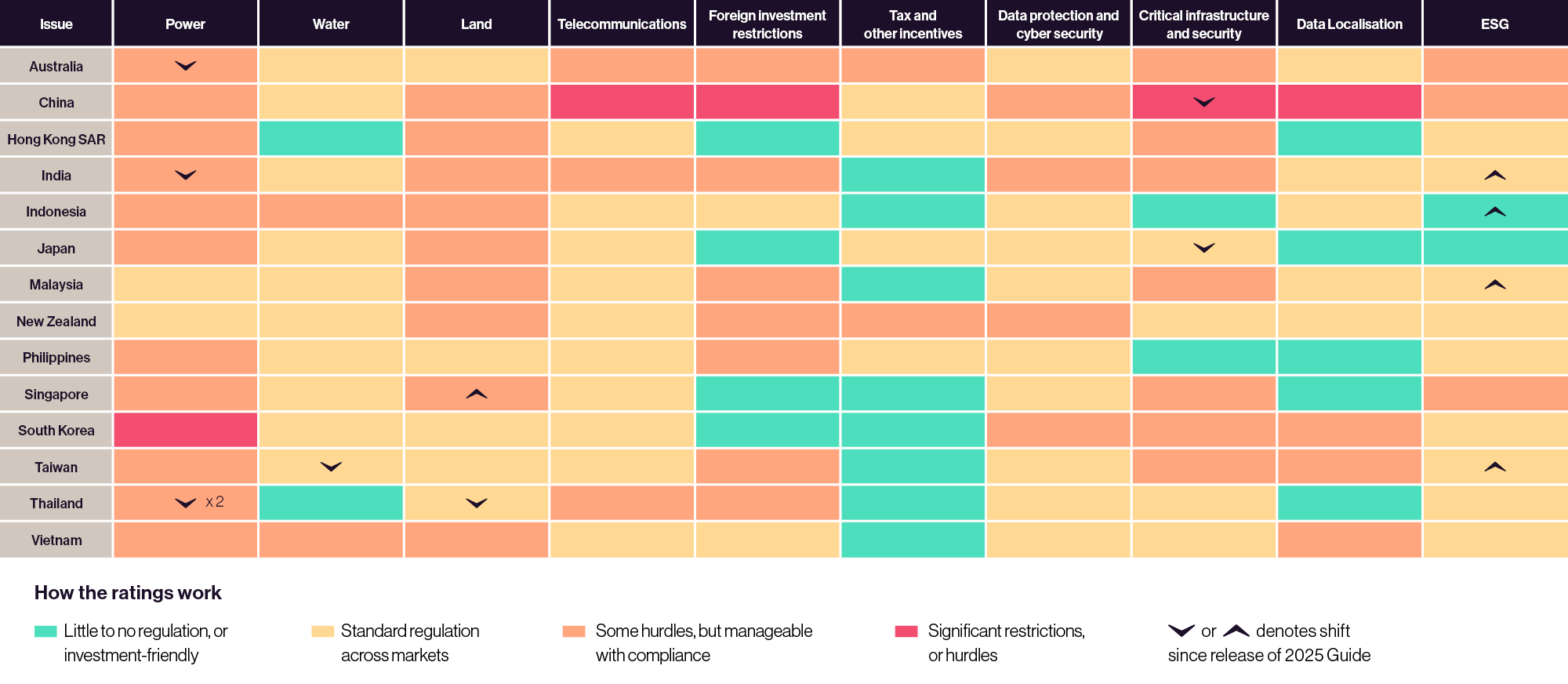 The 2026 regulatory heat map provides a high-level view of the relative ease of entry and operational complexity for data centre developers across key issues. Analysis by Mallesons. Data supplied by DC Byte.
Commenting on the current landscape, Mallesons Partner Rachael Lewis said:
"In 2025, the race to scale data centre and AI capacity in APAC accelerated. In 2026, governments have started to catch up.
"Social licence is becoming a much more material consideration for developers. Communities want to understand what is being built, what it means for them and how pressure on energy and water resources will be managed.
“Social license can have a direct influence on project approvals and timelines, particularly as governments become more responsive to community concerns. We’ve seen this play out on a large scale in the US and it is becoming increasingly relevant in Australia and across the APAC region.
“Data centre developers can learn from Australia’s resources sector on how to secure community and government support not just at the start of a project, but over time. From a legal perspective, this can mean factoring social licence into financing and transactions, balancing commercial confidentiality with early community engagement, establishing grievance mechanisms and offering local commitments."
Cox added:
"While scale is relevant, the true story lies in which countries are accelerating at the fastest rate and demonstrating a hunger for the AI prize. This does not necessarily mean introducing new regulatory frameworks. It means policy that simplifies market entry and expansion, facilitates the build-out of power infrastructure and supports industry to engage productively with communities and to demonstrate the benefit of data centres and AI.”
Managing Director, APAC at DC Byte, James Murphy said:
"Governments across APAC are having to balance growing demand for data centres with pressure on power, water and local infrastructure. Public opinion is also starting to influence these decisions, particularly as communities question the resources required to support new developments. How governments manage these competing priorities will have a direct impact on where future capacity is built. What is clear, however, is that demand remains strong across the majority of markets in the region."
About the report
This is the second edition of Mallesons’ annual Data Centres APAC Regulatory Guide, which provides updated analysis on key regulatory issues across 14 countries in the Asia-Pacific region. Country chapters focus on important considerations for data centre investment: power, water, land, telecommunications, foreign investment restrictions, tax and other incentives, data protection and cyber security, critical infrastructure and security, data localisation and ESG.
The guide is produced in consultation with regional firms ABNR (Indonesia), Chandler Mori Hamada (Thailand), Chapman Tripp (New Zealand), Frasers Law Company (Vietnam), Kim & Chang (South Korea), King & Wood (China and Hong Kong SAR), Lee and Li (Taiwan), Mori Hamada & Matsumoto (Japan), Romulo (Philippines), Skrine (Malaysia) and Trilegal (India). Data is supplied by DC Byte.
About Mallesons
Mallesons is the top-tier independent law firm from Australia, a full-service firm trusted on the most complex and consequential matters across our region and around the world. Our independence gives us the flexibility to combine our top tier full-service capability with the best advisers in every market. We have 190 partners and over 1,200 lawyers who are locally qualified and globally experienced. The quality of our capability is reflected in our market standing. For 8 consecutive years, we have had more Band 1 practices and Band 1 individuals in Chambers and Legal 500 than any other firm. Discover more on mallesons.com or follow us on LinkedIn @mallesons.
About DC Byte
DC Byte is a global market intelligence and research company specialising in the data centre industry. Headquartered in London, with offices in Virginia, Singapore, and Sofia, DC Byte provide trusted data, analytics, and strategic insights to organisations operating across the digital infrastructure ecosystem. The platform delivers comprehensive intelligence on over 8,700+ data centre projects across more than 135 countries, offering one of the most extensive global datasets available in the sector. DC Byte tracks capacity, development pipelines, ownership structures, power availability, and market dynamics to help investors, developers, operators, and technology companies make informed strategic decisions.