Everything you need to know about Australia’s new ACCC Mandatory Clearance Regime
A new era for more than just mergers in Australia
On 1 January 2026, the ACCC’s new mandatory notification regime officially commenced.
The introduction of this new regime is one of the most significant changes to Australia’s competition laws in 50 years.
The new regime replaces the ACCC’s longstanding voluntary informal clearance and formal merger authorisation processes with an administrative clearance regime that applies to a broad range of acquisitions.
The new regime includes statutory timeframes, prescribed filing requirements, and changes the legal test and threshold for ACCC clearance.
Acquisitions that meet the notification thresholds and are not notified, remain stayed. The ACCC can apply to the Federal Court for a declaration that a non-notified acquisition is void and taken to have always been void. Parties who proceed to completion without ACCC notification (or a waiver) will be exposed to civil penalties.
New laws, same depth of experience
Our competition team has been closely involved in the development process for the new regime, and is ready to help you navigate its complexities.
Our team advises on all aspects of competition merger control, and we are specialists in developing strategies for clients, from the most complex or contested merger transactions, right through to the ‘BAU’ deals now caught by the thresholds. Regardless of the industry or the size of the deal, our team works with local and international clients to help them navigate through the new Australian clearance process as smoothly as possible, often in coordination with other international merger approvals.
What types of acquisitions need to be notified to the ACCC?
The new notification regime is much broader in scope than the previous ACCC clearance pathways. The regime doesn’t just capture large-scale M&A deals, it applies to any acquisition of shares or assets that triggers the mandatory notification thresholds. This means in considering whether notification could be required, parties need to think about the following factors:
- Types of acquisitions – acquisitions of shares, units in unit trusts, interests in managed investment schemes and assets are all subject to the new regime.
- Assets are broadly defined to include any legal or equitable interest – this can include the acquisition of leasehold interests, intellectual property rights and licences, if the acquisition meets the monetary thresholds and no exception applies.
- Different monetary thresholds apply based on asset type – depending on whether the acquisition is of assets that involve ‘all or substantially all the assets of a business’ or whether the asset is a ‘standalone’ asset. See below for more details on the monetary thresholds.
- Control and voting power tests – for non-asset acquisitions, parties need to notify the ACCC where the monetary thresholds are met (and no exemption applies) if the acquisition would (i) result in sole or joint control of an entity, or (ii) meet ‘bright line’ voting power tests - even if the acquisition does not result in control.
Further details on the exceptions, ACCC process, voting power tests and the monetary thresholds are set out below.
What are the exceptions?
Some limited general exceptions apply for certain types of acquisitions, and transactions which are done “in the ordinary course of business”. There are also some specific exceptions for transactions relating to land, financing transactions, financial markets and the superannuation industry.
Mallesons' cross-discipline approach
Given the breadth of the new regime and the number of key issues to consider, our Corporate, M&A and Private Capital experts work closely with the competition law specialists to advise on the application of these new laws.
Similarly, many of the industry exceptions rely on relatively narrow and specific criteria. Mallesons' experts in our Banking & Finance, Real Estate and Superannuation teams are on hand to assist understanding the scope of these exceptions, or their application to any particular transaction.
What are the notification filing requirements, fees and timelines?
If an acquisition meets the notification thresholds (or there is uncertainty over whether the thresholds are met), there are two key pathways – notification (using the short or long form) or waiver. The notification process can involve a Phase 1, Phase 2 and public benefits phase, depending on the transaction.
Filing fees, forms and other key process information is set out below.
|
PROCESS
|
FILING FEE (AUD)
|
TIMEFRAME FOR DECISION
|
FORM OPTIONS
|
WHICH ACQUISITIONS ARE SUITABLE
|
|
Waiver application |
$8,300 |
Within 25 business days of lodgement If the ACCC does not make a decision within 25 business days, the ACCC must not grant the waiver |
Waiver form |
The ACCC has indicated the waiver process is for straightforward acquisitions that plainly do not give rise to competition issues or consumer harm and can be assessed based on the information provided without further investigation by the ACCC or market consultation. |
|
Notification review |
$56,800 |
Phase 1: Up to 30 business days Earliest possible approval is 15 business days after notification Acquisition will either be approved or moved to a Phase 2 review within 30 business days of notification ACCC has powers to extend the timeframe |
Short form Long form |
Short form: The ACCC has indicated most acquisitions will be suitable for the short form, being straightforward acquisitions that are unlikely to raise competition concerns. Long form: The ACCC has indicated that the long form is appropriate for acquisitions that raise greater competition risks and/or complexity. The ACCC has also provided guidance about situations in which the long form should be used, including based on the parties’ market shares and changes to market concentration resulting from the acquisition. |
|
Notification review |
Determined based on transaction value. $50 million or less: $475,000 Between $50 million and $1 billion: $855,000 Over $1 billion $1,595,000 |
Phase 2: Up to 120 business days (including Phase 1 review period) The Phase 2 review period lasts for up to 90 business days ACCC has powers to extend the timeframe |
No additional form required to proceed to Phase 2 |
The ACCC will provide a notice to parties before the end of the Phase 1 review period if it considers a Phase 2 review is required. Parties need to pay the Phase 2 fees before the matter can proceed. |
|
Public benefits phase |
$401,000 |
Public benefits phase: Up to 170 business days (including Phase 1 and 2 review periods) The Public Benefits phase lasts for up to 50 business days The ACCC has powers to extend the timeframe |
Application for public benefit determination |
A party can only lodge a public benefit application if the ACCC has conducted a Phase 2 review and decided not to approve the acquisition or approve it with conditions. |
What are the bright line voting power tests?
For share acquisitions, parties need to notify the ACCC where the monetary thresholds are met (and no exemption applies) if the acquisition would (i) result in sole or joint control of an entity, or (ii) meet ‘bright line’ voting power tests - even if they do not result in control. The bright line voting power tests in the table below are based on the ‘voting power’ of the acquirer group and its ‘associates’.
Notifiable acquisitions
|
Nature of target entity
|
Pre-acquisition voting power
|
Post-acquisition voting power
|
|
1. All target entities |
Between 20% and 50%* |
50% or more* |
|
2. Widely held/Chapter 6 entities (i.e. listed entities, or entities with more than 50 members) where already controlled by the acquirer |
20% or below |
Above 20% |
|
3. Widely held/Chapter 6 entities (i.e. listed entities, or entities with more than 50 members) where NOT already controlled by the acquirer |
Below 20% |
50% or more |
|
4. Private/unlisted entities (i.e. unlisted entities and entities with less than 50 members) |
20% or below* |
Above 20%* |
|
*Note: Disregard the voting power of associates that only have “minority shareholder protection rights”. |
||
What are the monetary thresholds?
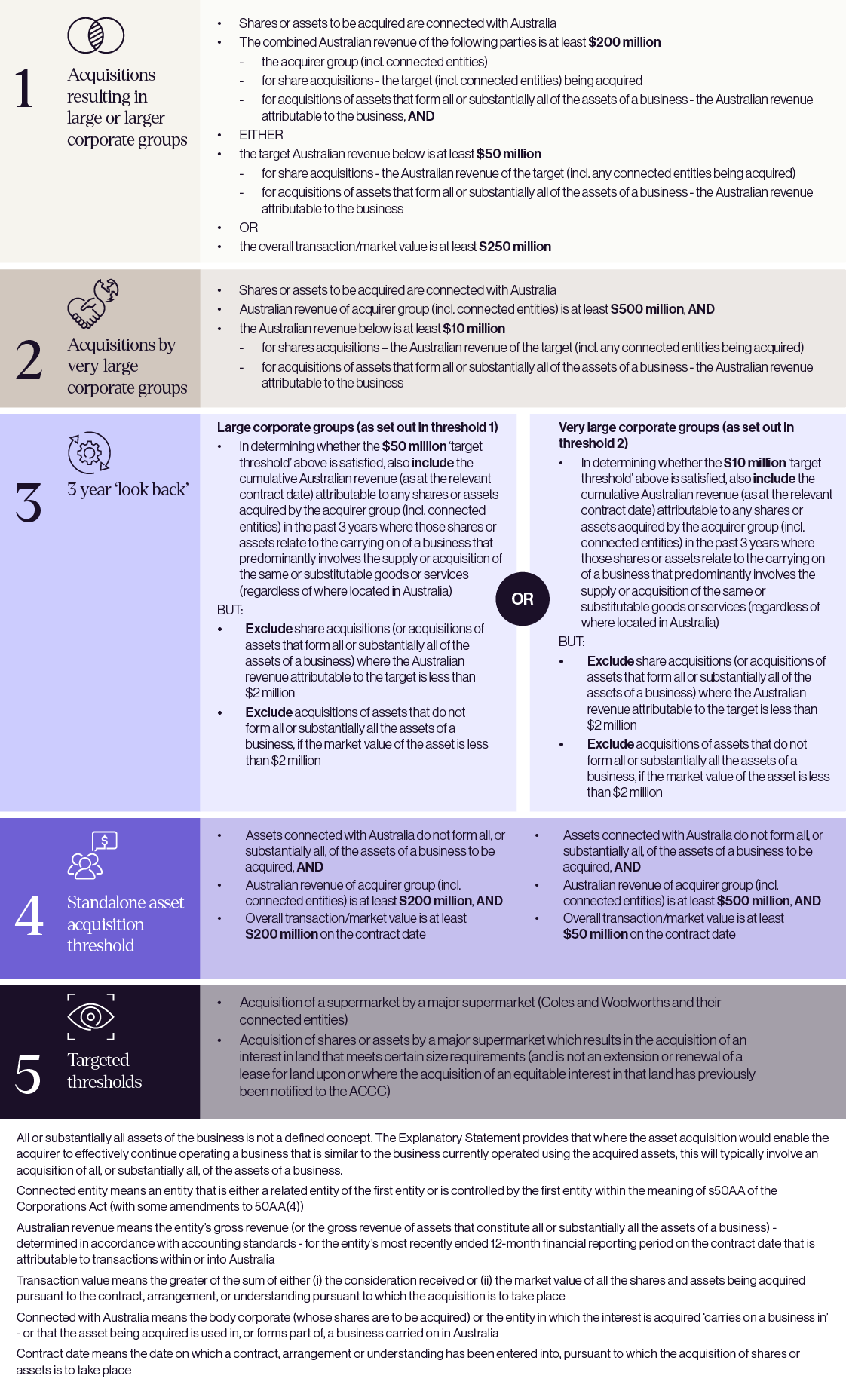
The notification thresholds are set out in the Competition and Consumer (Notification of Acquisitions) Determination 2025 (Determination), which determines the circumstances in which an acquisition is required to be notified and outlines the various exemptions. The Determination contains 4 monetary thresholds:
- Acquisitions resulting in large or larger corporate groups threshold
- Acquisitions by very large corporate groups threshold
- Creeping or serial acquisitions threshold
- Standalone asset acquisitions threshold
There is also one targeted threshold that applies specifically to supermarkets.
Details of the thresholds are set out in the graphic below.
Monetary thresholds
Podcasts
Resources
Our Merger Reform Insights
Gone, but not forgotten: Australia’s new ‘voidable’ merger regime
On 10 September 2026, the Treasury Laws Amendment (Strengthening Accountability for Tax Adviser Misconduct and Other Measures) Bill 2026 (Cth) (Bill) was passed by Parliament, which implements material changes to the ACCC’s mandatory notification regime.
18 September 2026
Control, Alt, Relief: Parliament clarifies the merger rulebook
On 2 July 2026, the Treasury Laws Amendment (Strengthening Accountability for Tax Adviser Misconduct and Other Measures) Bill 2026 - which makes material clarifying changes to Australia’s merger control regime – was introduced into Federal Parliament
07 July 2026
New ACCC mandatory notification thresholds commence: bright-line voting power & standalone asset thresholds
In December 2025, the Government announced late-breaking changes to Australia’s new mandatory merger clearance regime, introducing new notification thresholds, filing triggers, and exemptions.
01 April 2026
Changes to ACCC Merger Clearance Regime – New thresholds, exemptions and triggers
The Government today released details of late-breaking changes to Australia’s new ACCC mandatory notification regime – introducing new notification thresholds, filing triggers, and exemptions.
18 December 2025
Australia’s merger reforms: clarity provided for real estate deals
The Treasury has released the final Competition and Consumer (Notification of Acquisitions) Determination 2025 (Instrument) setting out the exemptions to the mandatory merger clearance regime
21 July 2025
Second Term’s a Charm: Labor’s ambitions for competition and consumer law reform
The Australian Parliament is due to resume on 22 July 2025 for the first time since the Labor Government was re-elected for a second term in the May 2025 federal election.
21 July 2025
Answering (some of) the threshold questions: Treasury releases updated ACCC clearance regime instrument
Treasury released the Competition and Consumer (Notification of Acquisitions) Determination 2025 (Instrument).
01 July 2025
Getting sponsors in shape for Australia’s new merger clearance regime
From the beginning of next year, a new merger clearance regime will mean that larger scale financial sponsors will see most of their future transactions in Australia - including ‘serial acquisitions’ – likely require regulatory approval to proceed.
17 April 2025
Instrumental changes: Treasury consults on draft notification thresholds instrument
Last Friday, Treasury released the exposure draft of the Competition and Consumer (Notification of Acquisitions) Determination for public consultation.
03 April 2025
Trusting the process: ACCC releases new merger process guidelines for consultation
Late last week the ACCC released its draft new process guidelines for public consultation.
03 April 2025
Same same but different: ACCC releases new merger assessment guidelines for public consultation
The ACCC has released its draft merger assessment guidelines for public consultation. The guidelines outline the ACCC’s approach to analysing the potential effects of mergers on competition under the new mandatory merger clearance regime, which will formally commence on 1 January 2026.
21 March 2025
Merger clearance reform: ACCC transitional guidelines released
The ACCC today released guidelines on the transition to the new merger clearance regime
04 March 2025
Concentrating on concentration – ACCC to focus on oligopolies and merger law reform in 2025
ACCC Chair Gina Cass-Gottlieb has emphasised the growing challenge posed by market concentration across the Australian economy, particularly in sectors such as supermarkets, retail, aviation and digital platforms, as part of the ACCC’s enforcement priorities for 2025.
20 February 2025
The new order begins: Merger Clearance Reform passes Parliament
Federal Parliament has passed legislation to establish a new mandatory and suspensory merger clearance regime.
29 November 2024
Australian Merger Clearance Reforms | Impacts for M&A
The Government has introduced into Parliament the Bill for the new merger control regime. It sets out the legal framework for the new regime, including what types of transactions cannot proceed without ACCC clearance, the timeframes for the ACCC’s review and the appeal rights from any ACCC decision.
12 November 2024
Australia’s Merger Reforms: what it means for commercial real estate deals
The Australian Government has proposed a new merger control regime replacing the existing voluntary informal notification and authorisation process regimes with a mandatory and suspensory clearance regime.
30 October 2024
The eagle has landed - New Merger Reform Bill introduced into Parliament today
oday, the Government introduced into Parliament the much anticipated Bill for its proposed new mandatory ACCC merger clearance regime.
10 October 2024
Is my deal caught? Government releases draft merger thresholds
The Government has today released details of the proposed thresholds above which merger parties will be required to obtain ACCC clearance under the new mandatory and suspensory merger clearance regime.
30 August 2024
Australian merger control overhaul: 6 key takeaways from the draft merger reform legislation (including some surprises)
Yesterday, the Government released exposure draft legislation for its proposed new merger clearance regime.
25 July 2024
Merger clearance reforms - what you need to know
Existing informal process and merger authorisation regime to be replaced by new mandatory and suspensory clearance regime with significant changes including to the legal test and appeal process.
25 June 2024
Holistic merger reform is coming – What is the impact on private capital deals?
Under proposed changes announced this week, Australia’s existing merger laws - which are currently premised on a voluntary notification system - will do a 180 degree pivot to a mandatory and suspensory regime.
15 April 2024
Stop right there: Australia’s merger regime set to change
Today, the government announced its proposal to overhaul Australia’s merger laws.
10 April 2024
Merger Reform – What happens now?
2024 is shaping up as a significant year for potential reform of Australia’s merger regime, as the ACCC ramps up its campaign for wholesale changes to the competition merger control laws.
19 February 2024
While the merger reform debate continues, the ACCC is finding new ways to use existing powers
The ACCC has advocated for changes to Australia’s merger clearance regime for some time. In April 2023, the ACCC formally proposed a series of reforms to address its concerns and, in November 2023, the Government published a consultation paper seeking views on a number of reform options, with submissions due by January 2024.
13 December 2023
Government consultation on merger clearance reform commences
On 20 November 2023, the Competition Taskforce (established by the Australian Government within Treasury) released a consultation paper outlining potential options for reforms to Australia’s merger control regime (Consultation Paper).
21 November 2023
Update on the ACCC’s proposals for merger law reform
This alert follows our alerts in August 2021 and March 2023 about the ACCC’s calls for changes to Australia’s current merger clearance laws and processes.
12 April 2023
Merger reform update - ACCC continues calls for mandatory regime
While the ACCC continues to believe that Australia’s current merger laws aren’t fit for purpose, it appears to have refined its thinking on aspects of the proposals first unveiled in August 2021, following comments made by ACCC Commissioner Stephen Ridgeway during a keynote discussion at the Mergermarket M&A Forum Australia today.
16 March 2023
How can Mallesons help you?
KWM's competition and antitrust team are at the cutting edge of complex competition and regulatory issues. We stand at the forefront of issues like merger reforms, navigating the evolving policy, regulatory and industry landscapes to deliver the best outcomes for our clients. Our passion for our clients’ businesses means that we are always attuned to your strategic objectives and commercial imperatives.