After a long journey, the Government's fundamental changes to Australia’s thin capitalisation rules have now been passed by Parliament. The Bill introducing the changes awaits Royal Assent but this is expected to occur without any further changes.
The legislation has gone through a number of iterations (see our alerts from March, June, July, September and October 2023) and the Bill, as passed, is substantially in the form incorporating the Government amendments announced in December last year with only minor additional amendments. These minor amendments include a review of the new laws being required by no later than 1 February 2026 and interestingly a carve out of ‘Australian plantation forestry entities’ from the new rules. Importantly, and as expected, the start dates are unchanged:
- the provisions generally apply to years commencing on or after 1 July 2023 (i.e., they already apply); and
- the debt deduction creation rules (DDCR) apply to years commencing on or after 1 July 2024.
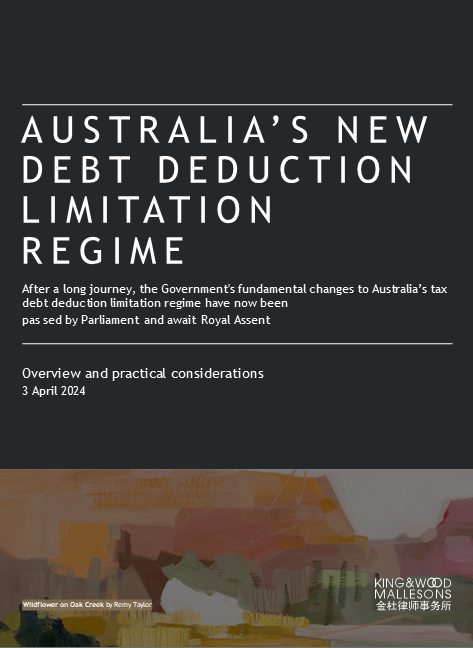
We’ve created a guide on these significant changes which also sets out a number of practical considerations that should be taken into account going forward. Click below to download the guide.
DOWNLOAD GUIDE
Australia’s new debt deduction limitation regime
We’ve created a guide on these significant changes which also sets out a number of practical considerations that should be taken into account going forward.
Download
Categories