A year of… accelerating AI-ready capacity, regulatory certainty and cross-border openness
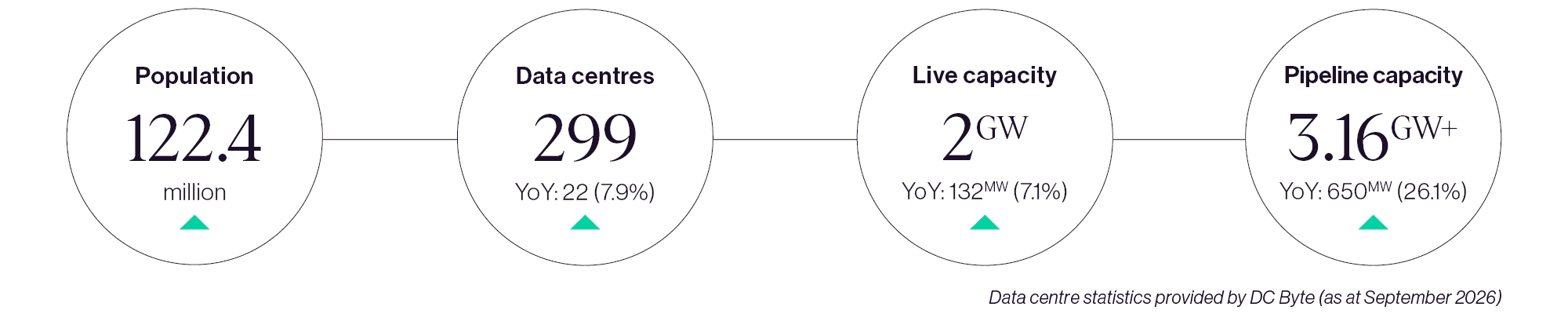
Japan’s data centre market is among the world’s largest by revenue, and the second-largest in APAC after China. Tokyo and Osaka dominate current capacity, but regional diversification, particularly in Kyushu and Hokkaido, is gathering momentum as power availability, resilience and decarbonisation increasingly drive location strategy.
Japan's growth is largely due to political stability, strong local talent, international connectivity and wide acceptance of AI. This is complemented by a clear regulatory framework with limited restrictions on critical infrastructure and foreign investment.
Incentives are more targeted. Current policy is focused on regional data centre hubs and local cloud and AI compute capacity, rather than a general tax holiday model.
Power availability is the main development constraint, particularly in Greater Tokyo, with potentially lengthy lead times. Construction costs, land scarcity and labour shortages can further delay projects, while exposure to natural hazards makes resilience and disaster recovery key commercial considerations.
Data centre statistics provided by DC Byte.
Japan’s commitment to regulatory transparency and its stable economic and legal environment make it an attractive destination for data centre developers and operators. In particular, there are clear standards for data protection and cyber security, along with a supportive approach to innovation.
The government has been openly hesitant to hinder innovation and create excessive burden in connection with AI. Japan has now enacted a law specifically focused on government-led promotion measures for AI, the Act on Promotion of Research and Development and Utilisation of Artificial Intelligence-Related Technologies.
Voluntary industry standards also continue to matter. In particular, the Japan Data Centre Council’s voluntary Data Centre Facility Standard is focused on ensuring and improving the quality and reliability of the design, construction and operation of data centres.
Japan’s commitment to foreign investment openness is a significant drawcard for international capital in the data centre sector. There is generally no restriction on foreign ownership of land, allowing offshore investors to acquire property. However, acquisitions involving companies operating in designated sectors may require prior filing, but approval is rarely withheld.
Nonetheless, foreign players should understand that Japan is a very localised market. Knowledge of, and respect for, cultural norms and business practices are critical for success.
The Japanese Government has adopted a policy position of promoting the free flow of data via the concept of Data Free Flow with Trust (DFFT). It does not provide general data localisation regulations or require government access to data. This may increase the attractiveness of politically independent Japanese data centres to overseas players.
Latest Thinking
Australia wants the data centre boom: can it get the power settings right?
Australia has an opportunity to secure its position as a major data centre hub in the region. But to capture it, investors need something Australia cannot afford to leave uncertain - a clear pathway for securing power.
10 September 2026
Australia's next AI bottleneck: Why copyright matters
If a major AI company was preparing a checklist to decide where to build its next AI training facility, you would expect to see access to land, power and water at the top of the list.
28 August 2026
AI data centres in Australia: breaking down barriers to investment
AI data centres in Australia: breaking down barriers to investment
29 April 2026
Unlocking opportunities and navigating challenges