Queensland has fired the legislative starting gun in the race for critical minerals investment. The State Development and Public Works Organisation (Critical Minerals) and Other Legislation Amendment Bill 2026 (the Bill), introduced into Parliament on 2 June 2026, proposes one of the most significant reforms to Queensland’s project facilitation framework in decades. It is squarely aimed at positioning the State as a globally competitive destination for critical minerals development – and it is not shy about the tools it deploys to get there.
The Big Picture
The Bill’s primary target is the State Development and Public Works Organisation Act 1971 (the SDPWO Act), Queensland’s long-standing legislative workhorse for coordinating and enabling major development.
The policy rationale is simple: Queensland sits atop significant deposits of copper, silicon, graphite, vanadium and permanent magnet metals, and global investment attention is increasingly focused on critical minerals as a defining economic opportunity.
The Crisafulli Government’s objective is to ensure the State’s regulatory framework keeps pace – not only with that opportunity, but also with increasingly competitive interstate and international jurisdictions.
South Australia, Western Australia and the Northern Territory have each recently introduced or expanded significant development facilitation regimes, and several of the Bill’s key mechanisms are expressly modelled on those frameworks.
The result is a proposed reform package that materially expands the State’s ability to intervene in, coordinate and accelerate projects it considers strategically and economically important – particularly in the critical minerals and downstream industrial sectors.
In this alert, we highlight the key takeaways from the proposed reforms.
At a Glance – What does the Bill Do?
The proposed reforms collectively represent a significant centralisation of planning and infrastructure coordination powers, particularly in regions experiencing major resource and industrial growth.
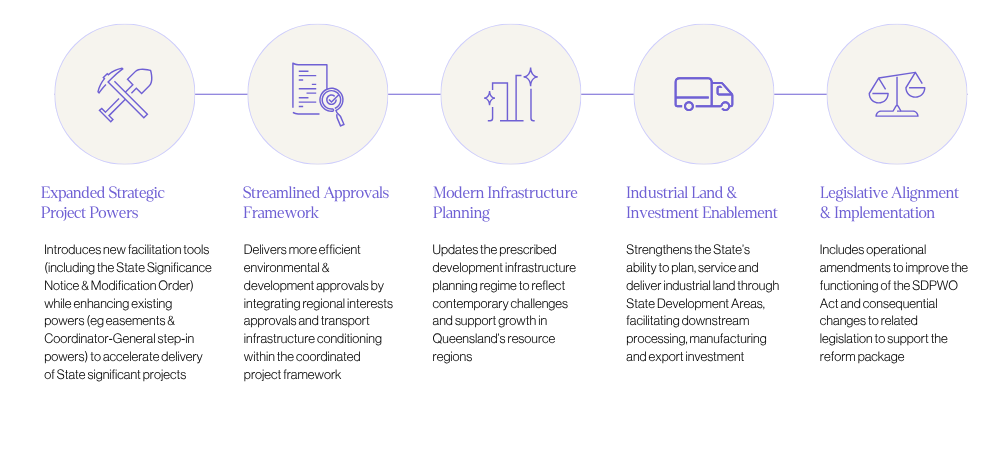
Click to expand

What Does It Mean for Industry?
The Bill signals a decisive shift in Queensland’s approach to major project development, equipping the Government with a substantial toolkit to cut through regulatory barriers for projects it deems strategically significant – particularly in the critical minerals sector. The modification order power alone is likely to attract close scrutiny, given its capacity to disapply legislation by executive action, albeit subject to safeguards.
- For project proponents, it offers the prospect of a more coordinated approvals framework, stronger Government support for strategically important projects, and new mechanisms to overcome regulatory and land access barriers.
- For investors, it underscores Queensland’s intention to compete aggressively for critical minerals and downstream processing opportunities at a time of sustained global demand.
- For landholders, local governments and other stakeholders, the proposed reforms introduce a greater degree of centralised decision-making and expand the circumstances in which the State may intervene to facilitate development.
The extent to which these powers are ultimately used - and how they are applied in practice – will no doubt be closely watched by all.
The Headline Reforms
At the centre of the Bill is the creation of a new category of development: the State Strategic Project (SSP).
Replacing the existing “critical infrastructure project” designation, SSPs are intended to capture Queensland’s highest-priority projects - those considered critical to the State’s economic, environmental or social objectives. Projects will be designated as SSPs by the Minister.
While SSPs continue to access the existing facilitation tools available to “prescribed projects” under the SDPWO Act, the designation unlocks a new suite of powers. These include State significance notices, modification orders, expanded land access arrangements, strategic infrastructure easements and, in certain circumstances, compulsory acquisition powers.
The clear policy intent is to identify and fast-track projects central to Queensland’s long-term economic development, particularly in the critical minerals sector.
Importantly, any existing “critical infrastructure project” declaration in force immediately before commencement will automatically transition to an SSP under the new framework.
The Bill introduces State significance notices, giving the Minister a formal and influential role in key approval decisions for SSPs.
Where a notice is issued, the relevant decision-maker for an application for a SSP must consult with the Minister before making a prescribed decision relating to an SSP, including decisions concerning the construction, operation, maintenance or delivery of the project. The decision-maker must provide the Minister with the proposed outcome, any proposed conditions and an explanation of how the matters identified in the notice have been addressed. The Minister may then provide advice, which must be taken into account and given appropriate weight.
While the final decision remains with the statutory decision-maker, the reform ensures that approvals for projects of the highest State significance are informed by broader Government priorities. In effect, it gives the Minister a seat at the table for critical approval decisions without formally transferring decision-making power.
The reform reflects a clear policy intent for the State to take a more active role in facilitating strategically important projects, ensuring that economic, environmental and social objectives are considered alongside the matters ordinarily relevant to the assessment of a project approval.
The Bill also seeks to provide greater certainty for proponents once decisions are made. Decisions subject to a State significance notice will generally not be open to third-party merits review or appeal, although judicial review rights will remain available.
Perhaps the most eye-catching element of the Bill is the introduction of modification orders. These give the Governor in Council, on the Minister’s recommendation, the power to exclude or modify the application of provisions of other Queensland laws to a State strategic project - effectively allowing the regulatory framework to be recalibrated for individual projects on a case-by-case basis where existing requirements create unnecessary duplication, delay or uncertainty.
The Bill recognises the constitutional significance of this power and seeks to constrain its use. Modification orders will only be available for the narrow class of projects declared as SSPs. The Minister must be satisfied that:
- the order is necessary and in the State’s interest;
- environmental impacts can be appropriately managed; and
- any departure from the objectives of the affected legislation is justified by the broader benefits of the project proceeding.
A number of important safeguards are also built into the regime. Mandatory consultation requirements apply, and modification orders cannot remove requirements to obtain key environmental authorities, resource tenures or development approvals. Specific exclusions also preserve Aboriginal and Torres Strait Islander rights and interests, revenue provisions, and Commonwealth bilateral environmental assessment processes under the Environment Protection and Biodiversity Conservation Act 1999 (Cth). Parliamentary oversight is maintained through the disallowance process.
The modification order has been modelled on comparable powers in South Australia, Western Australia and the Northern Territory.
The Bill expands the State’s ability to facilitate project delivery where land access becomes a constraint.
A new access authority regime will replace and broaden existing investigation powers. Proponents of “prescribed projects” will be able to seek access to land for investigation purposes, while SSP proponents may also seek authority to undertake limited enabling works where access cannot be secured by agreement.
The enabling works power is intended to operate as a last-resort mechanism. Before access is granted, both the Coordinator-General and Governor in Council must be satisfied that the works are necessary to facilitate the project, that reasonable efforts have been made to negotiate access, and that the works are minor, temporary and will not unreasonably interfere with the landowner’s use.
Landowner protections remain central to the regime, including notice requirements, compensation entitlements and access to the Land Court.
The Bill also replaces the existing reference to a “private infrastructure facility” as a purpose for which land may be taken with SSPs. While the underlying safeguards remain largely unchanged – including requirements for unsuccessful negotiations, final unconditional offers and compensation – the proposed reforms make compulsory acquisition available as a tool to facilitate projects of strategic importance, subject to approval by the Governor in Council.
The Bill proposes to replace the existing “prescribed development” framework with a new system of Infrastructure Coordination Plans (ICPs), signalling a more active State role in planning for growth in Queensland’s resource regions.
The proposed reforms respond to a recurring challenge: major projects often generate infrastructure demands that extend well beyond the project site. Transport, energy, water, housing, health services and community infrastructure can all come under pressure as development accelerates. The proposed ICP framework is designed to address these broader impacts through coordinated, region-wide planning.
Under the proposed new framework, the Minister may direct the Coordinator-General to investigate infrastructure needs arising from major resource projects and prepare an ICP to coordinate the delivery. The approach is deliberately holistic, capturing both project-specific infrastructure and the wider infrastructure required to support associated economic activity.
A key feature of the framework is its interaction with the Queensland planning system. During preparation of an ICP, certain planning applications may be referred to the Coordinator-General and called-in by the Minister, effectively placing them on hold to avoid decisions that could frustrate the planning process.
Once an ICP is in effect, the Minister may determine whether those applications should proceed through the usual planning pathway or are decided by the Minister directly. Where the Minister assumes the decision-making role, that decision will be final and not subject to merits review or appeal, although judicial review rights will remain available.
The Bill proposes a substantial update to Queensland’s State Development Area (SDA) framework, aimed at improving the planning, regulation and delivery of infrastructure.
Key proposed reforms include:
- SDA-related development – Enables certain development outside an SDA boundary to be brought within the SDA regulatory framework where it supports or is connected to the SDA’s purpose. While a declaration does not itself approve the development, it allows the development to be regulated under the applicable development scheme and the SDPWO Act.
- Enhanced Conditioning Powers – Provides the Coordinator-General with greater flexibility to impose conditions on SDA approvals, including requirements relating to infrastructure charges and environmental offsets.
- New SDA Rules – Introduces a standalone set of procedural rules to apply across SDAs where a development scheme is silent, provided there is no inconsistency. The objective is a more consistent and streamlined regulatory framework.
- Transition to the Planning Act framework – Establishes a mechanism for SDA approvals to continue operating under the Planning Act 2016 (Qld) (Planning Act) where an SDA ceases, preserving development rights and providing greater certainty for proponents.
The Bill seeks to reduce regulatory duplication by integrating elements of the Regional Planning Interests Act 2014 (Qld) (RPI Act) and Transport Infrastructure Act 1994 (Qld) (TI Act) into the “coordinated project” assessment framework under the SDPWO Act.
Importantly, these proposed reforms will apply to both new coordinated projects and change requests for existing projects.
For coordinated projects undergoing environmental impact assessment, public notification, consultation and assessment processes already undertaken under the SDPWO Act may be relied upon to satisfy equivalent requirements under the RPI Act and TI Act.
For proponents, this has the potential to reduce duplication, minimise parallel approval processes and improve certainty around approval outcomes. While separate approvals will still be required, the pathway to obtaining them is intended to be more streamlined.
The Coordinator-General will also have a more direct role in shaping approval outcomes, including the ability to state conditions that are subsequently incorporated into approvals issued under those Acts.
The Bill reframes Queensland’s existing “critical infrastructure easement” regime, renaming these as strategic infrastructure easements and expanding who may benefit from them.
Where the current framework largely limits these easements to public utility providers, the proposed reforms will allow them to be held by a broader range of entities, including private proponents of SSPs, subject to Ministerial or Governor in Council approval.
The intent is to facilitate more efficient delivery of infrastructure supporting projects of State significance. In particular, the regime supports the co-location of infrastructure within existing utility corridors – enabling assets such as transmission lines, pipelines and water infrastructure to utilise established easements rather than requiring entirely new corridors.
For proponents, this may reduce land access constraints, improve coordination across major infrastructure networks and support more efficient project delivery. While still subject to land tenure requirements and approvals, the proposed reforms represent a further expansion of the State’s facilitation toolkit.
The Bill significantly strengthens the enforcement framework under the SDPWO Act, aligning it more closely with the Planning Act and shifting toward a more proactive, investigation-led compliance model.
A central feature is the expanded role of the Coordinator-General, including the ability to appoint authorised officers to investigate suspected breaches – particularly unlawful development or non-compliance with conditions.
The proposed framework introduces a graduated set of entry powers. Authorised officers may enter premises with consent, under warrant or, in limited circumstances, where land is publicly accessible or used for business purposes. Once on site, officers are equipped with broad powers, including inspection, information gathering and the seizure of evidence.
Where enforcement notices are not complied with, authorised officers may enter land to carry out remedial works, with costs recoverable from the non-compliant party. These powers are supported by new offences and strengthened court-based mechanisms to restrain, remedy or prevent breaches.
What Happens Next?
The Bill has been referred to the Primary Industries and Resources Committee for detailed consideration. The Committee will undertake consultation with stakeholders, invite submissions and report back to Parliament with its recommendations.
Whatever form the final legislation takes, the message from Queensland is clear: it is open for critical minerals business and prepared to reshape the regulatory landscape to prove it.
We will continue to monitor the Bill's progress and provide further updates as it moves through the Parliamentary process.
Demand for critical minerals continues to rise, largely driven by the energy transition and the development of new technologies.