Under the Fair Work Act 2009 (Cth) (FWA) every pregnant worker - permanent, fixed-term or casual - must be afforded a “safe job” on identical pay and conditions; if none exists, the FWA requires the employer to provide “no-safe-job” leave.
On paper, the mandate looks simple. On a mine site, 1,500 kilometres from the nearest capital, surrounded by heavy plant, extreme temperatures, shift work and FIFO rosters, it can feel anything but.
As the resources sector strives to attract and retain more women and gender-diverse talent, employers are confronting the practical tension between legal imperatives and operational realities: How far must duties be reshaped? What medical evidence suffices? Who bears the cost of redeployment or paid leave? How do you balance safety, production targets and workforce equity without breaching the FWA, or alienating valued employees?
This article cuts through the complexity. It analyses the statutory framework, unpacks the pitfalls that routinely ensnare resource employers, and offers concrete, defensible strategies to ensure compliance while keeping the wheels, and the talent pipeline, turning.
What does the law say?
The FWA provides specific protections for pregnant employees, particularly through the concept of a ‘safe job’. The FWA does not provide an exhaustive definition of a ‘safe job’, but instead maps out clear parameters and expectations for employers as to what constitutes a safe working arrangement for pregnant employees.
Entitlement to a ‘Safe Job’
The entitlement attaches to any pregnant employee (regardless of length of service or employment status) who gives the employer evidence (typically a medical certificate) satisfying a reasonable person that the employee is fit for work, but that it is inadvisable for the employee to continue in their current position for a stated “risk period” because of pregnancy-related illness, risk or inherent hazards of their role or workplace (see s 81(1) FWA).
Once that evidence is provided, the employer must, for the duration of the risk period, transfer the employee to an appropriate safe job on no less favourable terms (see s 81(2) FWA). A failure to do so will expose the employer to civil penalties for contravention of a National Employment Standards (see s 44 FWA).
Definition of a ‘Safe Job’ under the FWA
Section 81(3) of the FWA defines an “appropriate safe job” as a position in which the pregnant employee is not exposed to the illness, risks or hazards identified in the medical evidence, and that either maintains the employee’s ordinary hours or adopts a different pattern of hours agreed with the employee. Importantly, the expression “safe job” means the role must, in substance, remove the relevant pregnancy-related risk while preserving the employee’s substantive employment conditions.
A compliant transfer to an appropriate ‘safe job’ must therefore satisfy three core elements:
- The job must exist and be genuinely safe having regard to the medical evidence (see s 81(3) FWA);
- the employees’ ordinary hours must mirror those of the pre-transfer position unless the employee agrees to vary them (see s 81(3) FWA); and
- the employee must be paid their full rate of pay for the pre-transfer position for every hour worked in the safe job (see s 81(4) FWA). Full rate of pay is defined in s 18 of the FWA to include loadings, monetary allowances, overtime or penalty rates and any other separately identifiable amounts. For employees in the resources sector, practically this might include shift loadings, industry allowances, and payments for rostered overtime.
Employers may require further medical evidence, including an independent medical examination, provided the request is reasonable and directed to the statutory criteria (see s 81(6) FWA). The risk period automatically ends if the pregnancy ends (see s 81(5) FWA).
Where no appropriate ‘Safe Job’ is available?
If no appropriate safe job is available, the FWA distinguishes between employees who are eligible for unpaid parental leave and those who are ineligible:
- For paid no safe job leave, where the employee is entitled to unpaid parental leave and has complied with the parental-leave notice requirements, that employee must be granted paid leave for the risk period at the base rate of pay for ordinary hours (see s 81A FWA). In contrast to full rate of pay, s 16 of the FWA defines base rate of pay to exclude loadings, monetary allowances, overtime or penalty rates and any other separately identifiable amounts. Practically, this may exclude shift loadings, overtime and any industry allowances. During the final six weeks before the expected birth, the employer may require a fresh medical certificate and, if the employee is unfit or fails to provide the certificate within seven days, may direct the employee onto unpaid parental leave (see s 82 FWA).
- For unpaid no safe job leave, employees who are not yet entitled to unpaid parental leave (often due to insufficient service or irregular casual engagement) are nevertheless entitled to unpaid leave for the risk period, subject to the provision of reasonable evidence of pregnancy (see s 82A FWA).
These provisions ensure that, where the workplace cannot eliminate the risk through a safe job, the employee remains protected either through a paid stand-down or an unpaid absence until the risk period concludes.
What are the common issues employers are facing in the resources sector?
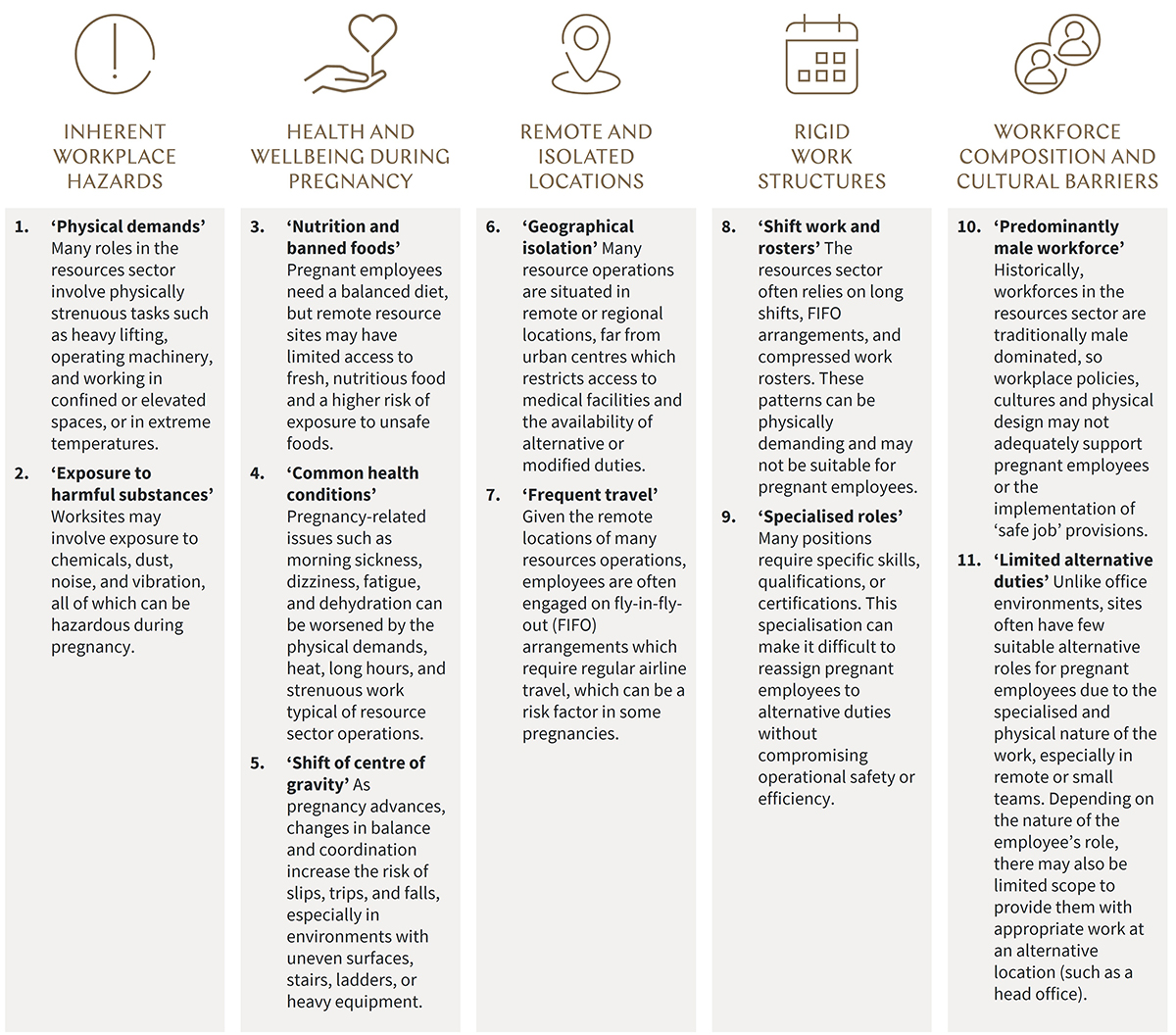
Employers in the resources sector (including mining, oil and gas, and related extractive industries) faces distinct challenges when implementing ‘safe job’ provisions for pregnant employees under the FWA. These complexities arise from the nature of the work, the environment and remote locations, the traditionally ‘male dominant’ landscape and the structure of employment in the sector.
Aside from the compliance challenges, and issues with costs and resource allocation, the issues we often see are:
Click to expand

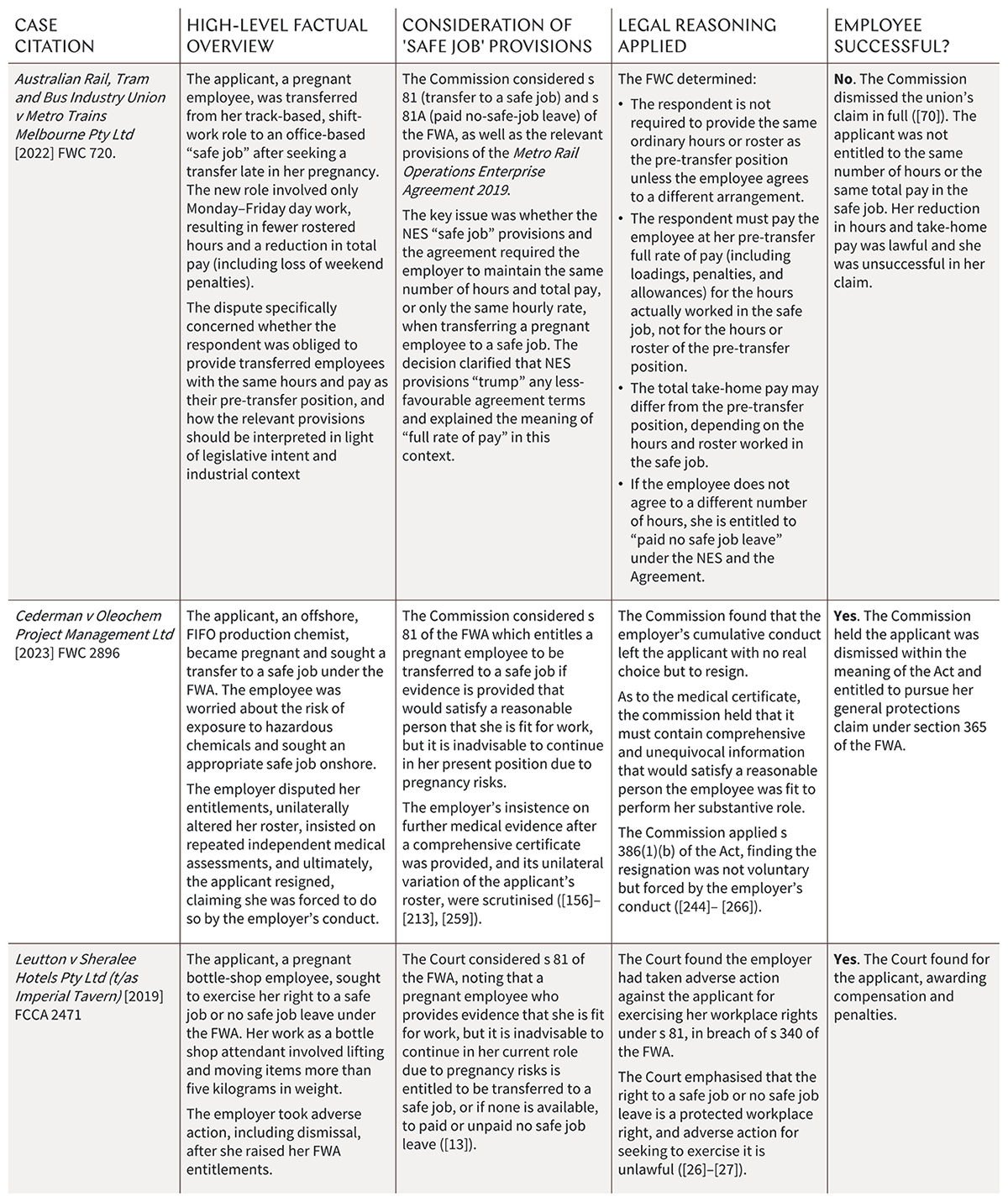
Recent decisions
The table below summarises key recent decisions on the FWA’s safe job provisions. It outlines the main facts, legal principles, and outcomes to clarify current interpretations and applications of these entitlements. The key themes include whether employers must maintain a pregnant employee’s pre-transfer hours and pay when moved to a safe job, the requirements for a comprehensive medical certificate, and whether the right to a safe job is a protected workplace right.
Click to expand
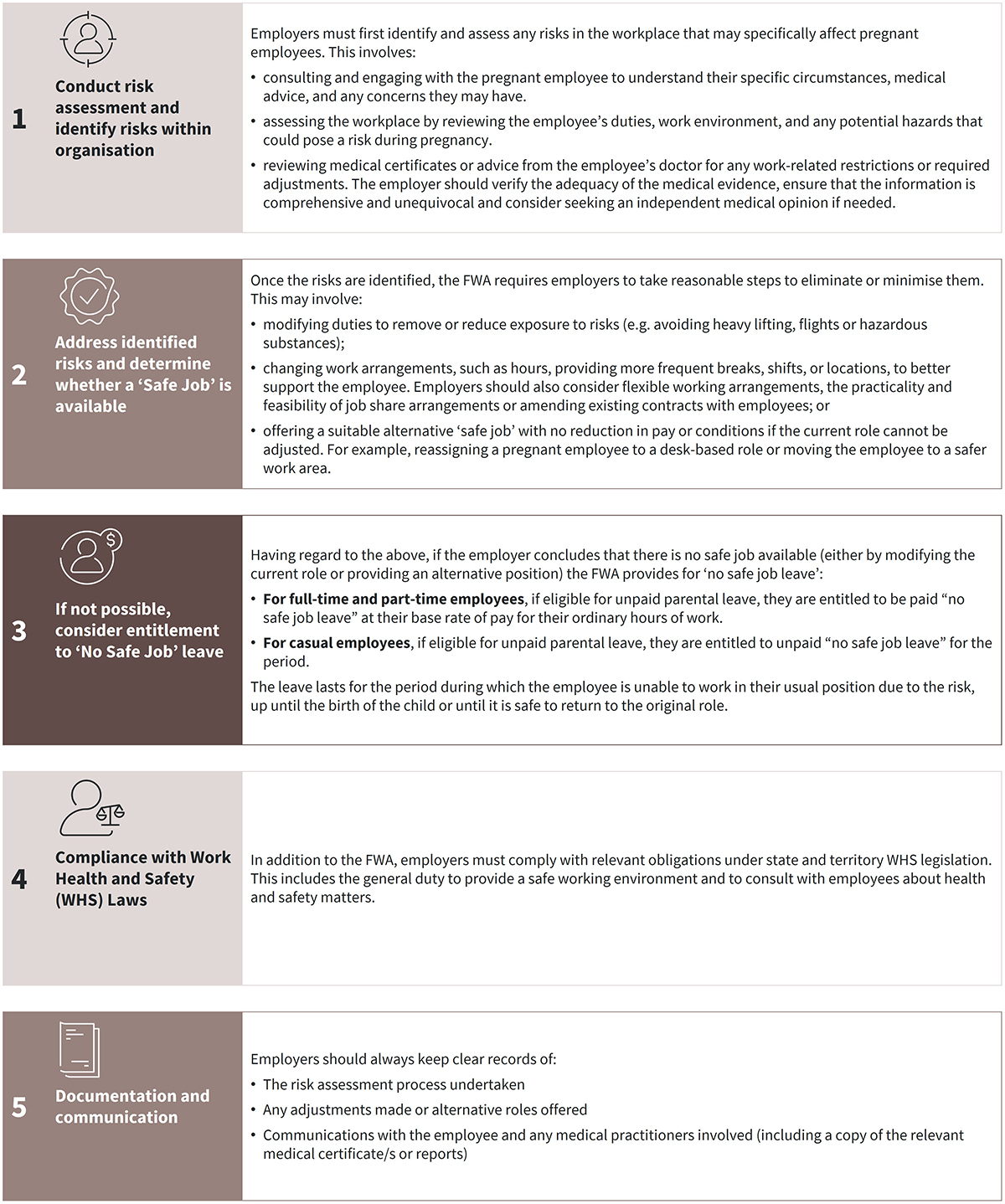
How should employers tackle these issues and assess and address risks for pregnant employees?
Below is a step-by-step practical guide tailored for employers within the resources sector, aimed at assisting in the identification, assessment, and management of workplace risks that may uniquely impact pregnant employees. This guide offers practical recommendations to support legal compliance and foster a safe, inclusive, and supportive workplace environment.
Click to expand
Practical takeaways for employers
The FWA’s definition of a ‘safe job’ for pregnant employees is centred on the principle of risk elimination and the provision of suitable, hazard-free work. Employers, particularly in the resources sector, must ensure that the health and safety of both the employee and her/their unborn child is always prioritised.
Employers must be proactive in identifying and managing risks for pregnant employees. This includes regular reviews of workplace practices, effective communication with affected employees, analysis of roles and medical evidence, and a willingness to remain flexible and make reasonable adjustments as necessary. Failure to comply with these obligations can result in significant legal and reputational consequences.