Australia is home to much of the periodic table of critical minerals and rare earth metals that are vital for defence and other advanced technologies” - Prime Minister Anthony Albanese[1]
The unprecedented shift in global priorities and focus on supply chain challenges in 2025 has brought the critical mineral sector into our daily newsfeeds. In our final insight for 2025, we reflect on the new United States-Australia Framework deal in the context of Australian government initiatives following the May Federal election which are relevant to Australian projects.
Now in the mainstream: nuts and bolts of critical minerals
Critical minerals are considered by the Australian Federal Government as metallic or non-metallic materials that are essential for modern technologies, economies or national security, and have supply chains that are vulnerable to disruption. In 2023, Australia published its Critical Minerals Strategy 2023-2030 and updated its Critical Minerals List, signalling renewed focus on Australia’s critical minerals sector.
Our new interactive periodic table graphic below:
- highlights the level of Australian resources of Australia’s designated critical minerals and strategic materials; and
- links through to the energy transition use cases and level of Australian production for each mineral.
The categorisation of critical minerals is, of course, an outcome of policy and access, rather than geological science. Individual countries develop their own lists of critical minerals based on the relative importance of particular minerals to their industrial needs and their strategic assessment of supply risks, to reflect market and political conditions at a particular point in time and are subject to change.
For example, in the last fortnight the United States published its final 2025 List of Critical Minerals, which added 10 new minerals: boron, copper, lead, metallurgical coal, phosphate, potash, rhenium, silicon, silver and uranium.
The definition of a “critical mineral” differs between jurisdictions, is dynamic and under continual review – as demonstrated below in our revised comparative venn diagram for Australia, United States, Canada and the United Kingdom.
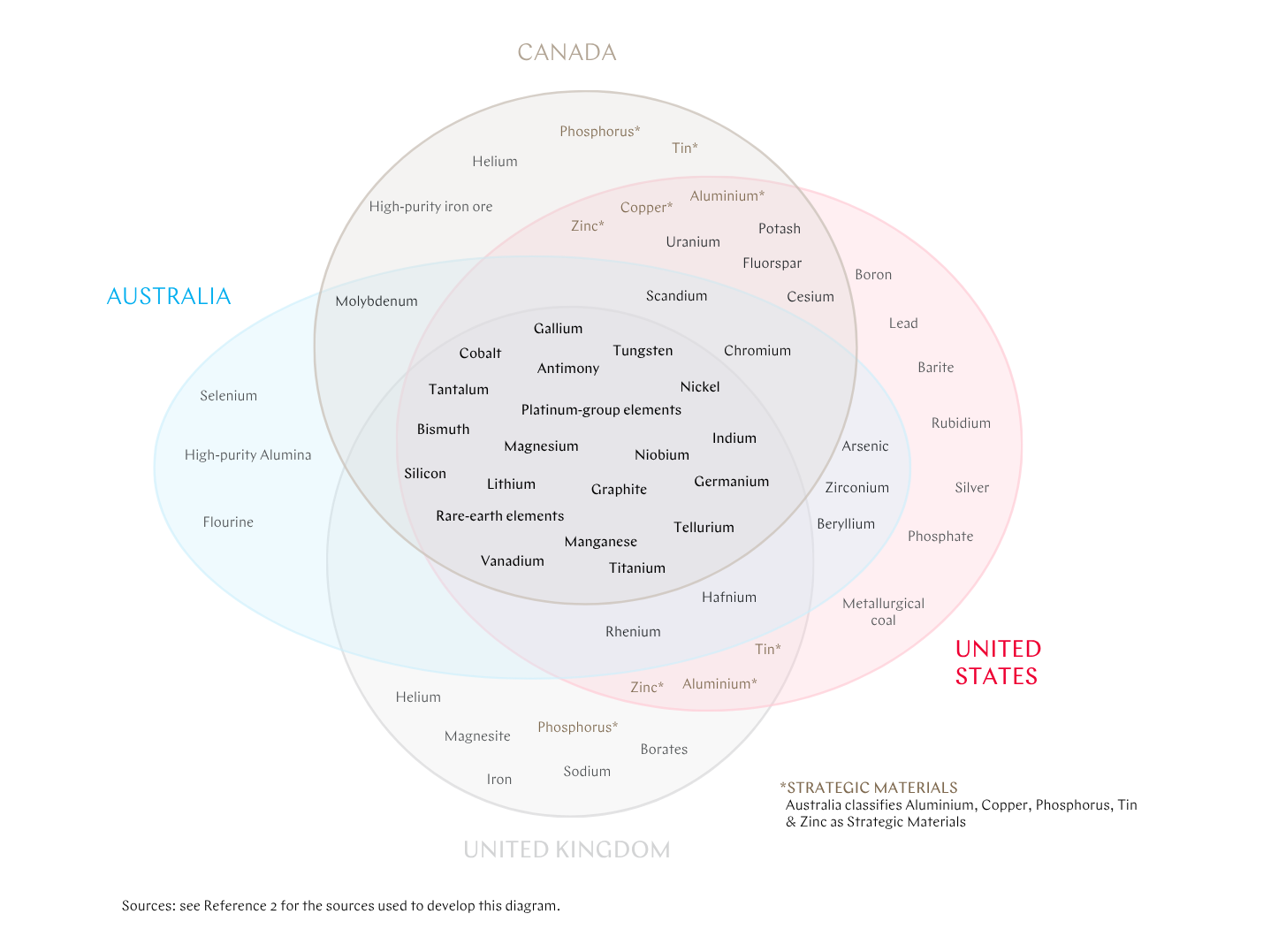
Click to expand

What is the October United States-Australia critical minerals deal?
United States–Australia Framework for Securing of Supply in the Mining and Processing of Critical Minerals and Rare Earths”[3]
The October US-Australia Framework includes commitments from both countries to:
This diagram has been developed using the following sources: Government of Canada “Canada’s Critical Minerals” (2025), (search “Canada’s Critical Minerals”); Department of Interior “Final 2025 List of Critical Minerals” (2025); and UK Critical Minerals Intelligence Centre “UK 2024 Criticality Assessment” (2024) (click on “Reports”, “Critical mineral data cards” and “UK 2024 Criticality Assessment”).
This diagram does not include the US additional critical materials for energy identified in 2023: Aluminium, Cobalt, Copper, Dysprosium, Electrical steel, Fluorine, Gallium, Iridium, Lithium, Magnesium, Natural graphite, Neodymium, Nickel, Platinum, Praseodymium, Silicon, Silicon carbide and Terbium.
|
|
Take measures to provide at least USD$1b in Australia and the United States in next 6 months. Investment options include capex and opex via guarantees, loans, equity, offtakes, insurance, regulatory facilitation. |
|
PRICE MECHANISMS |
Protect their domestic critical minerals markets “from non-market policies and unfair trade practices” including adoption of a “standards based systems” to trade within a pricing framework, including price floors. |
|
ASSET SALES |
Develop new or strengthen existing authorities and diplomatic tools that “review and deter critical minerals and rare earths asset sales on national security grounds”. |
|
PERMITTING |
Take measures to accelerate, streamline or deregulate permitting timelines and processes, consistent with applicable law. |
|
PROJECT SELECTION |
Jointly identify projects of interest to address gaps in priority supply chains. The first 2 projects for Australia are:
|



NB: U.S. Export-Import Bank (EXIM) has issued letters of interest for USD$2.2b in financing 7 critical minerals projects in Australia, including another $300m for Arafura Nolans Project, Graphinex’s graphite project, Northern Minerals’ rare earths project, LaTrobe Magnesium’s plant, VHM’s mineral sands and rare earths project, RZ Resources’ rare earths project and Sunrise Energy Metals’ scandium project.
The US-Australian framework should be seen in the context of the increased domestic policy attention in Australia over the past year, particularly following the May Federal Election with the announcement of the proposed strategic reserve. Consequently, every day seems to bring a new critical minerals announcement into our newsfeeds.
The following schematic summarises the key polices to be aware of which are, or shortly will, impact Australian critical minerals projects:
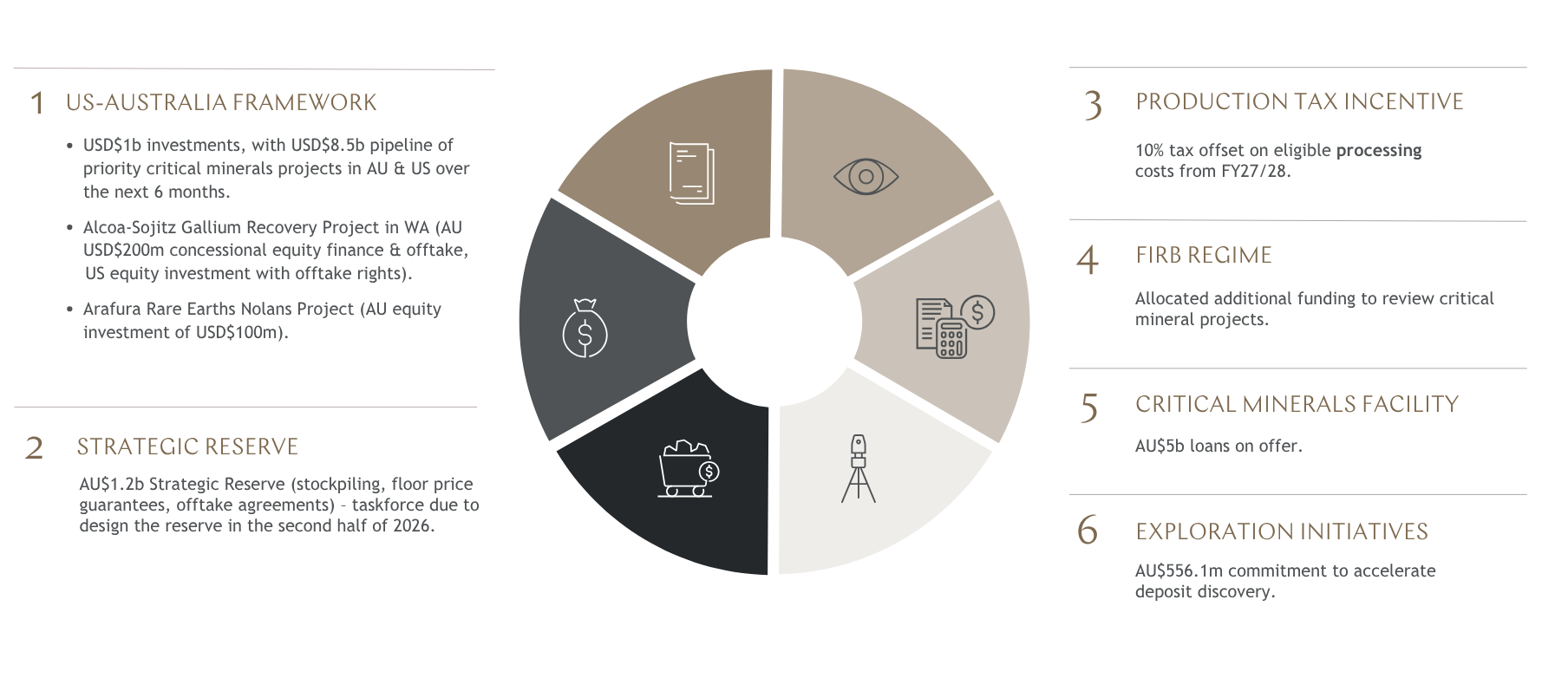
Click to expand
Recent Australian projects
KWM has been fortunate to be involved in several recent critical minerals deals, currently in the headlines:
- Iluka Resources: advised on the development of the Eneabba Rare Earths Refinery, as well as long term rare earths concentrate feedstock agreements for the refinery with Northern Minerals and Lindian Resources;
- Lynas Rare Earths: advised on AU$750m equity capital raising, with follow-on AU$75m share purchase plan; and
- Australian Strategic Materials: advised on AU$20.2m equity raising for its Dubbo Rare Earths project.
What else has happened this past year in Australia’s critical minerals sector?
The new initiatives above follow on from a very active year in the critical minerals space. We have canvassed this past year the foundational aspects of Australia’s critical minerals sector, the increased demand AI and exponential investment in data centres will place on copper and renewable energy (and therefore CETM), the role of uranium and nuclear energy in supply chains globally, and international partnerships.
Our recent insights in our ongoing critical minerals series highlighted:
- How critical minerals are impacting global markets and supply chains
Overview of the key themes in 2025 activity, including downstream processing, cross-border focus, funding initiatives and the spotlight on rare earth elements. Read more here.
- Critical Minerals Production Tax Incentive
The development of the CMPTI and proposed regulations expanding the eligibility of processing activities for the tax credit. Read more here and here.
Looking ahead to 2026 and beyond
Next year we expect an exponential increase in critical mineral activities including, but by no means limited to:
- US-Australia Framework: New project selections under the US-Australia Framework, with a mix of debt and equity funding commitments including over an initial 6 month period to April 2026.
- EPBC Reform: Progression of reforms to the Federal Environment Protection and Biodiversity Conservation Act 1999 (Cth) to introduce a number of approvals streamlining measures. Read more
- Strategic Reserve: Further announcements on Australia’s Strategic Reserve policy, with a taskforce due to design the reserve in the second half of 2026.
- CMPTI: Further development of the Critical Minerals Production Tax Incentive ahead of FY27/28 eligibility, including in respect of the community benefit principles that will underpin the CMPTI community benefit rules.
- FIRB: Outcome of the 31 October Treasury consultation on further FIRB reforms, including considering automatic approvals of low-risk investments, but with tighter security of sensitive investments (including critical minerals).
- M&A and financing: increasing M&A and financing activity for critical minerals deals as investors look to capitalise on government funding and favourable policy settings to acquire and develop critical minerals projects.
- COP31: focus on critical minerals as the “backbone” of the energy transition including responsible and equitable development, with potentially, Australia hosting COP31 climate talks in 2026 (watch this space!).
Interested in our insights and experience on the future of energy including energy generation & storage, decarbonisation, energy generation and critical minerals?