Further implementation details for the Guarantee of Origin Scheme (GO Scheme) were released for consultation on 23 June 2025.
Enacted in November 2024, the GO Scheme creates:
- tradable Renewable Electricity Guarantees of Origin (REGOs) to certify renewable electricity; and
- non-tradable Product Guarantees of Origin (PGOs) to verify emissions of certain manufactured products.
For more information about the primary legislation enabling the GO Scheme, read our previous alert here.
The new consultation round includes three exposure drafts of legislative instruments that will support the GO Scheme:
- Future Made in Australia (Guarantee of Origin) Rules 2025 (Draft Rules) – further rules supporting the legislation for both REGOs and PGOs;
- Future Made in Australia (Guarantee of Origin) Methodology Determination 2025 (Methodology Determination) – details the methodology for hydrogen produced via electrolysis, the first available PGO production pathway; and
- Future Made in Australia (Guarantee of Origin Charges) Regulations 2025 (Draft Charges Regulations) – sets out the charges regulations for both PGOs and REGOs.
The consultation package also includes a 'Concept Paper for Energy Storage Systems' (Storage Paper), outlining the Government’s approach to energy storage system rules within the REGO scheme. The Government will separately consult on rules for REGO energy storage later in 2025. Importantly, the Government has deferred consultation on aggregated systems (i.e. hybrid solar and battery systems) until late 2025 and early 2026, meaning aggregated systems will not be able to be registered at the GO Scheme’s launch in December 2025.
Key changes in the Draft Rules
The Draft Rules set out the operational aspects of the GO scheme, including registration, certification, cost-recovery and various other administrative matters. The table below summarises the key details for PGOs and REGOs.
|
PGO'S
|
REGO'S
|
Example
uses 2
|
|
The PGO scheme now requires detailed reporting for production, delivery, and consumption profiles specific to a facility and specific to production (i.e the batch data) (sections 14-19). |
The list of eligible renewable energy sources is aligned with the with the Renewable Energy (Electricity) Act 2000 (Cth), with a specific exclusion of biomass from native forests (section 69(2)(c)). |
|
|
PGO certificates will be required to include more granular information, such as co-product use, renewable electricity use (including grid-matching), and product-specific attributes (e.g., pressure, purity, water source) (section 23(1)(d)-(f)). |
The eligible amount of electricity for certification is to be calculated using updated formulas, with flexibility for different time periods (hour, day, month, year) and explicit treatment of auxiliary and transmission losses (sections 45 and 46). |
|
|
The rules provide for optional inclusion of attributes necessary for compliance with international schemes, supporting export market requirements (section 26). |
Double counting is addressed by prohibiting REGO creation for renewable generation that has been issued with I-RECs, potentially curtailing the I-REC market in Australia once below-baseline generation is fully integrated into the REGO scheme (section 49). |
|
|
PGO certificates can be backdated to the date a valid production profile application was made, addressing delays in the Regulator's profile assessment (section 25(2)(a)). |
|
|
Hydrogen Methodology Determination
The exposure draft for the Methodology Determination establishes a single, detailed methodology for calculating greenhouse gas emissions associated with hydrogen production from electrolysis. This is the first production method under the GO Scheme, with the intention being to expand the Methodology Determination to other production sources, such as green metals and aluminium in the future.
The key developments for the Methodology Determination framework are:
- An emissions accounting framework with procedures for monitoring, measuring, and reporting emissions from all material sources in the hydrogen supply chain, including electricity (both grid-supplied and on-site generation), water supply and use, steam supply and use, synthetic gas use, and post-production transport and storage. Where supplier-specific data is unavailable, producers have the flexibility to use default emission factors for inputs (e.g., water, steam, transport) (Chapter 2).
- Reporting systems that leverage National Greenhouse and Energy Reporting Scheme (NGERS) processes, minimising additional regulatory burden for producers already reporting under NGERS.
- A materiality threshold which excludes reporting for any emissions source that contributes less than 2.5% of the emissions intensity of an efficient production pathway (i.e., less than 0.015 kg CO2-e per kg hydrogen), reducing unnecessary reporting of immaterial sources.
- Co-product emissions reductions for hydrogen that are available when co-products (notably oxygen from electrolysis) are sold at market value, with clear evidence requirements to ensure genuine sales (section 22).
- Hydrogen functional units that represent 1 kg of hydrogen, with emissions intensities for production, post-production, delivery, and co-product reduction published on PGO certificates. The number of PGO certificates will be rounded down to the nearest whole number (e.g. a 10.9 kg hydrogen batch produces 10 certificates) (section 16).
- Batch-based emissions accounting which requires emissions to be calculated on a batch basis, allowing for flexible batch periods (from one hour to one year) (section 17).
Energy storage systems in the GO Scheme
The Storage Paper outlines the proposed policy framework and rules for including energy storage systems (ESS) in the GO Scheme, specifically for the creation of REGO certificates. The scheme will allow ESS to be registered and to create REGO certificates, provided the electricity dispatched is demonstrably renewable.
The key issues raised in the Storage Paper are:
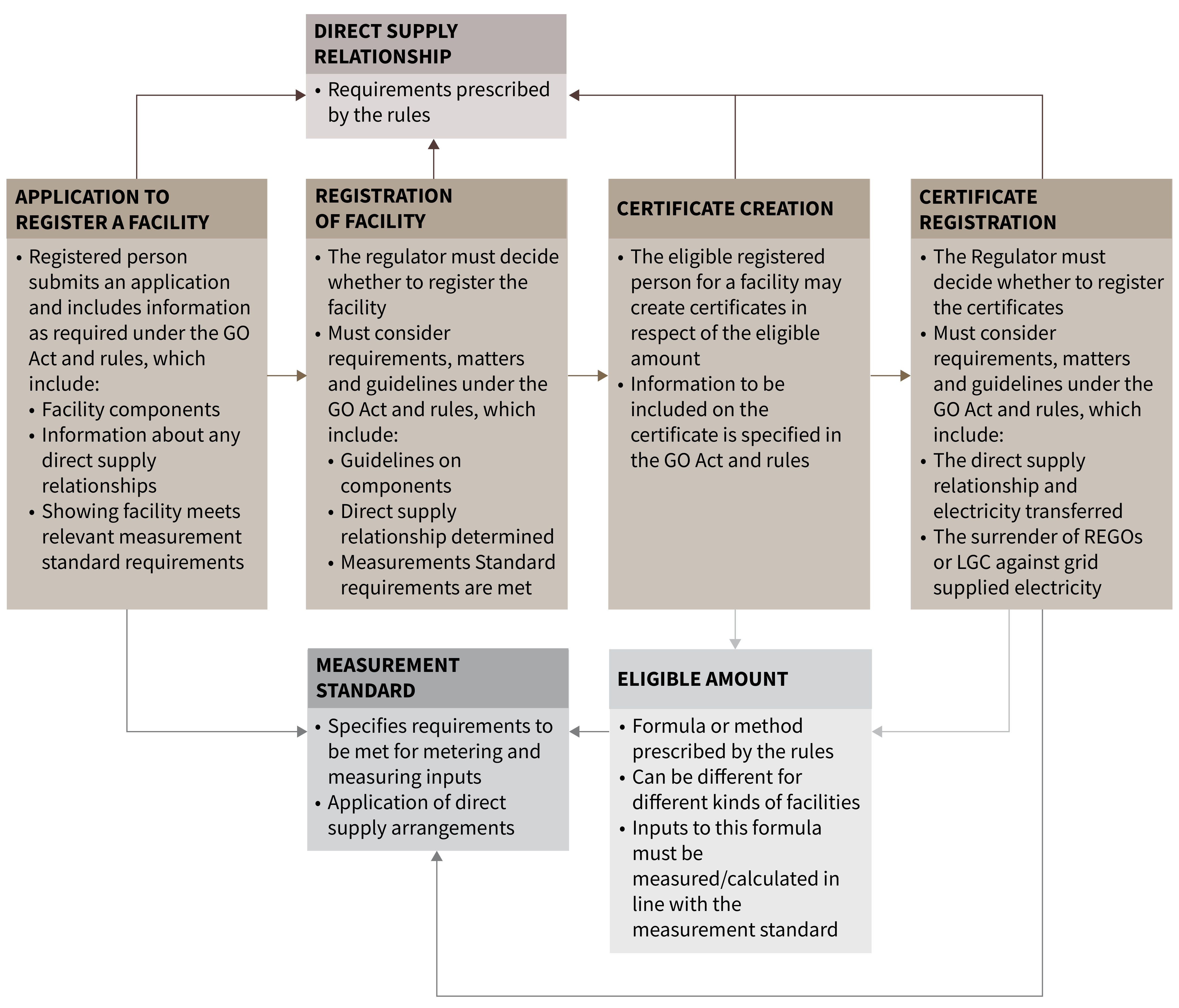
- Registration - ESS must be registered as separate facilities, even when part of a hybrid system together with a generation asset. Registration requires detailed information, including storage capacity, type, all electricity inputs, operational processes, round-trip efficiency, and metering arrangements. The key steps for an energy storage system to register and participate in the REGO scheme can be seen below in Figure 1.
- Direct Supply Relationships - There are specific rules proposed for where an ESS is directly supplied by a renewable generation system via a direct line (noting that other arrangements are proposed with respect to proxy generation when an ESS is not directly supplied by a renewable generation system):
- All electrical inputs to the ESS, including from renewable and non-renewable sources (as well as the grid), must be separately and appropriately metered according to the measurement standard for the facility.
- The electricity generation system must supply eligible renewable electricity to the ESS. This is demonstrated if the generation system is registered under the GO Scheme or accredited under the Renewable Energy (Electricity) Act 2000 (Cth). If not registered or accredited, the system must still use an eligible renewable energy source and comply with relevant planning and approval requirements.
- The transfer of electricity must occur through a 'direct line' (i.e. behind a connection point meter, not through the grid). The direct line does not need to be exclusive, provided the amount of electricity from the generation system to the storage system can be clearly determined and all other inputs are separately measurable.
- Calculation of Eligible Amount – A method is proposed to determine the maximum eligible amount (i.e. the amount of eligible renewable electricity) for which REGOs can be created for ESS. It is based on the net electricity dispatched from the ESS in the relevant time period, adjusted for auxiliary losses (i.e. defined as the amount of electricity used to operate and maintain the facility, excluding losses due to energy conversion and self-discharge) and transmission losses. For ESS charged solely by directly supplied renewable electricity, the process is straightforward. Where ESS are charged from multiple sources (including the grid), the operator must demonstrate the renewable provenance of the input electricity by retiring LGCs or REGOs, or through direct supply, accounting for round-trip efficiency losses.
- Certificate Information - REGO certificates for ESS will include mandatory information such as the type of storage system and all energy inputs.
- Component Sharing - Clear guidelines will be required for when components (such as inverters in DC-coupled systems) can be shared between generation and storage facilities, particularly in hybrid setups.
Click image to expand

Figure 1 – Energy storage systems: Registration and Certificate (Storage Paper, pg. 6)
Draft Charges Regulations
The Draft Charges Regulations establish the financial and administrative structure for the GO Scheme, by establishing annual charges for participants in the GO Scheme to recover costs related to monitoring, compliance, and enforcement. These charges are designed to ensure the scheme is fully cost recovered over time. The Draft Charges Regulations specify annual charges for different types of registered profiles and facilities, including production, delivery, and consumption profiles, as well as accredited power stations, renewable electricity generation facilities, energy storage systems, and aggregated systems. There is a phased approach to cost recovery for hydrogen production by electrolysis to support the competitiveness of this new sector.
Key takeaways from consultation
- Registration for aggregated systems delayed: Noting the complexity involved in formulating rules for aggregated systems, the Government has postponed the consultation on aggregated systems until the second half of 2025 and early 2026. As a result, aggregated systems cannot be registered when the scheme is launched.
- Storage rules and commencement delayed: A future consultation in the second half of 2025 will cover rules related to REGOs for ESS, building on the consultation on the Storage Paper. Key issues for the future rules include how to account for renewable electricity inputs and the charge–discharge losses they incur, and the appropriate method for allocating losses across different storage system configurations. The delay in the establishment of rules may have an impact on when storage assets will be able to actually commence generating REGOs.
- Below-baseline exceedance (REGO's): Facilities with legacy baselines may issue below-baseline certificates for electricity generated until their cumulative annual generation reaches or exceeds the baseline. The Draft Rules include a mechanism to assess whether a facility has surpassed its baseline by evaluating each certificate against the facility’s cumulative generation. If the electricity represented by a certificate, when added to the cumulative total, causes generation to exceed the baseline, that certificate will not be classified as below-baseline.
- Below baseline retirement conditions (REGO's): Until 1 January 2031, below-baseline certificates can only be retired under three specific conditions: (i) to create a PGO certificate, (ii) for the benefit of a person with a valid Emissions-Intensive Trade-Exposed (EITE) exemption, or (iii) for use by the facility that owns the certificate. These transitional restrictions are designed to balance the need to support EITE industries and the GO Scheme, while also protecting investment signals for new renewable energy projects.
- Metering considerations in ESS direct supply relationships: A hybrid facility may claim REGOs for its storage asset if it has a direct supply relationship with a scheme-approved renewable generator. The Storage Paper provides that such a relationship exists when every inflow to the storage system is metered in accordance with the applicable standard, the generator can prove it produces eligible renewable electricity and separately meter any non-renewable output, and the electricity is supplied via a dedicated, metered line situated behind the connection-point meter that serves only the auxiliary and behind-the-meter loads of the generation and storage units, allowing the transfer to be uniquely measured.
- Residual quantities for REGO's: Clarification is still needed on how residual quantities operate (i.e. where a plant generates 18.7MWh and has a 0.7 residual). Under the GO Scheme, residual output is aggregated over each calendar month so that one certificate is issued for every whole megawatt-hour generated, with any fractional balance carried forward to the following month but extinguished at year-end. The Rules currently contemplate that such residual certificates are created on a monthly and not an hourly basis, even though both hourly and monthly markets operate concurrently.
- I-REC market: REGO certificates must not be issued for renewable generation that has already been awarded I-RECs, which may undermine the I-REC market when below-baseline generation is brought within the REGO scheme.
- Expansion of the GO scheme (PGOs): The GO scheme will rely on a single methodology determination that can be expanded over time by adding chapters covering emissions accounting for other products, such as low carbon liquid fuels, green metals and biomethane.