With private equity trade sale exits facing headwinds and Virgin Australia’s IPO trading above its offer price, conditions may finally be tilting in favour of sponsor-backed IPOs.
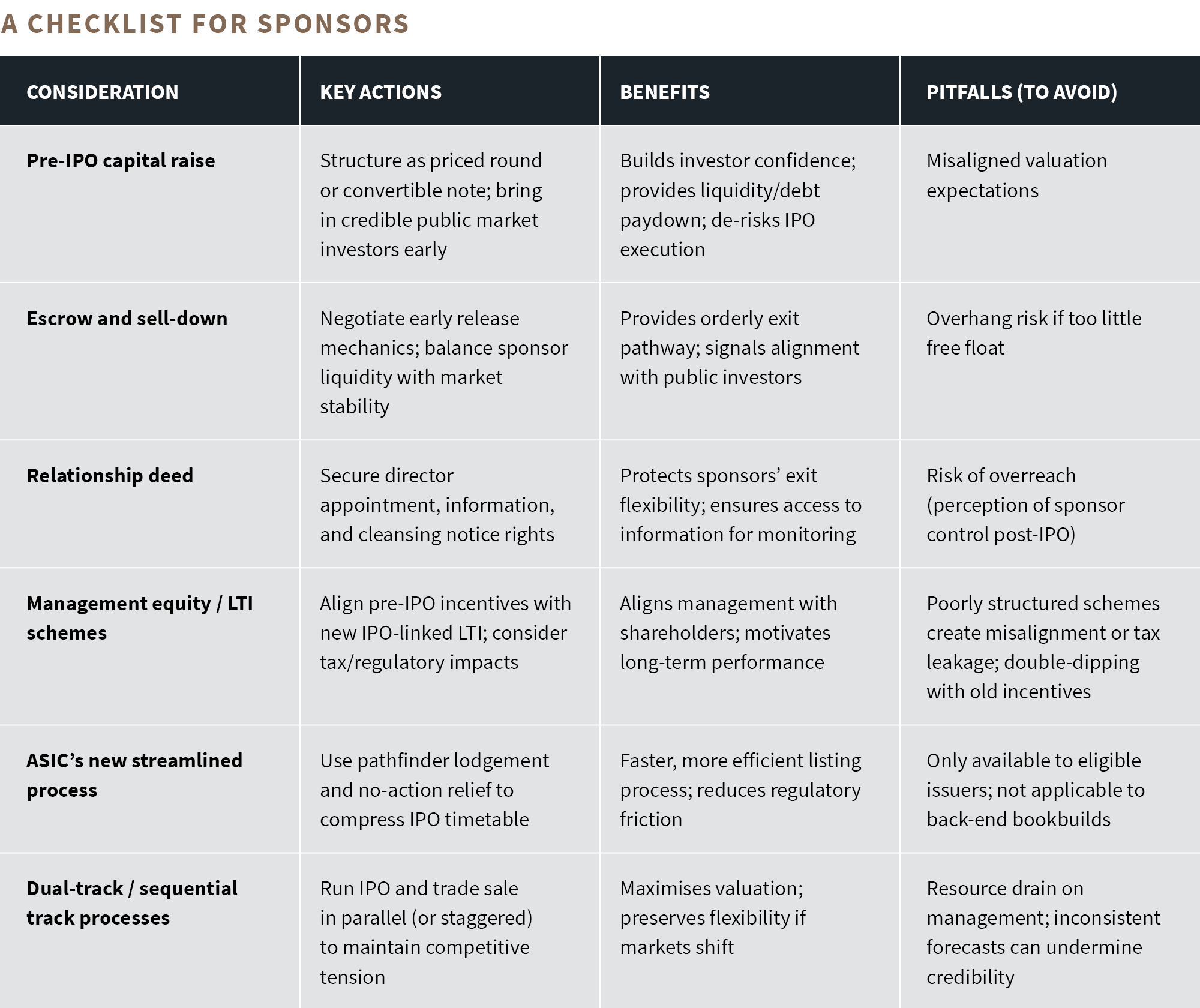
For sponsors who haven’t had cause to think about IPO exits for a while, here’s a practical checklist of some of the key areas to consider and manage.
Pre-IPO raisings – de-risking execution
Pre-IPO capital raises are becoming increasingly common and typically take the form of priced rounds (often preference shares) or convertible notes that convert at a discount to the IPO price. These raisings allow institutional investors to join the shareholder register well before the IPO bookbuild, giving them deeper insight into the business and greater confidence to participate in the IPO. They can also provide the company with liquidity to pay down debt or offer early returns to existing investors.
Escrow and sell-down - balancing liquidity and investor confidence
In Australian IPOs, sponsors are typically escrowed or ‘locked-up’ until the end of the prospectus forecast period, which is often a full financial year plus a ‘stub’ period.
In the last wave of IPO exits by sponsors, it was common to have an ‘early release’ of 25% of the sponsor’s shares midway through the escrow period, provided the trading price exceeded the IPO offer price by at least 20% for 10 consecutive trading days immediately prior to the release.
The IPO of Virgin Australia showed how escrow can work in practice. Sponsors were locked up until the end of the forecast period but allowed an early release of 25% of shares once the price exceeded the IPO offer by 20% for 10 consecutive days.
The result? Liquidity for the sponsor without shaking investor confidence - a model we expect to continue seeing in future sponsor-backed IPOs.
Escrow deeds restrict the shareholder from disposing of shares, creating a ‘relevant interest’ under Chapter 6 of the Corporations Act. ASIC provides class relief for escrow deeds that meet the following conditions:
- Escrowed securities are the same class as those offered under the IPO
- Voting rights on escrowed shares are not restricted
- The shareholder may accept a takeover offer if at least half of the non-escrowed bid class accepts
- Escrowed securities can be transferred under a scheme of arrangement
- If the deed is with the company, it terminates no later than two years after execution.
The ASX currently requires listed companies to have a minimum ‘free float’ of 20% - meaning at least 20% of shares must be freely tradable and not held by affiliated shareholders, such as sponsors.
On 21 August 2025, S&P announced it will reduce the minimum free float for index inclusion from 30% to 15%. This could lead the ASX to reduce the minimum free float requirement to 15%. While this would give helpful support for sponsors who may wish to sell-down less at IPO, it should also be weighed against the potential drawbacks of a larger overhang and reduced liquidity.

Relationship deeds – protecting sponsor interests
On an IPO, boards typically include an independent chair and a majority of independent directors. Sponsors, however, often put in place a ‘Relationship Deed’ with the portfolio company shortly before listing to provide additional contractual comfort for sponsors on a range of post-IPO matters.
A Relationship Deed typically contains:
- Director appointment rights: These rights typically reduce as the sponsor sells down. For example, one director can usually be appointed while holding up to 10% of shares, and two directors while holding more than 20%.
- Information rights: Allow sponsors’ board nominees to pass information back to the sponsor for investment monitoring and compliance.
- Rights that facilitate sell-down: Rights that enable sponsors to pick a favourable sell-down window while still complying with insider trading laws, including requiring the listed company to issue a ‘cleansing notice’ where inside information would otherwise block a sale by a sponsor.
Management equity – aligning interests
As part of an IPO, companies typically implement a new long-term incentive (LTI) scheme. These schemes often include time and performance-based vesting conditions designed to align management’s interests with those of public shareholders, compared to pre-IPO incentive schemes for management, which are generally linked to the cash returns of the sponsor.
Given potentially larger post-IPO shareholdings for sponsors in the future, careful planning of the interaction (if any) between the pre-IPO incentive plans and the post-IPO LTI is essential. This includes considering disclosure, tax and regulatory implications and ensuring the new IPO LTI works seamlessly alongside any pre-IPO incentive arrangements that may continue to apply. The goal is to achieve the desired commercial outcomes for both management and shareholders while supporting a successful IPO and ongoing value creation for all shareholders.
New streamlined IPO process – faster access to the market
In June 2025, ASIC unveiled a two-year trial aimed at simplifying the pathway to listing, reducing the regulatory burden and accelerating IPO timelines. There are two key changes:
- Pathfinder prospectus: Eligible entities can submit a confidential pathfinder prospectus to ASIC at least 14 days before formal lodgement. This can remove the need to extend the exposure period from 7 to 14 days, potentially reducing the IPO timetable by up to a week. Eligibility requires a market capitalisation of at least A$100 million at listing and no ASX-imposed escrow.
- No-action position during exposure period: Eligible companies can accept investor applications during the exposure period for new listings, potentially shortening IPO timeframes even further.
This streamlined approach is available only for ‘front-end bookbuilds’, where the IPO price is set before the prospectus is lodged - a structure commonly used in Australia. It is worth noting that historically some of the larger Australian IPOs, with significant US offering components, have used back-end bookbuilds (where pricing is set after the prospectus is lodged) to align with US IPO pricing practice. It will be interesting to see whether IPO candidates looking to raise larger sums (including by accessing investors in the US market) will favour accessing the ASIC’s streamlined listing path over any back-end bookbuild process, which may be favoured by IPO managers and/or US investors.
Dual-track or sequential track processes – maximising exit flexibility
Even if a trade sale is the preferred option for exit, running a dual-track process – where an IPO and a sale process run concurrently – can be highly beneficial. A ‘sequential-track’ process is a variant where both options are explored, but not pushed simultaneously to completion.
Advantages:
- Maximises valuation: Exploring both avenues can create competitive pricing tension between buyers and public investors.
- Provides flexibility: Sponsors have more than one exit avenue available to them allowing them (in theory) to pivot based on market conditions and/or investor interest.
Challenges:
- Resource-intensive: Managing two exit processes (at the same time or sequentially) demands extra time, effort, advisory and financial resources relative to a single process. The demands are particularly acute for the relevant portfolio company and its management team where it may be necessary to recruit additional specialist internal resources to help manage the additional intensity and informational demands.
- Forecast asymmetry: Trade sale forecasts can (and often will) stretch out to cover up to five years of forecast performance albeit heavily caveated and entirely at the risk of the buyer. Contrast IPO forecasts where the forecast period in the prospectus will typically not stretch beyond a full financial year plus a stub period. Reconciling these differing approaches needs to be considered carefully by sponsors who embark down a dual-track or sequential-track process.
- Stakeholder pressure: Divergent opinions and interests between sponsors and their management teams as to which exit pathway is best to follow can create tensions. Balancing these interests and opinions while maintaining a clear strategic vision is crucial for a successful sale process.
Seizing the IPO window
Finally, an IPO window can open and shut abruptly, particularly in the current ‘eventful’ climate. Sponsors and their portfolio companies who can move quickly and efficiently when a window opens will be the ones most likely to succeed in such times.
To successfully exit through an IPO, it is important to have a well-developed forecast model, a well-populated and extensive data room, and a clear understanding of any key legal or commercial issues. Equally essential is the appointment of advisers who understand the underlying business and its drivers, along with well-defined strategies for investor engagement, IPO escrow, sell-down and management equity.