While debate may continue for some time in relation to net zero, the Australian government has invested in various policy and regulatory frameworks designed to support its targets. For the agriculture and land sector, a plan has recently been released to support the identification of decarbonisation opportunities and a path towards net zero. In addition, legal frameworks to support investment into carbon farming and biodiversity projects continue to evolve.
In this alert, we explain the drivers to decarbonise under the net zero framework. We also identify the opportunities and risks faced by organisations and persons in the agriculture and land sector considering implementing or investing in projects under the carbon and nature repair markets. These opportunities were strengthened by recent reforms to Federal environmental legislation.
Net Zero Plan and Agri Plan
The Australian Federal Government recently published key documents under its net zero framework for reducing greenhouse gas emissions, namely the:
- Net Zero Plan, which contains a pledge to reduce emissions by 62–70% on 2005 levels by 2035, and reaffirms the target of reaching ‘net zero’ emissions by 2050 (which means achieving balance between the emissions produced and taken out of the atmosphere); and
- six sector-specific emissions reduction plans (Sector Plans), which support the Net Zero Plan by identifying opportunities for Australia’s six key sectors to decarbonise.
The Net Zero Plan sets out how Australia can achieve its ambitious net zero target by focusing on 5 decarbonisation priorities:
- Clean electricity across the economy;
- Lowering emissions by electrification and efficiency;
- Expanding clean fuel use;
- Accelerating new technologies; and
- Net carbon removals scaled up.
The Sector Plans provide tailored guidance on decarbonisation pathways for each of Australia’s six key sectors, namely: electricity and energy; agriculture and land; the built environment; industry; resources; and transport.
In 2023-24, approximately 19.6% of Australia’s net emissions were attributable to the agriculture and land sector.[1]
The Agriculture and Land Sector Plan (Agri Plan), one of the Sector Plans, provides a tailored pathway for the agriculture and land sector to reduce emissions and contribute towards achieving net zero. It identifies three ‘strategic objectives’ supported by four ‘foundational areas of action’ to reduce sectoral emissions, shown below:
Department of Agriculture, Fisheries and Forestry (DAFF), Agriculture and Land Sector Plan. https://www.agriculture.gov.au/sites/default/files/documents/agriculture-and-land-sector-plan.pdf

The agriculture and land sector is uniquely placed to contribute towards decarbonisation targets by delivering carbon sequestration projects. ‘Enhancing land’s role in a net zero economy’ is identified as a foundational area of action under the Agri Plan, and the Net Zero Plan notes that land-based abatement (particularly reforestation) is the most cost-effective carbon removal option to help achieve net zero emissions by 2050. The Agri Plan encourages landowners and businesses to participate in Federal carbon and nature repair schemes, to leverage their assets and expertise, and to take advantage of commercial incentives.
Leveraging commercial incentives under carbon and nature repair schemes
The Government has developed schemes that provide commercial incentives to undertake projects that reduce emissions (abatement projects) or remove and store carbon already existing in the atmosphere (sequestration projects), which are administered by the Clean Energy Regulator (CER).
These schemes include:
- the Australian Carbon Credit Unit Scheme (ACCU Scheme) as implemented in 2011; and
- the Nature Repair Market Scheme (NRM Scheme) as launched in December 2024.
ACCU Scheme
The ACCU Scheme incentivises businesses and landowners to undertake carbon abatement and sequestration projects. It is regulated under the Carbon Credits (Carbon Farming Initiative) Act 2011 (Cth) (CFI Act) and Carbon Credits (Carbon Farming Initiative) Rule 2015 (Cth) (CFI Rule). We have previously explored how landowners can take advantage of carbon abatement opportunities.
ACCU Scheme projects can be registered under various methodology determinations, including agricultural methods where carbon is stored in soil, and vegetation methods where trees are planted that will sequester carbon as they grow.
Registered ACCU Scheme projects generate one ACCU for each tonne of carbon dioxide equivalent sequestered or abated. The project proponent can then trade the ACCUs generated on the open market or relinquish them to the CER to satisfy their excess emissions liability under the Safeguard Mechanism.
NRM Scheme
The NRM Scheme, which commenced on 1 March 2025, operates alongside the ACCU Scheme. It incentivises businesses and landholders, particularly in the agriculture and land sector, to undertake projects that restore or protect Australia’s natural environment (e.g. land and waterways) and that deliver improved biodiversity outcomes. The NRM Scheme is regulated under the Nature Repair Act 2023 (Cth) (Nature Act) and the Nature Repair Rules 2024 (Cth) (Nature Rules).
Like ACCU Scheme projects, NRM Scheme projects must comply with a registered method. However, the key point of difference is that NRM Scheme projects must have a target ‘biodiversity outcome’ set out in a project plan approved by the CER. If the project is successfully implemented, and achieves the target ‘biodiversity outcome’, the proponent is issued one biodiversity certificate which it can trade or hold.
The commercial value and utility of a biodiversity certificate is evolving. Originally, the Nature Act expressly prohibited biodiversity certificates from being used for an environmental offsetting purpose. However, reforms to the Nature Act were passed under the Environment Protection Reform Bill 2025 (Cth) (Reforms) and received royal asset on 1 December 2025, which will remove this prohibition when they come into effect (either on or before 1 December 2026). As a result, a NRM Scheme method may specify whether a biodiversity certificate can be used as an environmental offset, provided that the certificate meets requirements set out under the Nature Rules or the relevant method. The Reforms could increase the commercial value and utility of biodiversity certificates, because they may be used in support of project approvals or development consents.
Current NRM Scheme methods
On 27 February 2025, the first approved NRM Scheme method commenced, namely the Nature Repair (Replanting Native Forest and Woodland Ecosystems) Methodology Determination 2025 (Cth) (Replanting Method). The Replanting Method applies to projects where native forest and woodland ecosystems are replanted on historically cleared land in modified landscapes in a way that improves the extent and condition of native vegetation or supports ecological connectivity. The Replanting Method does not allow for environmental offset-capable projects.
On 12 August 2025, the first NRM Scheme project was registered under the Replanting Method, namely the Silva Capital Cooplacurripa Biodiversity Project No.1 (Cooplacurripa Project) located in New South Wales. This project involves the replanting of native forest on previously cleared land. Interestingly, the Cooplacurripa Project under the NRM Scheme fully overlaps, or ‘stacks’, with a registered ACCU Scheme reforestation project run by the same proponent. This means that the same reforestation project activities are registered under both Schemes. We explain ‘stacking’ later in this Alert. More information on the Cooplacurripa Project can be found on the CER’s website.
New NRM Scheme methods under development and policy changes under consultation
The Federal Department of Climate Change, Energy, the Environment and Water (DCCEEW) is currently exploring two proposed new methods under the NRM Scheme, namely:
- the enhancing native vegetation method - designed to build on the Replanting Method, to support projects that enhance biodiversity in areas with existing native vegetation; and
- the protect and conserve method – designed for projects that establish new or increase the size of existing protected and conserved areas and improve biodiversity outcomes by enhancing management activities.
Public consultation on the proposed new methods closed in late 2025, and Nature Repair Committee consultation is expected to occur in 2026.
DCCEEW is also exploring the feasibility of additional methods, including:
- coastal wetland restoration and rehabilitation;
- desert rangelands habitat management and protection;
- feral ungulate management and reduction in Northern Australia’s coastal wetlands and floodplains;
- native forests protection and management;
- northern savanna fire management for biodiversity enhancement and protection; and
- pastoral rangelands native vegetation enhancement.
On 20 April 2026, DCCEEW released three issues papers outlining proposed changes to NRM policy settings to enable the supply of environmental offsets and give effect to the Reforms, which include:
- developing the enhancing native vegetation method to become the first offsets-capable project method; and
- changing the Nature Rules to include:
- a process to define a 'significant reversal event' for a NRM Scheme project where, if established, the CER may direct the proponent to relinquish a biodiversity certificate previously issued for the project or an equivalent certificate; and
- certificate equivalency requirements so that, where a proponent is directed to relinquish a biodiversity certificate for a ‘significant reversal event’, there are guidelines to ensure that the certificate relinquished is equivalent to the certificate originally issued for the project.
The issues papers are open for consultation until 4 May 2026.
Key opportunities
The agriculture and land sector is uniquely placed to leverage commercial incentives under the ACCU Scheme and NRM Scheme by developing projects that can be registered under one or both Schemes. As demonstrated by the Cooplacurripa Project, the Schemes were designed to be ‘stacked’, meaning that one reforestation project can be dual registered and generate benefits under both Schemes, namely ACCUs for carbon sequestered by planted trees and a biodiversity certificate under the NRM Scheme for achieving the target ‘biodiversity outcome’. Importantly, a NRM Scheme project may either be used as an environmental offset under the Environment Protection and Biodiversity Conservation Act 1999 (Cth) or be stacked with an ACCU Scheme project if the method permits it, but not both. This is because of the ‘additionality’ requirement under the ACCU Scheme’s project eligibility criteria.
‘Stacking’ creates an opportunity for landowners to utilise less productive agricultural land for dual registered reforestation projects, which provides ancillary benefits to ongoing agricultural operations. Subject to the methodology requirements, once trees planted under ‘stacked’ projects are sufficiently mature, the land could be used for agricultural grazing while the trees continue to grow and sequester carbon and generate ACCUs and, if the target ‘biodiversity outcome’ is achieved, could result in a biodiversity certificate being issued.
Benefits of adopting the dual approach are set out below:

Scheme eligibility requirements
Landholders or businesses interested in developing ‘stacked’ projects must be careful to ensure that a project will satisfy all eligibility requirements under both Schemes.
To participate in the NRM Scheme, the proponent must:
- be a fit and proper person;
- hold the required land rights and consents to carry out the project activities on the land, including obtaining consent from all persons who hold an eligible interest in the land; and
- obtain all regulatory approvals required for the project before applying for registration.
For the project to be eligible to for registration under the NRM Scheme, it must:
- comply with an approved method;
- not be an excluded project under the Nature Rules; and
- not be required by law.
The lists above are not exhaustive, so proponents must carefully consider all eligibility requirements before commencing any project activities.
Key risks
It is essential that landowners, businesses, and investors understand the unique legal risks associated with NRM Scheme and ACCU Scheme projects before commencing or investing in a project.
ACCU Scheme projects involve unique risk because:
- the fact that a project is registered by the CER does not ‘certify’ that all eligibility requirements are met, and the CER may revoke a project’s registration at any stage (even after the project has commenced) if the project or proponent fails to satisfy eligibility requirements; and
- reforestation ACCU Scheme projects are subject to a ‘permanence period’ of either 25 years or 100 years during which the carbon sequestered by the trees must be maintained. If carbon stored in ACCU project trees is released back into the atmosphere through a ‘reversal event’ (e.g. bushfire) within the ‘permanence period’, the CER may direct the proponent to relinquish ACCUs previously issued or impose a ‘carbon maintenance obligation’ requiring the proponent to maintain carbon stores at certain levels.
NRM Scheme projects also involve risk because the CER may revoke a project if it considers that the project is unlikely to achieve the target ‘biodiversity outcome’.
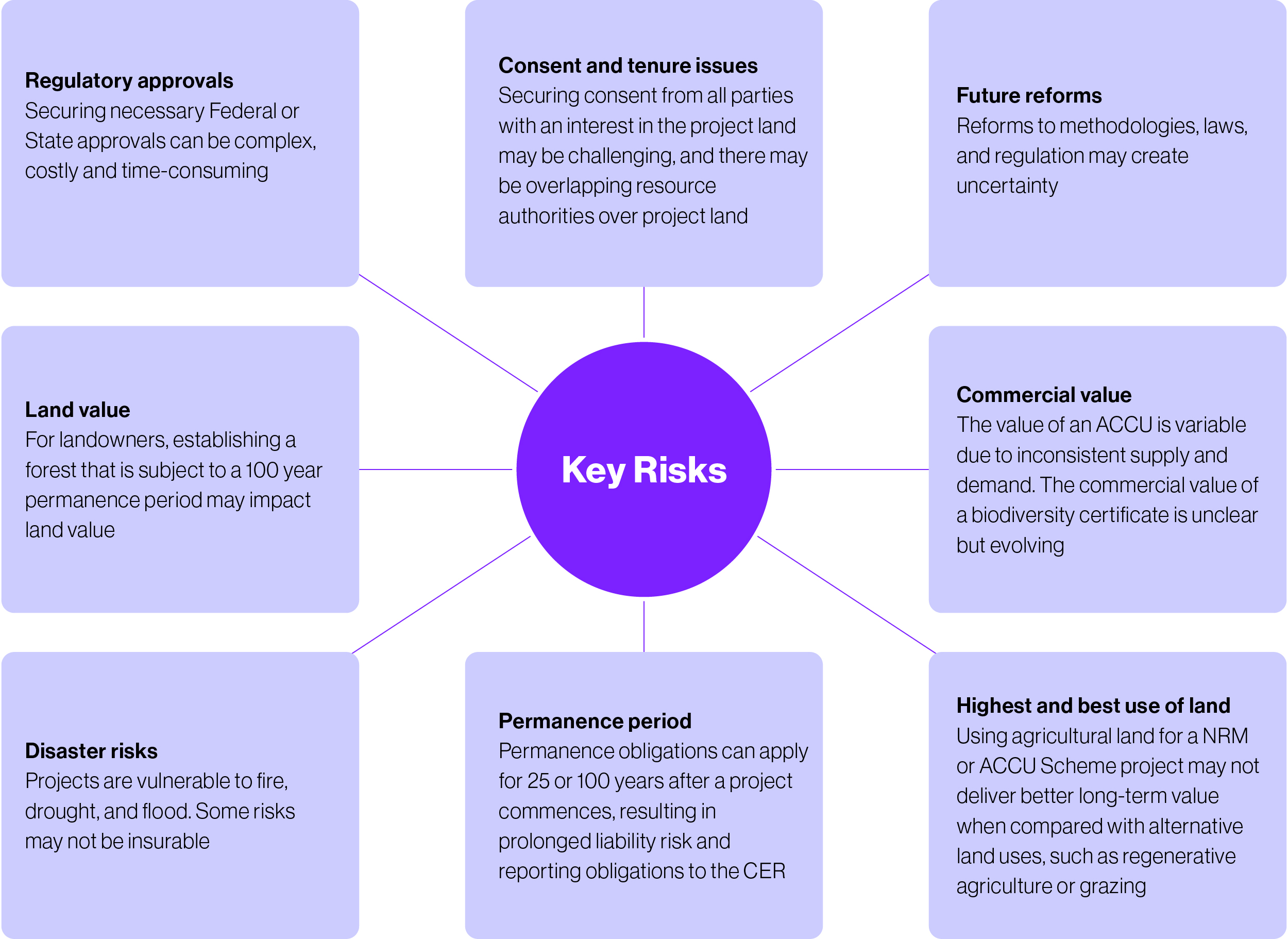
We identify below additional key risks for proponents to evaluate when considering implementing an ACCU or NRM Scheme project:
What happens next?
The CER’s registration of the first NRM Scheme project and the release of the Net Zero Plan and Sector Plans are important steps in Australia’s progress towards achieving net zero.
We encourage landholders who may be interested in leveraging carbon and nature repair opportunities to monitor the progress of the proposed new NRM Scheme methods and identify projects suited to their land, including ‘stacked’ projects.
Please get in touch if you would like further advice about the ACCU Scheme, NRM Scheme, or the associated opportunities and risks.