When does this question tend to arise?
It is typical to include service credits as a remedy for service level failures, particularly in IT outsourcing or business process outsourcing arrangements where services will be provided over an extended period and the customer wants to have a way to measure and incentivise performance.
In formulating service levels and determining how service credits will be applied, parties should consider the interplay with other remedies and the broader liability framework in the contract. In particular, the question of whether other remedies should be available for service level failures, in addition to service credits, is often a hotly debated point of negotiation between the customer and the supplier.
What does the law say?
If a contract does not state that payment of service credits is the ‘sole and exclusive remedy’ for a failure of the supplier to meet service levels in performing the services, then other remedies available under the contract and at law remain available to the customer. This could include a right to terminate the contract (either under a contractual termination framework or at common law if the failure is sufficiently material) or to make a claim for damages if the failure to meet the relevant service level is a breach of the relevant contract.
If the contract does provide that service credits are intended to be the ‘sole and exclusive remedy’ then other remedies may be shut off for the customer. It is important in this case to bear in mind that the clause will, in effect, operate as a limitation of liability and will be subject to usual caveats around liability clauses. In particular, the clause may be narrowly construed against the party seeking to rely upon it (in this case, the supplier) and it may also raise issues from an Unfair Contract Terms perspective, and applicable consumer protection legislation, if the effect is to unfairly deny the customer a meaningful remedy and there is no legitimate business justification for doing so.
On the other hand, nominating an unreasonably high service credit amount can raise difficulties of its own, as whether such a credit is enforceable will depend on whether the clause could amount to a penalty (i.e. where the nominated credit clearly exceeds any loss that could be reasonably expected to flow from a relevant service failure). See our separate IT Bytes article here for further details on the law of penalties.
What are the practical implications for your contract?
In drafting service credit clauses, you will need to consider how payment of service credits should be treated against other remedies which might be available to the customer for the underlying failure to meet service levels. Your approach will likely vary depending on whether you are the customer or the supplier.
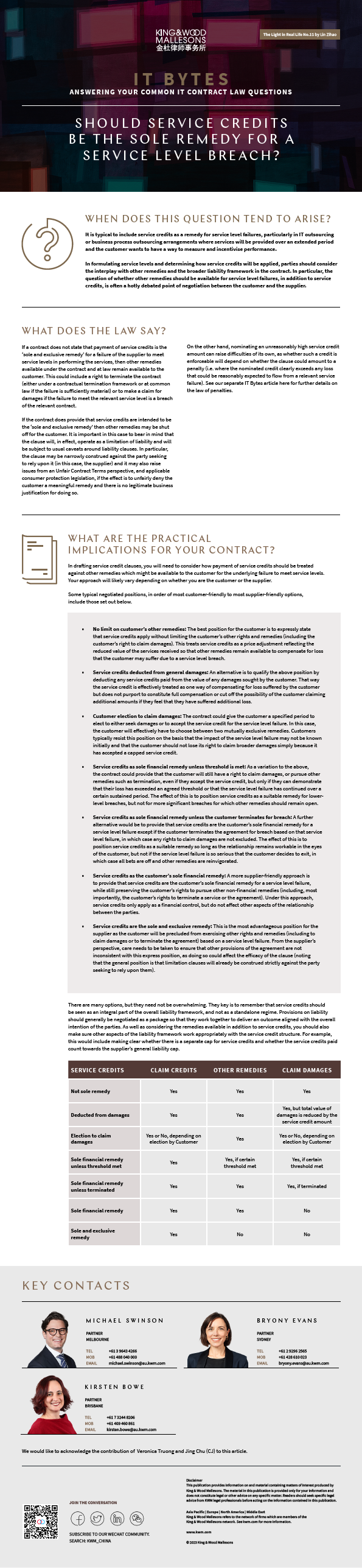
Some typical negotiated positions, in order of most customer-friendly to most supplier-friendly options, include those set out below.
- No limit on customer’s other remedies: The best position for the customer is to expressly state that service credits apply without limiting the customer’s other rights and remedies (including the customer’s right to claim damages). This treats service credits as a price adjustment reflecting the reduced value of the services received so that other remedies remain available to compensate for loss that the customer may suffer due to a service level breach.
- Service credits deducted from general damages: An alternative is to qualify the above position by deducting any service credits paid from the value of any damages sought by the customer. That way the service credit is effectively treated as one way of compensating for loss suffered by the customer but does not purport to constitute full compensation or cut off the possibility of the customer claiming additional amounts if they feel that they have suffered additional loss.
- Customer election to claim damages: The contract could give the customer a specified period to elect to either seek damages or to accept the service credit for the service level failure. In this case, the customer will effectively have to choose between two mutually exclusive remedies. Customers typically resist this position on the basis that the impact of the service level failure may not be known initially and that the customer should not lose its right to claim broader damages simply because it has accepted a capped service credit.
- Service credits as sole financial remedy unless threshold is met: As a variation to the above, the contract could provide that the customer will still have a right to claim damages, or pursue other remedies such as termination, even if they accept the service credit, but only if they can demonstrate that their loss has exceeded an agreed threshold or that the service level failure has continued over a certain sustained period. The effect of this is to position service credits as a suitable remedy for lower- level breaches, but not for more significant breaches for which other remedies should remain open.
- Service credits as sole financial remedy unless the customer terminates for breach: A further alternative would be to provide that service credits are the customer’s sole financial remedy for a service level failure except if the customer terminates the agreement for breach based on that service level failure, in which case any rights to claim damages are not excluded. The effect of this is to position service credits as a suitable remedy so long as the relationship remains workable in the eyes of the customer, but not if the service level failure is so serious that the customer decides to exit, in which case all bets are off and other remedies are reinvigorated.
- Service credits as the customer’s sole financial remedy: A more supplier-friendly approach is to provide that service credits are the customer’s sole financial remedy for a service level failure, while still preserving the customer’s rights to pursue other non-financial remedies (including, most importantly, the customer’s rights to terminate a service or the agreement). Under this approach, service credits only apply as a financial control, but do not affect other aspects of the relationship between the parties.
- Service credits are the sole and exclusive remedy: This is the most advantageous position for the supplier as the customer will be precluded from exercising other rights and remedies (including to claim damages or to terminate the agreement) based on a service level failure. From the supplier’s perspective, care needs to be taken to ensure that other provisions of the agreement are not inconsistent with this express position, as doing so could affect the efficacy of the clause (noting that the general position is that limitation clauses will already be construed strictly against the partyseeking to rely upon them).
There are many options, but they need not be overwhelming. They key is to remember that service credits should be seen as an integral part of the overall liability framework, and not as a standalone regime. Provisions on liability should generally be negotiated as a package so that they work together to deliver an outcome aligned with the overall intention of the parties. As well as considering the remedies available in addition to service credits, you should also make sure other aspects of the liability framework work appropriately with the service credit structure. For example, this would include making clear whether there is a separate cap for service credits and whether the service credits paid count towards the supplier’s general liability cap.
|
CLAIM CREDITS
|
OTHER REMEDIES
|
CLAIM DAMAGES
|
|
|
Not sole remedy
|
Yes |
Yes |
Yes |
|
Deducted from damages
|
Yes |
Yes |
Yes, but total value of damages is reduced by the service credit amount |
|
Election to claim damages
|
Yes or No, depending on election by Customer |
Yes |
Yes or No, depending on election by Customer |
|
Sole financial remedy unless threshold met
|
Yes |
Yes, if certain threshold met |
Yes, if certain threshold met |
|
Sole financial remedy unless terminated
|
Yes |
Yes |
Yes, if terminated |
|
Sole financial remedy
|
Yes |
Yes |
No |
|
Sole and exclusive remedy
|
Yes |
No |
No |
Download
4.44MB, 1 Pages
More It Bytes
Joint Ownership of IP – A Solution or Complication?
Questions of joint ownership often surface in collaborative endeavours such as joint ventures, research and development projects, and co-creation initiatives between businesses or research institutions.
13 March 2026
When is a duty to act in good faith implied in a contract?
You are negotiating a long-term supply agreement with a key business partner. The contract gives your counterparty broad discretion to set delivery schedules and approve variations but is otherwise silent on how this discretion should be exercised.
05 March 2026
What is the difference between ‘shall’, ‘will’ and ‘must’?
While the words ‘shall’, ‘will’ and ‘must’ are often used interchangeably in contracts, these terms all carry specific meanings.
20 February 2026