Five years after Australia’s national environmental laws were found to be fundamentally broken, and following an unsuccessful attempt to fix those laws in its first term, the Albanese Government is now ramping up its environmental reform agenda in its second term to accelerate Australia’s energy transition and boost productivity. With assessment and approval timeframes for essential renewable energy, critical minerals and housing projects at an all-time high, and project costs consequently ballooning for proponents, the need for urgent, meaningful reform is undeniable.
Following the Government’s recent announcement to bring forward its mid-2026 environmental reform deadline to late-2025, in this first part of our two-part series we explore the need for reform and what we can expect to see in the coming months.
Background
The Environment Protection and Biodiversity Conservation Act 1999 (Cth) (EPBC Act) is Australia’s primary piece of Federal environmental legislation. Among other things, it contains a referral and approval framework for any projects or activities (regardless of the sector) that may significantly impact matters of national environmental significance, which sits on top of any State or Territory based approval frameworks for the project or activity.
Since its commencement in 2000, the EPBC Act has undergone 2 independent reviews:
- the ‘Hawke Review’ in 2008-2009; and
- the ‘Samuel Review’ in 2019-2020, which highlighted widespread flaws and inefficiencies in the EPBC Act which have resulted in significant environmental decline and challenges for industry, calling the EPBC Act ‘outdated’ and in need of ‘fundamental reform’.
EPBC Act – Current challenges
There are many issues with the current EPBC Act, which proponents across a range of sectors have experienced firsthand. These include (but are not limited to) the following.
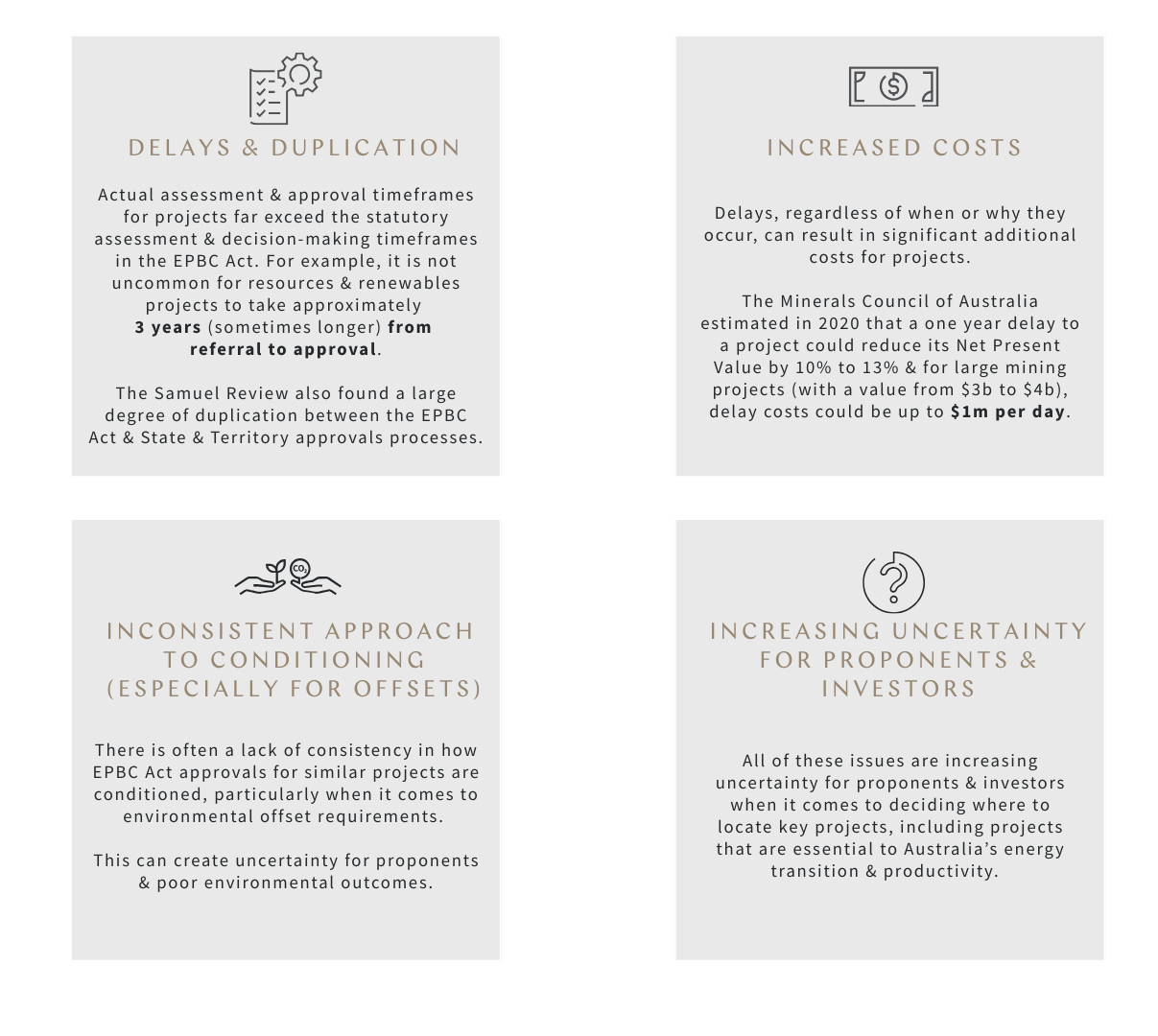
Click to expand

In circumstances where the Albanese Government:
- is targeting 82% of grid electricity coming from renewable energy by 2030;
- has a current legislated emissions reduction target of 43% compared to 2005 levels by 2030 and net zero by 2050 (and announced plans on 18 September 2025 to bolster this emissions reduction target to 62% to 70% below 2005 levels by 2035);
- is currently reviewing the National Electricity Market to consider wholesale market settings to promote investment in firmed, renewable generation and storage capacity; and
- has an ambitious $43 billion housing agenda,
it is critical that the hurdles currently presented by the EPBC Act can be overcome to ensure that Australia’s productivity and energy transition – and the projects critical to facilitating this – can be assessed in a streamlined manner to allow for faster decisions, which will assist with promoting investment certainty and progress towards achieving targets.
‘Passing these [EPBC Act] reforms are vital to us achieving a number of other national priorities that we have both as a government and as a country. We need to pass these laws to be able to deliver the homes that Australians need, to become the renewable energy superpower that we know Australia can become, to deliver our Future Made in Australia agenda, to meet the productivity challenge that we have as a country to achieve the aspirations of First Nations people in our country, to achieve the energy security that our country needs, and most importantly, to deliver the environmental protection that Australia's spectacular, unique natural environment deserves.’
Minister Watt, 19 June 2025
Will the second time be the charm when it comes to EPBC Act reform?
The Albanese Government unsuccessfully attempted to overhaul the EPBC Act in its first term, with the key aspects of that attempt set out below (and further detail provided in the hyperlinks to our previous alerts).
|
December 2022
|
Government releases Nature Positive Plan (its blueprint for EPBC Act reform) |
|
|
|
January – November 2023
|
|
|
|
|
December 2023
|
|
|
|
|
April 2024
|
Government splits its reform agenda into 3 stages (with Stage 1 having passed in December 2023) |
|
|
|
May 2024
|
Government introduces legislation for Stage 2 reforms (with Stage 3 reforms deferred until after May 2025 election) |
|
|
|
October 2024
|
|
|
|
|
February 2025
|
|
|
|
|
March 2025
|
|
|
Following the Albanese Government’s recent re-election and the appointment of a new environment Minister, ‘take two’ of EPBC Act reform is now underway, this time heavily underpinned by a focus on accelerating the energy transition and boosting productivity as set out below.
|
May 2025
|
|
|
|
|
June 2025
|
Minister holds meeting with industry stakeholders and confirms 3 pillars to EPBC Act reforms: stronger environmental protections, faster and more efficient approval processes, and more transparency and integrity around environmental decision making Target of mid-2026 to introduce EPBC Act reform legislation |
|
|
|
August 2025
|
|
|
|
|
September 2025
|
|
|
|
What’s on the ‘take two’ reform agenda?
While no draft reform legislation or policy has been released yet, we have identified below the types of reforms that are expected based on announcements made by the Minister.
While many of these reforms reflect those pursued by the Government in its last term, it is unclear at this stage how similar or different these reforms will be in ‘take two’ as opposed to ‘take one’. However, the Minister has indicated that ‘an enormous amount of work’ has been done to date and ‘it makes sense to draw on the work that has been done’, subject to further engagement with stakeholders and the community.
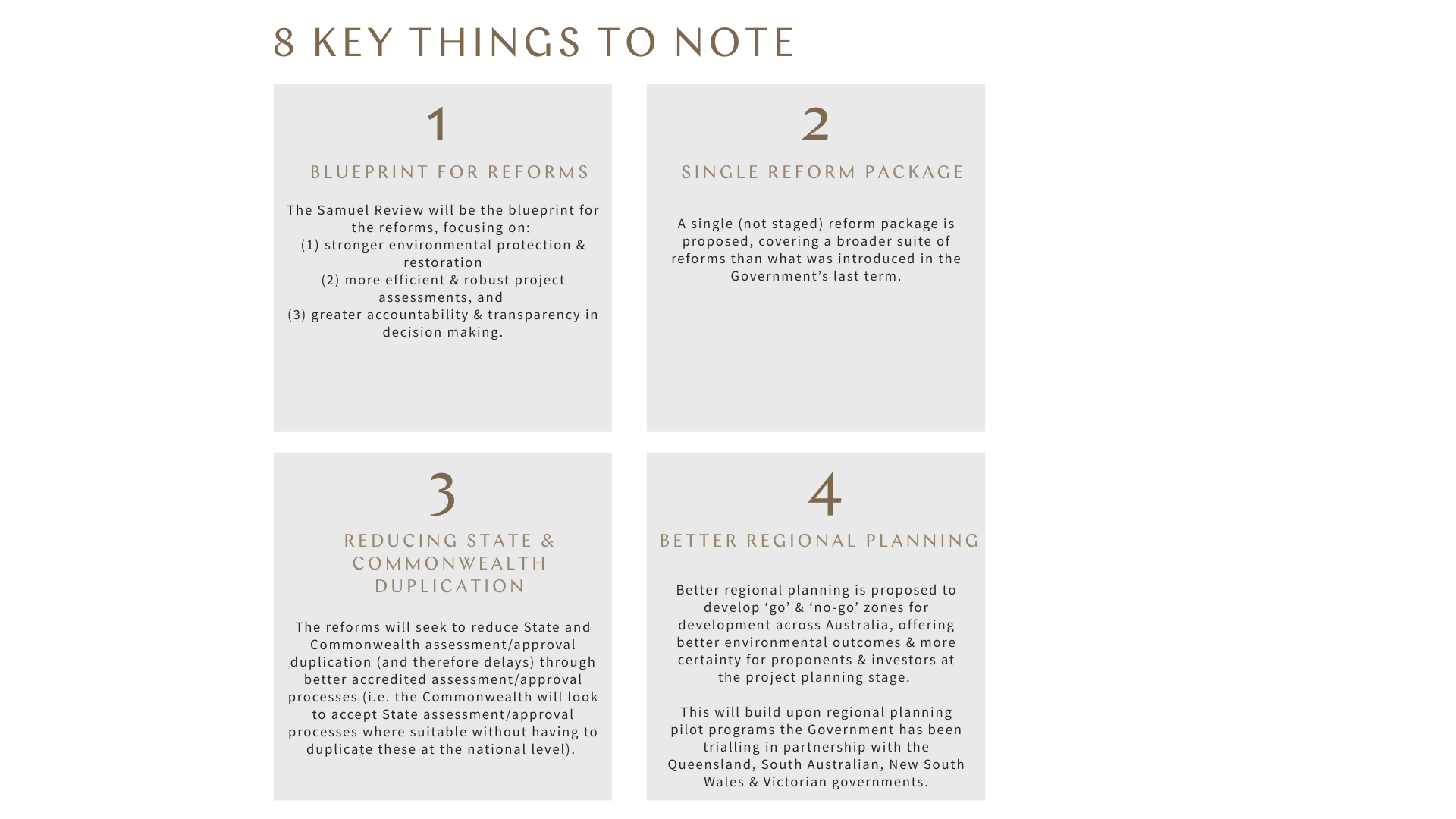
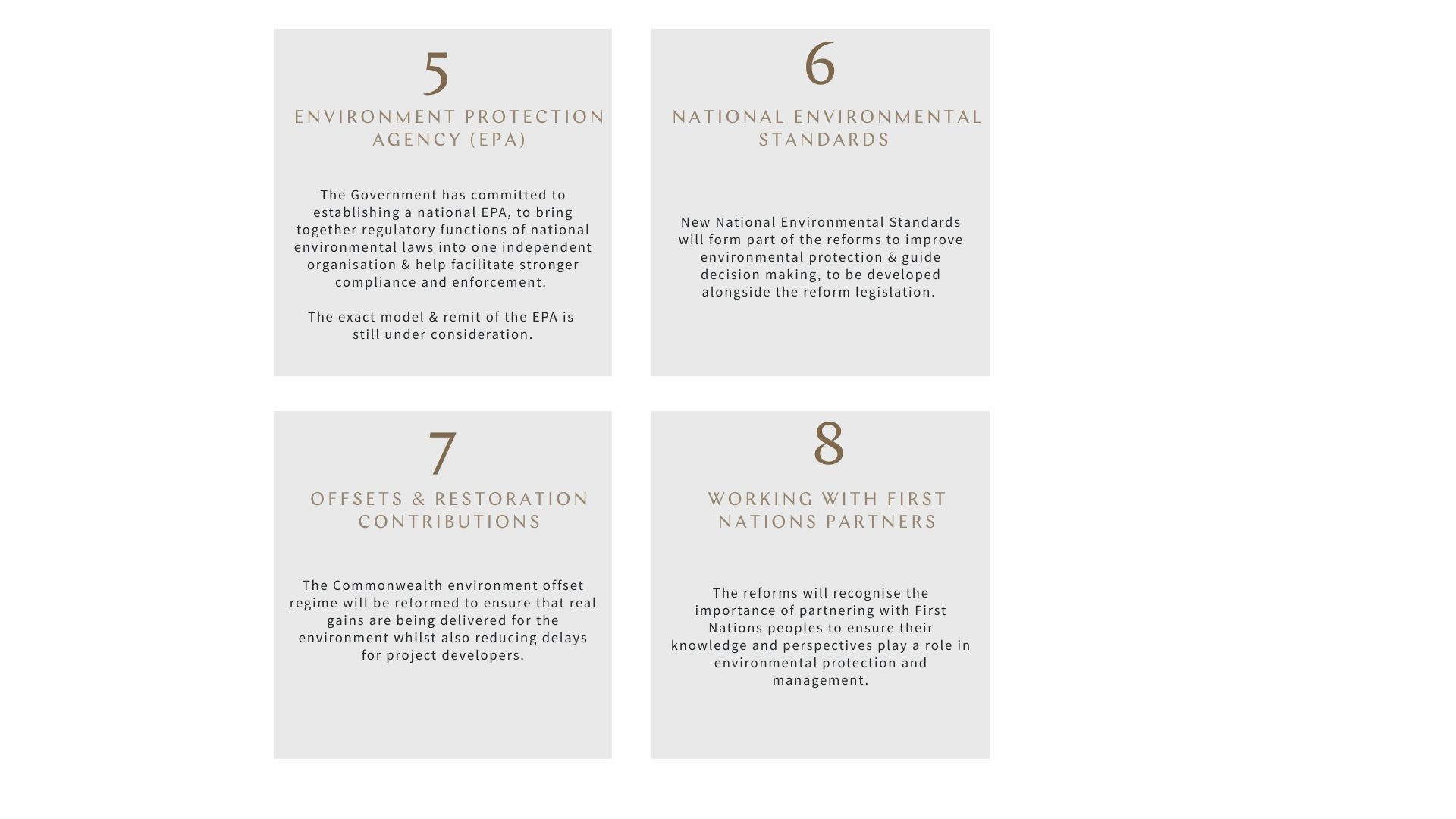
Click to expand
In terms of what is not on the ‘take two’ reform agenda:
- a new ‘climate trigger’ (which would require projects which may significantly impact the climate to engage with the EPBC Act referral and approval framework) appears unlikely – the Minister has pointed to the Samuel Review (which did not recommend a climate trigger) and said that, rather than a climate trigger, the Government is leaning towards a requirement that proponents disclose their emissions and provide an abatement plan;
- the ‘nature positive’ focus of the ‘take one’ reforms does not currently appear to form part of the ‘take two’ reforms - it remains to be seen whether the concept of ‘nature positivity’ will feature in the reforms as things progress and the Government puts pen to paper; and
- retrospective application of the EPBC Act reforms appears unlikely, with the Minister stating he ‘would see these laws acting prospectively, as occurs with 99% of the laws passed by this Parliament’.
Other key commitments made by the Government include fast-tracking the assessment of more than 26,000 homes currently tied up in the EPBC Act process and speeding up the assessment of new EPBC Act referrals for homes. Measures to achieve this include establishing a new ‘strike team’ within the Department of Climate Change, Energy, the Environment and Water (which assesses and approves EPBC Act referrals) to progress those applications and piloting artificial intelligence to simplify and speed‑up assessments and approvals.
Additional reforms to the EPBC Act to expedite approvals and better protect the environment have also been proposed by the Productivity Commission in its August 2025 Interim Report on its inquiry into ‘Investing in cheaper, cleaner energy and the net zero transformation’ (as summarised in the timeline above) and we expect EPBC Act reform recommendations will feature in the Productivity Commission’s Final Report due December 2025.
Timing and next steps
As noted above, following the Economic Reform Roundtable in August 2025, the Albanese Government committed to bring forward the introduction of EPBC Act reform legislation from mid-2026 to late-2025. With Parliament’s last sitting dates for this year being 27 November 2025 for the House of Representatives and 4 December 2025 for the Senate, we expect we will see the reform legislation introduced by 27 November 2025 at the latest.
While it is unclear what degree of public and industry consultation will occur before and after the reform legislation is introduced later this year, the Minister has reported holding over 40 meetings, roundtables and forums with environment, resources, energy, property and other business groups between June and August 2025, and has expressed an intention to continue consultation as the reform legislation is developed in the next 2 months.
In the second part of this two-part alert series, we will delve further into the anticipated reforms outlined above and what they may mean for industry going forward. We recommend that industry monitor the development of the reform legislation and participate in any available consultation opportunities as they arise.