The science is clear: Nature and climate change are inextricably linked. Like hands on a clock, incremental changes add up – and the clock has been ticking while the world has focused on limiting global warming to less than 1.5 degrees Celsius.
However, unlike time which marches only forward, the science also shows that by addressing changes in one that amplify the other, it is possible to turn back the spiral of climate change and natural decline.
Growing awareness of this possibility is seeing nature risk – and the Nature Positive movement - emerge as the next big thing in environmental thinking.
With its growing momentum comes a new question: How can we reverse the decline of nature and protect and enhance biodiversity going forward?
“These issues are interlinked. Without protecting and restoring our ecosystems, we have no chance of achieving the Paris goals, getting to the 1.5°C target or buffering the impacts of an already disrupted climate”.
– Mirey Atallah, Head of United Nations Environment Program (UNEP)
The global push for ‘nature positive’
Need to know concepts:
- “Climate” - climate change-related transition and physical risks and opportunities, tends to relate primarily to carbon emissions.
- “Nature” - a much broader concept that consists of four realms: land, ocean, freshwater and atmosphere.
- “Biodiversity” - the variety of all life forms on earth - the different plants, animals and micro-organisms and the ecosystems of which they are a part.
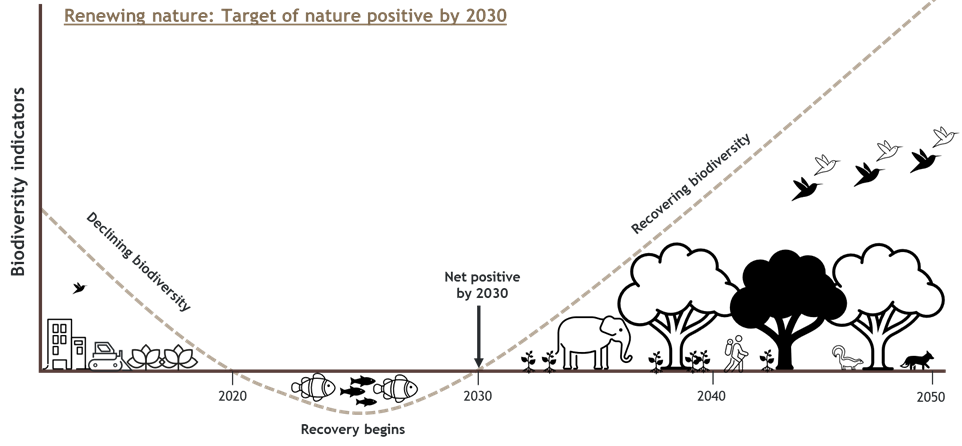
- “Nature Positive” - an improvement in the diversity, abundance, resilience and integrity of ecosystems from a baseline.
- “Nature-based Solutions” - actions to protect, sustainably manage and restore natural or modified ecosystems, that address societal challenges effectively and adaptively, simultaneously benefitting people and nature.
- “Natural Capital” - the collective stock of renewable and non-renewable natural resources, such as plants, animals, air, water, soils, and minerals.
To date, efforts to tackle climate change have outpaced those regarding nature and biodiversity loss.
This is shortsighted, considering the world’s reliance on nature cannot be understated, with the World Economic Forum revealing in its New Nature Economy publication released in January 2020 that over half of global GDP is estimated to be moderately or highly dependent on nature.
This is also beginning to change, as the global shift towards protecting and investing in nature continues to increase.
- Since January 2021, 119 countries (including Australia) have joined the High Ambition Coalition for Nature and People and formally supported the protection of at least 30% of the world’s land and waters by 2030 (30x30 target).
- In December 2022, representatives from 188 governments (including Australia) attended the 15th meeting of the Conference of Parties to the United Nations Convention on Biological Diversity. The ‘Kunming-Montreal Global Biodiversity Framework’ (GBF) was passed, providing 4 longer term goals and 23 shorter term targets aimed at halting and reversing nature loss (including a 30x30 target).
- Sustainability-related financial disclosure obligations are expanding beyond climate and into nature, with the Taskforce on Climate-related Financial Disclosures (TCFD) now disbanded and the Taskforce on Nature-related Financial Disclosures (TNFD) driving voluntary nature reporting through the release of its final framework. In the same way that voluntary climate reporting is shifting towards mandatory climate reporting (e.g. in Australia through the passing of the Treasury Laws Amendment (Financial Market Infrastructure and Other Measures) Act 2024 (Cth) on 9 September 2024), as support for the TNFD framework grows, voluntary nature reporting is likely to become mandatory in time.
- According to the UNEP’s State of Finance for Nature Report published on 1 December 2022, approximately $200 billion was invested in nature-based solutions in 2022, but this needs to increase to $384 billion by 2025 to halt biodiversity loss and limit global warming to below 5°C.
- Australia hosted the Global Nature Positive Summit in Sydney from 8-10 October 2024, bringing together various government, indigenous, research, environmental and business leaders to drive a greater understanding of the threats to nature and people, the urgent need to protect the world’s stock of natural capital, to explore options to invest in nature and collective actions to reverse the decline.
Examples of what’s happening on the world stage
- The United Kingdom has introduced a 10% Biodiversity Net Gain requirement (over 30 years) for all new developments requiring planning permission to ensure developments result in more, or better quality, natural habitat than what existed before the development.
- The European Union (EU) has adopted the Corporate Sustainability Due Diligence Directive (known as the CS3D), which requires in-scope companies (both EU and non-EU based) to identify, assess, mitigate and remediate actual or potential adverse human rights and environmental impacts throughout a company’s entire value chain.
- Australia has released its Nature Positive Plan, which serves as the blueprint for significant Federal environmental law reform aimed at better protecting and restoring nature and helping Australia meet its 30x30 target. Australia has also established a world-first voluntary Nature Repair Market.
- These reforms under the Nature Positive Plan are currently being delivered in stages as discussed further below.
Spotlight on Australia
As one of only 17 countries classified as “mega diverse”, Australia will play a critical role in achieving global nature-related goals. The push towards a nature-positive Australia is being driven by a plethora of public and private forces.
International nature-related goals agreed to by Australia’s Federal Government, a stronger focus on compliance and enforcement by regulators, a push for mandatory climate and nature reporting and government-based reviews into the state of nature continue to guide legislative change.
In 2020, Australia’s key piece of Federal environmental legislation (the Environment Protection and Biodiversity Conservation Act 1999 (Cth) (EPBC Act)) was independently reviewed by Professor Graeme Samuel AC. This review found that the EPBC Act was not adequate to protect Australia’s declining environment and recommended a complete overhaul of Federal environmental legislation, with a key theme for the reforms: a focus on nature.
The Federal Government’s Nature Positive Plan released in December 2022 sets an ambitious agenda for EPBC Act reform that is now to be delivered in stages.
- Stage 1 occurred in December 2023 with the passing of the Nature Repair Act 2023 (Cth) and Nature Repair (Consequential Amendments) Act 2023 (Cth). This legislation created the framework for a ‘world-first’ voluntary Nature Repair Market, under which ‘biodiversity certificates’ can be issued (and subsequently traded) for ‘biodiversity projects’ which enhance or protect nature. The Nature Repair Market is designed to operate alongside Australia’s existing carbon market, such that one project could be capable of generating a biodiversity certificate under the Nature Repair Market and Australian carbon credit units (ACCUs) under the carbon market. The Federal Government has recently carried out a range of consultation on operational aspects of the Nature Repair Market prior to its intended launch in 2025.
“Seeing nature-related issues appear in legislation, boardrooms, media, amongst stakeholders and the courts serves as a clear indication that as nature-related risk and opportunities grow, so too will their importance.”
- Matthew Austin, KWM Partner
- Stage 2 is currently occurring, with 3 bills currently before Federal Parliament (namely the Nature Positive (Environment Protection Australia) Bill 2024 (Cth), the Nature Positive (Environment Information Australia) Bill 2024 (Cth) and the Nature Positive (Environment Law Amendments and Transitional Provisions) Bill 2024 (Cth) (Nature Positive Bills)). The Nature Positive Bills seek to establish an independent data and information body known as Environment Information Australia and an independent compliance and enforcement body known as Environment Protection Australia. They also seek to provide Australia’s first legislative definition of ‘nature positivity’, being “an improvement in the diversity, abundance, resilience and integrity of ecosystems from a baseline”.
On 9 September 2024, the Senate Environment and Communications Legislation Committee published its report recommending the passing of the Nature Positive Bills, subject to 5 recommendations (including that the Federal Government undertake further consultation regarding the definition of 'nature positive' to ensure it is consistent with Australia's international commitments such as the GBF).
The Nature Positive Bills have not yet passed. Given the Federal Government does not hold a majority of seats in the Senate, and the Coalition, Australian Greens and two independent senators have heavily opposed the Nature Positive Bills in their current form, their passage through Parliament hinges on the Federal Government striking a deal with its opponents. While a potential deal was in the works with the Australian Greens to include a ‘climate trigger’ as part of the reforms, this was ruled out by Prime Minister Albanese in mid-September 2024. It remains to be seen what deal will be struck to get the Nature Positive Bills over the line, and whether this may involve a softer approach to climate considerations if not a formal ‘climate trigger’.
“Australia’s natural environment and iconic places are in an overall state of decline and are under increasing threat. The environment is not sufficiently resilient to withstand current, emerging or future threats, including climate change. The environmental trajectory is currently unsustainable.”
- Professor Graeme Samuel AC
- Stage 3 has been deferred while further consultation occurs. The reforms proposed as part of Stage 3 are the most significant and include, for example, legally binding National Environment Standards requiring projects to be ‘nature positive’, a new approach to offsets which will likely require offsets to deliver an [X]% biodiversity gain relative to a baseline, and far more comprehensive conservation and threatened species planning and recovery frameworks. It is unclear if Stage 3 reform legislation will be introduced before the next Federal election (by May 2025), but the final form of the Stage 3 reforms will heavily shape what ‘nature positivity’ really looks like in Australia moving forward.
As we wait to see how these reforms navigate through Federal Parliament, additional forces in the private sector are driving companies to shift their focus from climate to nature now. For example, both in Australia and abroad, we are seeing:
- Shareholders voting against climate and sustainability plans where the plans don’t adequately consider nature-related impacts.
- Stakeholders calling on companies, directors, and regulators to consider and address nature-related impacts throughout an organisation’s supply chain, under threat of litigation.
- Investors creating new financial instruments to fund nature-based solutions and technology as demand for responsible investment increases.
- Companies beginning to investigate and invest in nature-based solutions and use the array of available government funding to do so.
“The tax aspects of nature positive expenditure cannot be ignored. This includes how biodiversity certificates under the Nature Repair Market should be accounted for from a tax perspective, as well as the tax deduction profile for investments in nature-related projects.”
- Jason Barnes, KWM Special Counsel
Reaping Rewards, Reducing Risk
Climate change reforms have provided a helpful blueprint for the establishment of new standards relating to, and accounting for, nature. As reforms in the nature space continue to evolve, impacts on business will undoubtedly mirror the impacts of earlier climate change reforms, with similar risks and opportunities likely to arise.
Nature-related opportunities can be identified, and risks minimised, at an early stage by engaging in voluntary nature-reporting (e.g. utilising the TNFD framework). Implementing an internal framework for nature reporting may assist with the identification of nature-based solutions for new projects and throughout a company’s supply chain, in meeting shareholder expectations around nature and environmental protection issues and broader social licence concerns.
“We expect with more extensive corporate reporting, there will be a greater amount of data about the climate and nature related risks and supply chain vulnerabilities of reporting entities. This will increasingly become an important part of due diligence in corporate transactions, valuing a business, and accessing financing for projects. Managing the collection and reporting of this data will also be an increasing governance challenge.”
- Tim Bednall, KWM Partner
Fulsome and accurate climate and nature reporting is no longer a ‘nice to have’ - environmental disclosures are becoming determining factors for access to benefits such as market access, favourable interest rates, lower insurance premium costs and mortgage eligibility. An increasing number of government incentives are available for nature-based research and project development and investors are creating a variety of new mechanisms to fund nature-based solutions and tap into novel nature-based markets (e.g. nature funds and credit schemes). As funding in the nature space increases, expect a greater emphasis on the need for verifiable environmental information.
“With increased reporting obligations and interest from customers, investors and other stakeholders, data management and the importance of technology to track nature cannot be understated. Whilst access to reliable data will create opportunities for companies to highlight what they do well, it also comes with increased cybersecurity risks, barriers to market entry and costs associated with technological upgrades.”
- Scott Bouvier, KWM Partner
With the growing appetite for nature-based markets and projects, be prepared to see a raft of new nature-based contract clauses relating to environmental liability and disclosures. Sensitive project designs may drive new opportunities for proponents, who may reap the rewards from both nature repair and carbon markets, take advantage of potential streamlined Federal environmental approval processes and ensure a positive brand reputation and stakeholder sentiment. Projects that fail to embrace nature positive approaches to designs, may face greater regulatory hurdles in securing project approvals, increased stakeholder scrutiny and potential litigation.
“Australia already sees the second highest number of climate-change related cases in the world. As demand for nature-related information and reporting increases, there’s little doubt that a new wave of nature-related litigation will follow.”
- Claire Rogers, KWM Partner, Head of ESG
As momentum builds around nature reforms, the importance of biodiversity, nature repair and environmental stewardship is only set to grow. Legislative reforms and other driving forces will not just affect businesses with direct impacts on the environment, but every business practice throughout a supply chain.
So, how do you ensure your business reaps the rewards and reduces the risks associated with the new push for nature positivity?
- Watch for nature reforms and trends coming through (not just in your own jurisdiction, but on a global stage).
- Consider the impacts, risks, and opportunities to your business practices.
- Get in touch with us to seek advice as soon as possible.