The halfway mark for the ATO’s limited family trust distribution tax (FTDT) amnesty has now passed. Family groups who self-review and pay FTDT liabilities before 31 December 2026 may be eligible for up to 80% remission of general interest charges.
Unlike income tax, FTDT has no amendment period meaning that the ATO can pursue historical liabilities indefinitely, together with accumulated interest. The general interest charge (GIC) imposed on FTDT liabilities also ceased to be tax deductible from 1 July 2025.
Whilst there has been a focus on discretionary trusts as a result of the 30% minimum tax on discretionary trusts which was announced in the 2026-27 Federal Budget, the family trust election (FTE) and FTDT sits outside of those new proposed measures. Those changes may themselves have a material effect on distributions, even within the ‘family group’. You can read our insight on the minimum tax on discretionary trusts here.
The Federal Court’s recent decision in Cameron v Commissioner of Taxation [2026] FCA 609, which upheld an FTDT liability of approximately $2.4 million, underscores the significance of these exposures. FTDT is imposed at 47% on distributions outside the family group, and interest generally accrues from 81 days after distribution.
Proactive self-review provides the best opportunity for GIC remission. The ATO’s amnesty also provides for a partial remission on voluntary disclosure during the early stages of an ATO review, though at a lower rate.
What is a family trust election?
An FTE is a voluntary election made in a trust’s income tax return under Schedule 2F to the Income Tax Assessment Act 1936 (Cth). Making an FTE allows the trust to access certain tax concessions, including flow-through treatment for franking credits to beneficiaries, utilisation of prior year trust losses (subject only to the income injection test), and satisfaction of the continuity of ownership test for companies with discretionary trust shareholders. However, the election imposes practical limitations on the persons and entities to which distributions may be made.
The FTE must specify an individual (the ‘test individual’) whose family determines the scope of the election. Once made, the FTE generally cannot be varied or revoked except in limited circumstances. The choice of test individual will define the trust’s family group for the duration of the election.
Where a trust that has made an FTE makes a distribution to a person or entity outside the test individual’s family group, FTDT is imposed at the rate of 47% on that distribution. The concept of ‘distribution’ is broadly defined in Schedule 2F and includes payments (including by way of loan), credits, transfers or use of property, reinvestments, applications for the benefit of a person, and forgiveness of debts, where there is no corresponding consideration.
Who is in the family group?
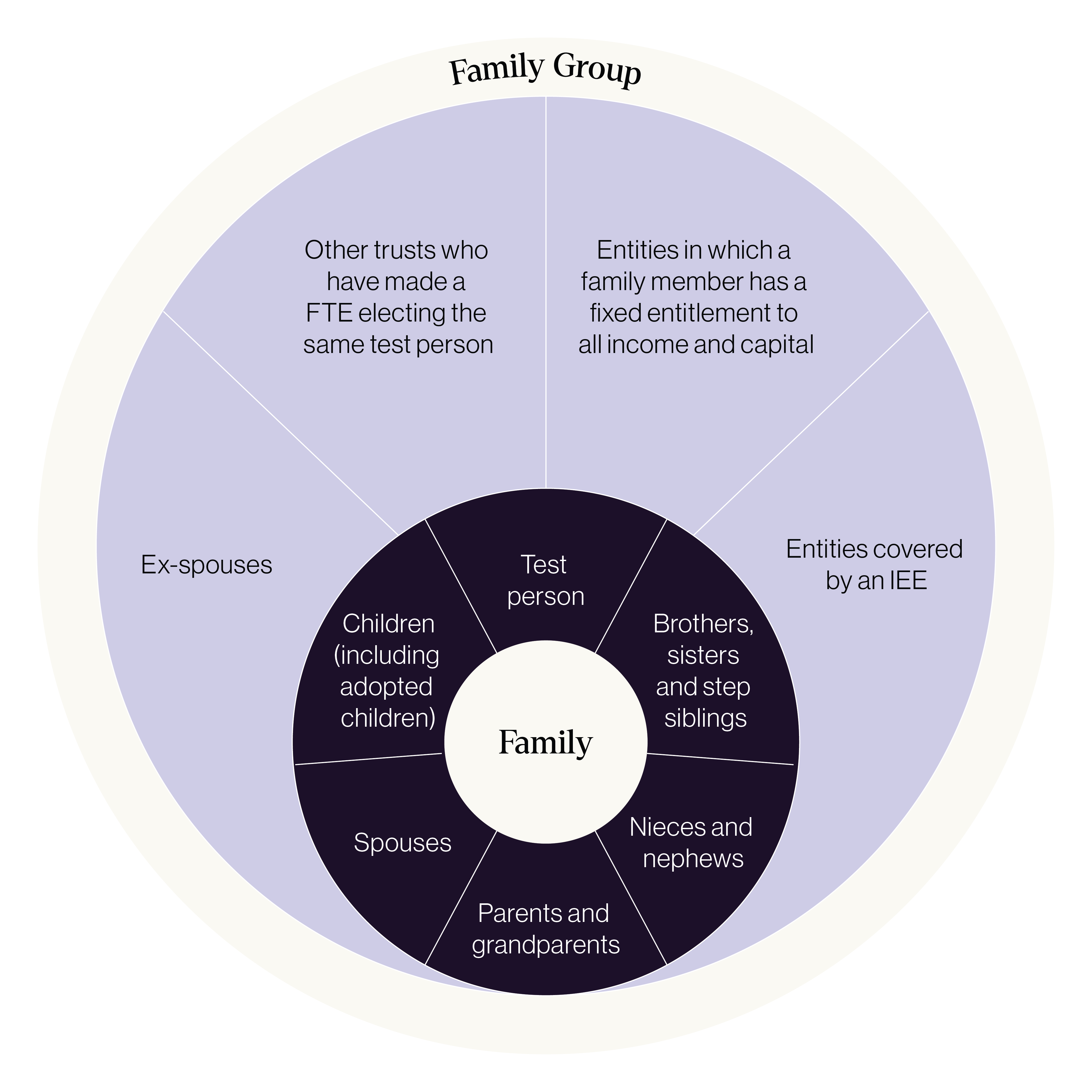
The family group is defined by reference to the test individual specified in the FTE. It includes the test individual’s ‘family’ as defined in section 272-95 of Schedule 2F: parents, grandparents, siblings, nephews, nieces and their respective spouses. Step-siblings and adopted children are included. Aunts and uncles of the test individual are not.
The family group also includes:
- other trusts that have made an FTE specifying the same test individual;
- entities that have made an interposed entity election (IEE) to be included in the family group; and
- companies, partnerships or trusts in which the test individual, members of their family, or trustees of family trusts with the same test individual, hold fixed entitlements to all of the income and capital.
An IEE allows a company, trust or partnership to elect to be included in the family group of a trust that has made an FTE. Like the FTE, an IEE is generally irrevocable, which can create complications on a subsequent sale of shares or corporate restructure where the purchaser or new entity is not within the family group.
FTDT
FTDT is imposed under the Family Trust Distribution Tax (Primary Liability) Act 1998 (Cth) at the rate of 47% of the amount distributed or conferred outside the family group. It is due and payable 21 days after the distribution or conferral. The general interest charge applies from 60 days after the due date for payment (currently 11.43% per annum).
Critically, FTDT is not an income tax and does not carry the typical restrictions on the Commissioner’s ability to recover income tax. There is no statutory amendment period, which means the ATO can pursue historical FTDT liabilities indefinitely, together with accumulated GIC. In some cases, the effective tax rate (FTDT plus GIC) has exceeded 90%.
Once FTDT is paid, the distributed amount becomes non-assessable non-exempt income in the hands of the recipient. Where distributions have previously been assessed to the recipient, it may be possible to coordinate the FTDT disclosure with an amendment request to recover the income tax paid by the recipient (subject to amendment periods).
Common circumstances giving rise to FTDT
FTDT exposures commonly arise where family circumstances change, including:
Separation or divorce
Following a separation, the former spouse of the test individual or a family member remains within the family group. However, entities controlled by the former spouse may fall outside the family group. Distributions to those entities, including as part of a Family Court settlement, can trigger FTDT. It is possible to vary an FTE where Family Court orders result in a new individual having control of the trust.
Death of the test individual
The death of the test individual does not terminate an FTE. However, estate administration can give rise to FTDT exposures where distributions are made to beneficiaries or entities outside the family group. An IEE can be made in respect of a deceased test individual to assist in managing the estate within the FTE framework, though careful analysis of control and timing is required.
Succession planning
The FTE is anchored to the specified test individual. As control of the family group passes between generations, entities may fall outside the family group at the time of subsequent distributions. New corporate vehicles established for younger generations may not satisfy the family control test for the purposes of making an IEE. For these reasons, FTE arrangements should be reviewed before implementing any succession plan.
Cameron v Commissioner of Taxation: a practical case study
The Federal Court’s recent decision in Cameron v Commissioner of Taxation [2026] FCA 609 illustrates the consequences of FTDT exposures. In that case, the Court upheld an FTDT liability of approximately $2.4 million arising from distributions made to entities outside the family group. The ATO produced contemporaneous records of the election, and the taxpayer could not displace those records to establish that no valid FTE had been made.
As GIC had been accruing since the distributions were made (due and payable 21 days after distribution, with GIC applying from day 81), the total liability including interest was substantial. This underscores the significance of the unlimited review period for FTDT and the compounding effect of GIC over time.
The taxpayer has filed an application for an extension of time to appeal the decision.
The Cameron case is not an isolated incident. The complexity of the FTE and IEE framework, coupled with the potentially severe financial consequences, highlights the importance of careful and ongoing review of family trust arrangements.
The amnesty
The ATO has published guidance on circumstances in which it will consider remitting GIC on FTDT liabilities. The indicative remission settings are as follows:
- Proactive self-review (before a review has commenced): up to 80% GIC remission.
- Early voluntary disclosure (during a review but prior to audit): partial remission at a lower rate.
In either case, the taxpayer must lodge the relevant FTDT payment advice form and pay the FTDT liability.
The indicative remission settings are generally unavailable once a risk review has progressed to audit, an FTDT notice has been issued, or where there is evidence of mischief, fraud or evasion.
The ATO has no power to waive the FTDT liability itself; only the GIC may be remitted. The underlying 47% tax remains payable.
The amnesty ends on 31 December 2026. After that date, GIC remission requests will be assessed on their individual merits, and the ATO may be less likely to apply these indicative settings.
Recommended actions
- Seek advice before circumstances that commonly trigger an FTDT liability arise: It is of course better to prevent an FTDT liability from arising by ensuring that your private group is structured with consistent and well documented FTEs, IEEs and a coherent family group.
- Review FTE and IEE records: The ATO’s Online Services for Agents now displays all elections lodged. While a useful starting point, this data does not verify the validity of those elections.
- Map the family group boundaries by reference to the test individual specified in each FTE: Advisers frequently discover that FTEs were made in prior years with a different test individual than expected, or that distributions have been made to entities that fall outside the family group. Historical distributions should be reviewed against those boundaries.
- Where an exposure is identified, quantify the FTDT and GIC liability: Consider whether FTDT disclosures should be coordinated with amendment requests for recipients to recover income tax previously assessed on those distributions (subject to amendment periods).
The amnesty window closes on 31 December 2026. Early engagement with advisers is essential to access the full remission.
How can we assist?
Mallesons’ Tax team has deep expertise in private group structuring, including with FTDT and FTEs. Please reach out to discuss how to review your arrangements or take advantage of the ATO’s amnesty.