As AI accelerates data centre growth, policymakers face the complex challenge of balancing emerging power demands with the broader energy transition. A sleeper issue is the critical role copper will play in determining Australia’s success in our latest economic growth opportunity.

Global annual investment in data centres, transformed with the emergence of generative AI in 2022 and subsequent hyperscaler expansion, is forecast to rise from roughly US$800 billion this year to $1.8 trillion per year in 2050. [1]
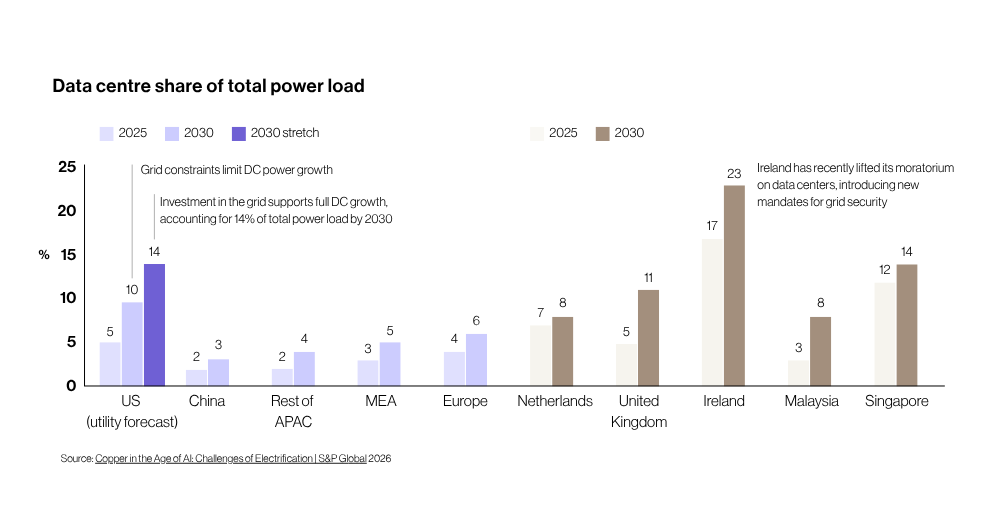
With energy access now becoming central to the expansion of data centres – and half of the data centre growth expected to be in the United States – it is estimated that the data centre demand for US electricity will rise from 5% of total electricity demand in 2025 to as much as 14% by 2030.[2]
Equally in Australia, the Australian Energy Market Operator (AEMO) recently described that the most likely demand scenario will result in data centre electricity consumption tripling to 7.8% of National Electricity Market (NEM) operational consumption by FY2030, and then 13% by FY2036. AEMO made the role AI and data centres are playing in driving this demand abundantly clear by saying:
‘Rapid growth in data centres, driven by increased artificial intelligence (AI) adoption and cloud services, remains one of the most significant sources of forecast growth and uncertainty as a strong pipeline of projects is evident in grid connection enquiries.’ [3]
There are many factors that must come together to support this, including material inputs. One element that is often overlooked, but a critical ingredient, is copper.
In 2024, we explored the central role of copper to AI and net zero in the context of expansion of data centres, which require vast quantities of critical minerals to build and power - read our previous insight here.
In this insight, we further reflect on this rapid growth as the most recent accelerant to electrification, and the flow on impact to critical inputs, including copper.
AEMO ESOO consideration of data centre impact on power consumption
AEMO released its 2026 Electricity Statement of Opportunities (ESOO) on 25 August 2026, which identifies data centres as one of the most significant sources of forecast electricity demand growth and uncertainty in the NEM.
Importantly, AEMO forecasts data centre loads separately from large industrial loads, given the high pace of data centre development and uncertainty over the medium and long term of the expected need for digital services. The ESOO is supported by the 2026 ESOO Data Centre forecasting overview, which outlines how AEMO develops data centre demand forecasts, including the assumptions, analysis and forecasting methods used in the ESOO.
The rapid expansion of AI and cloud computing is already reshaping electricity use, particularly in New South Wales and Victoria, and AEMO noted recent regulatory attention is focussed on supporting efficient operation of data centres as demand grows[4]. Among the recent regulatory developments highlighted by AEMO are the proposed Federal and NSW reforms seeking to make data centres support additional renewable generation and firming, contribute to network costs and provide demand flexibility.[5]
ESOO page 28, section 3.1: “Electricity consumption and demand outlook”
2026 ESOO Data Centre forecasting overview: ‘Data centre electricity demand today.’
2026 ESOO Data Centre forecasting overview: “Data centre policies, standards and market reforms being considered.”
Read about energy considerations for data centres series including the recently proposed federal and NSW reforms:
- Big day for data centres: New renewable energy, grid connection and cost recovery rules explained
- Another big day for data centres…in NSW: A new framework for connection
- Wired for growth: capitalising on energy demand from the data centre revolution
- Australia wants the data centre boom: can it get the power settings right?
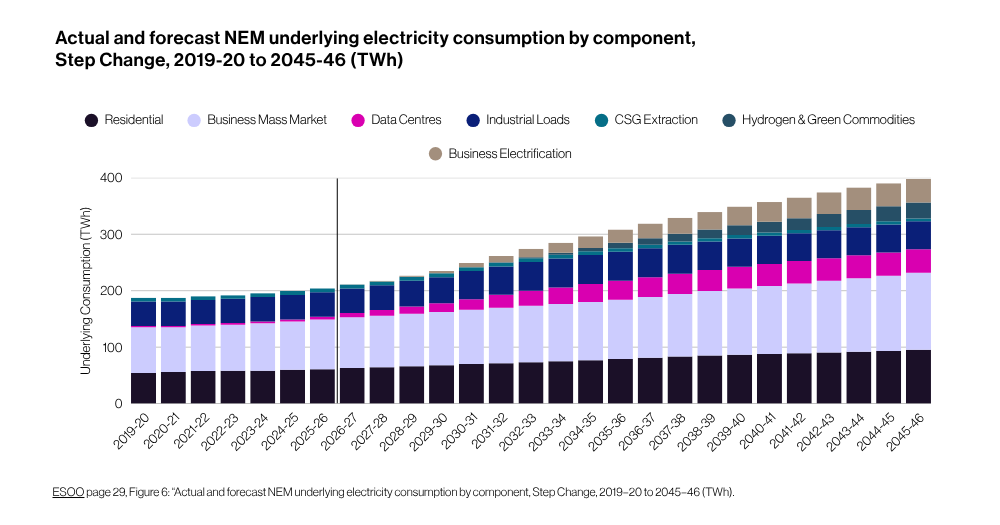
Under AEMO’s Step Change scenario (its central and most likely demand scenario), data centre electricity consumption is expected to triple to approximately 15TWh or 7.8% of NEM operational consumption by FY2030. By FY2036, consumption is forecast to reach approximately 34TWh, or 13% of forecast NEM operational consumption.
Click to expand

AEMO’s data centre forecasts combine project-level information gathered from data centre developers and network service providers (including development and connection status and developer size) and averages these project-level assessments with an economic outlook reflecting digital transformation, AI adoption and Australia’s potential role as an Asia-Pacific data centre hub.
The message on data centre growth from the ESOO is that, while data centre demand is growing rapidly and will become an increasingly significant component of NEM consumption, it forms part of a much broader system-wide increase in electricity use.
The key challenge is therefore to ensure that the pace and uncertainty of that growth, across data centres and other sources of demand, is matched by timely investment in the generation, storage and transmission infrastructure needed to maintain reliable supply for all consumers.
This challenge is also emerging in other jurisdictions which are experiencing rapid data centre growth, as can be seen in the chart below:
Click to expand
Source: Copper in the Age of AI: Challenges of Electrification | S&P Global
The demand matching will necessarily flow through to material input supply, importantly copper.
Significant increase in copper demand from data centre surge
Copper is essential to many aspects of building and operating a data centre, including:
- power cables
- busbars
- electrical connectors and heat exchangers
as well as to the semiconductor chips that underpin AI technology.
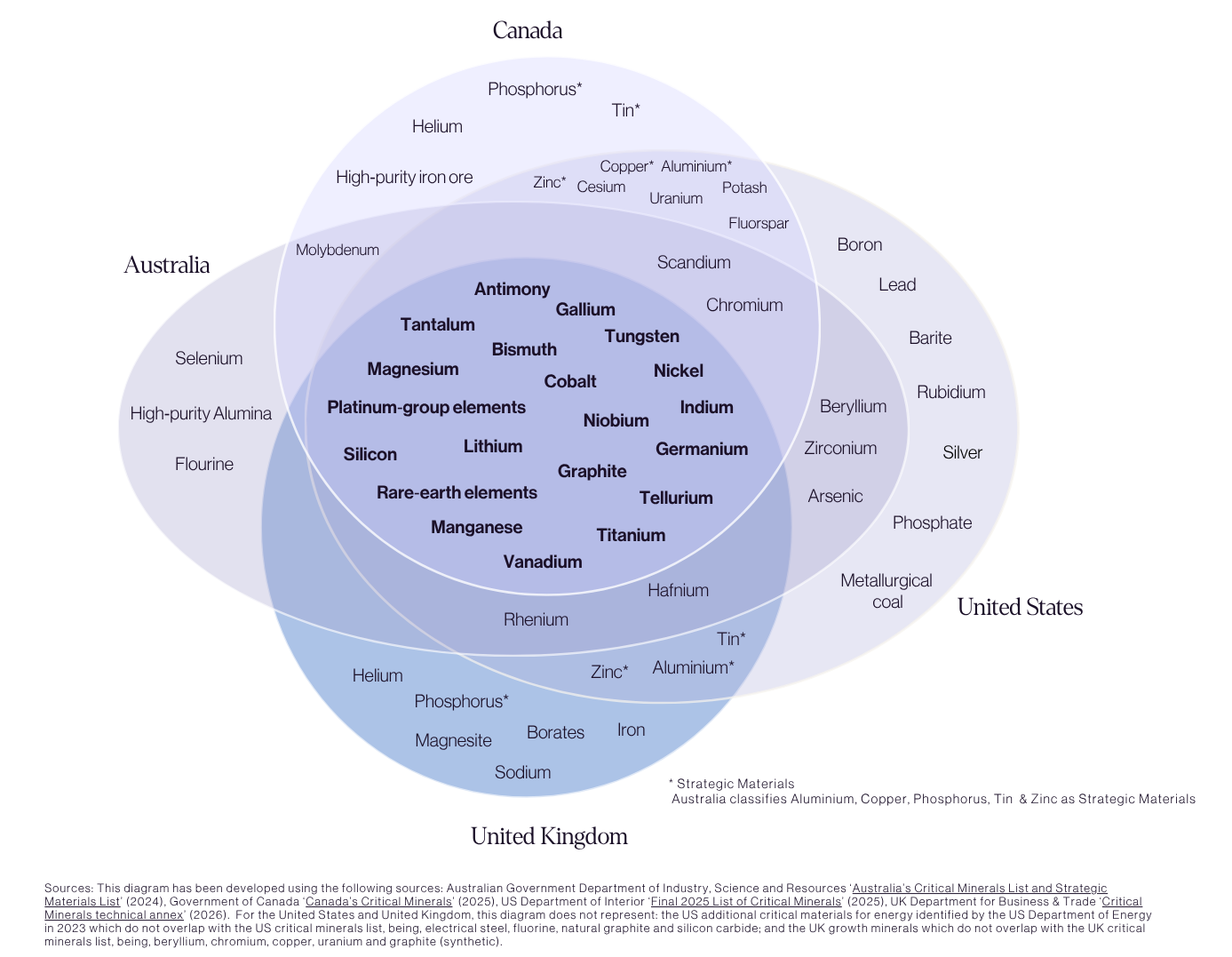
Copper is classified as a critical mineral in certain jurisdictions such as the United States and Canada (as seen in our diagram below). By contrast, in Australia, copper is considered only to be a ‘strategic’ mineral, given its significant reserves (second largest globally behind Chile)[6] and the lack of supply chain disruption risks.
Under Australia's framework, critical minerals are materials that are both essential for modern technologies, economies or national security and have supply chains vulnerable to disruption, whereas strategic materials capture minerals like copper that are important to the global energy transition, but whose supply chains are not currently considered vulnerable enough to warrant critical mineral status. In 2024 we explained this distinction and how copper's classification may evolve – read here.
page 73 of Mineral Commodity Summaries 2026
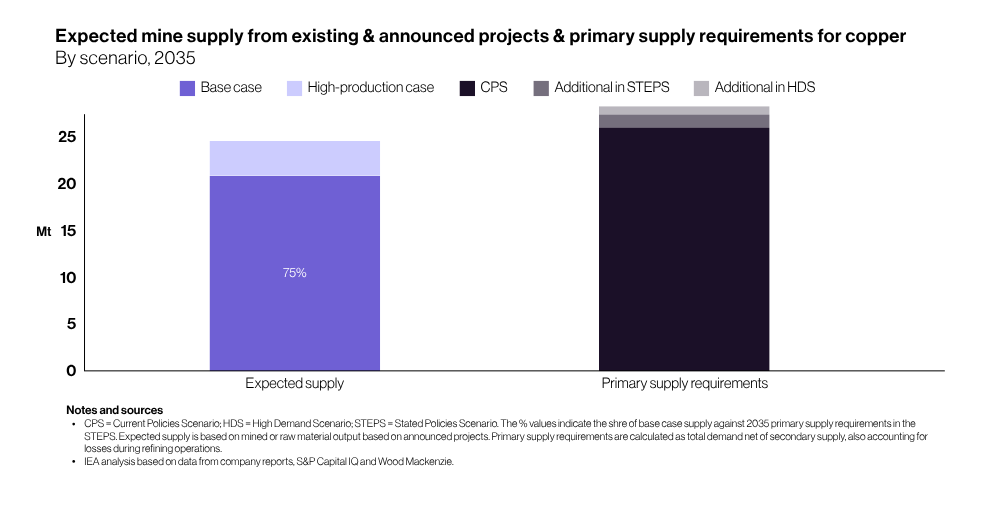
The International Energy Agency (IEA) in its 2026 Outlook has noted that for copper, the project supply deficit in 2035 has narrowed from 30% to 25% with new projects being advanced:
Click to expand
Source: https://www.iea.org/reports/global-critical-minerals-outlook-2026/outlook
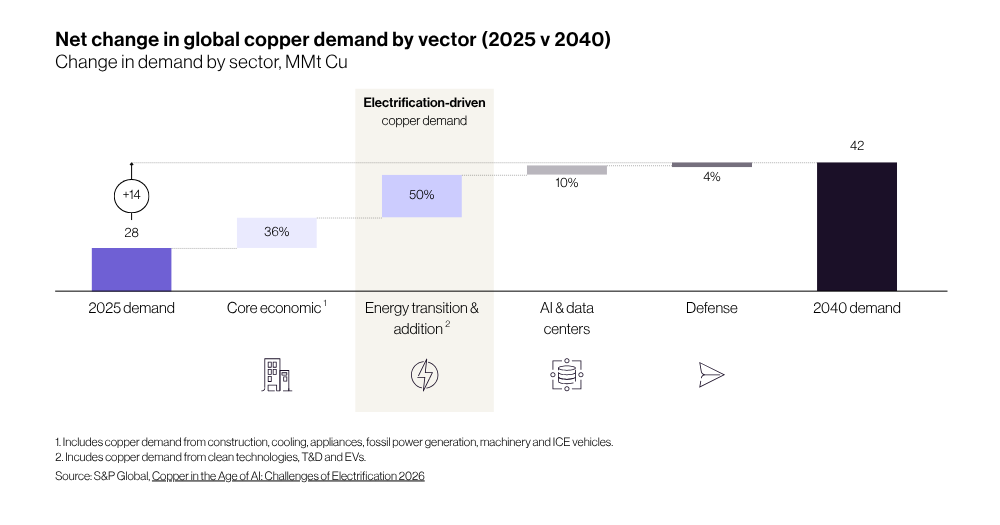
Data centres (and AI) are also one vector of copper demand recently assessed by S&P Global, together with energy transition, defence and ‘core economic’ (such as construction and fossil fuel power generation).
Depending on a number of variables such as power availability and pace of data centre adoption and construction, annual future copper demand in 2040 could vary between 1.7 and 2.7 million tonnes.[7] This range reflects the dynamic investment sector and complexity of policy and technical factors, which creates challenge and uncertainty for planning for future copper supply – which nonetheless is in the context of the projected shortfall noted by the IEA’s analysis above.
It has also been acknowledged that data centre metals demand goes beyond the server door, with Wood Mackenzie stating:
‘That captures the smallest part of the picture. The infrastructure required to keep a modern data centre running, redundant power systems, on-site generation, transmission reinforcement, has a metals footprint that dwarfs what is happening inside the facility. At the system level, we are looking at three to four times the volume implied within the asset. For investors and grid planners, that is a material difference.’[8]
Copper demand not just a data centre story
While data centres are an increasingly significant driver of growing energy and copper demand, they represent only one piece of a larger picture. The energy transition, coupled with evolving geopolitical dynamics around supply chain security, is reshaping demand for these resources on a global scale. Even without the uptick in investment in data centres over recent years, the more significant demand for electrification and material inputs such as copper relate to the energy transition, which is outlined in the following chart:
Click to expand
Suppliers redefining business models to capture the copper opportunity
On the supply side, major players like BHP have signalled a significant pivot to expanding their copper production. A key domestic example is BHP’s ‘Copper South Australia’ (Copper SA) province centred around its Olympic Dam operations. Underpinning the expansion, BHP cites a persistent structural copper supply deficit driven by global megatrends including electrification, digitalisation and data centres and the energy transition. The estimated Copper SA Phase 1 capital expenditure for this province is between US$9 billion and US$11.6 billion encompassing mine, concentrator, smelter and refinery expansions. [9]
This follows a growing global trend of other diversified mining companies, such as Rio Tinto, Glencore and Anglo American, also pivoting from iron ore and/or coal and towards copper to meet this growing demand and shore up future revenue streams while managing shareholder expectations. Underpinning this is the rise of copper pure-play and high-growth mid-tier market participants.
Key takeaways
- In the past 5 years, data centres have increasingly required government policy consideration for their impacts on increased energy demand, generation mix and grid structural arrangements, which would not previously have been factored into Net Zero or operational scenarios.
- Equally, data centre power demand cannot be considered in isolation, with most jurisdictions facing into wider competing power demands through electrification as part of the energy transition.
- These factors have added to existing drivers of increased demand for relevant input production, especially copper supply.
BHP, Results for the year ended 30 June 2026, presentation dated 18 August 2026, slides 5, 6, 27, 29 and 40.