Recent events have reinforced that Australia’s ability to produce and supply food depends on secure access to critical inputs and resilient supply chains. The National Food Security Strategy review is no longer abstract policy planning, but a live issue with commercial, regulatory and economic implications.
In the 2025-2026 Federal Budget, the Australian Government committed $3.5 million to develop the Feeding Australia: A National Food Security Strategy (National Food Security Strategy), which seeks to set a vision for a sustainable, resilient and secure food system that serves all Australians, from producers to consumers. This commitment brought food security into focus as a national policy interest, not just an agricultural one.
During the review process, renewed geopolitical instability – including the conflict in the Middle East – exposed pre-existing vulnerabilities in Australia’s supply chain. One being Australia’s dependence on importing diesel and fertiliser, the implications of which have been felt by all Australians through the rising cost of and availability of fuel.
Disruptions in fuel and fertiliser supply may have long-term implications through higher food prices, lower agricultural yields and more Australians struggling with food security.
This update aims to explain:
- the process of Australia’s food security strategy review to date
- the diversity and richness of some of the important ideas that have been unearthed to date
- some reforms which should improve our resilience for future events.
Before the conflict, the current process may have been seen as prudent, but it could have fizzled like many food security reviews in the past. However, recent developments have significantly sharpened the policy rationale for reform, reinforcing the need move to implementation. These developments sit alongside significant humanitarian consequences internationally, which are not addressed in this analysis.
For the nation’s food security, this is no longer a drill. We need to prioritise reform and support for food security as critical to a healthy, resilient and prosperous society.
Mallesons’ long-standing Food & Agribusiness and market-leading energy teams have long recognised that food and energy security were the two great challenges of the 21st century.
All participants in the food and agricultural supply chain should ensure that they get involved in the National Food Security Strategy co-design process and Ambitious Australia innovation reforms described below.
We welcome the opportunity to discuss the issues raised in this update with you.
Overview
The Australian Government’s $3.5 million commitment over two years aims to boost the productivity, resilience and security of our food system. The strategy will be developed through a co-design process involving key stakeholders, which builds on the 318 submissions received in response to a discussion paper released in 2025.
The submissions suggested a range of approaches to create a more food secure Australia. These strategies range from lower cost pathways (such as creating an international harmonised system for bio manufactured exports and addressing planning laws to optimise land use) to higher cost pathways (such as public investment in R&D and commercial infrastructure and supporting the domestic manufacture of critical agriculture inputs, such as fertiliser).
Our update covers the background of Australia’s path to food security, a summary of the National Food Security Strategy and an overview of key submissions. We then share our insights on potential reforms to our innovation system which will be critical to achieving a more food secure future.
Australia’s food security
Australia has a complex and interconnected food system that faces several threats to its food security. Some of these threats include:

These threats are not a recent revelation, with at least 18 food security reports since the 2008 global financial crisis. Despite this analysis, there is lingering doubt as to Australia’s level of preparedness across the food system.
Priority areas - Feeding Australia: A National Food Security Strategy
To develop the National Food Security Strategy, the Government first sought submissions to a discussion paper which proposed that the strategy involve three key priority areas, supported by five whole-of-system considerations. The key priority areas were:
- Resilient supply chains: Focusing on strengthening supply chains against shocks from natural disasters, changing consumer landscapes, geopolitical tensions and biosecurity threats while ensuring stable and accessible food supply.
- Productivity, innovation and economic growth: Harnessing technology and innovation to improve agricultural productivity and support employment in the face of pressure from growing resource, climate and land-use.
- Competition and cost of living: Addressing challenges of food affordability and market concentration, and the impact on vulnerable households.
The key priority areas would then be supported by five whole of system considerations:
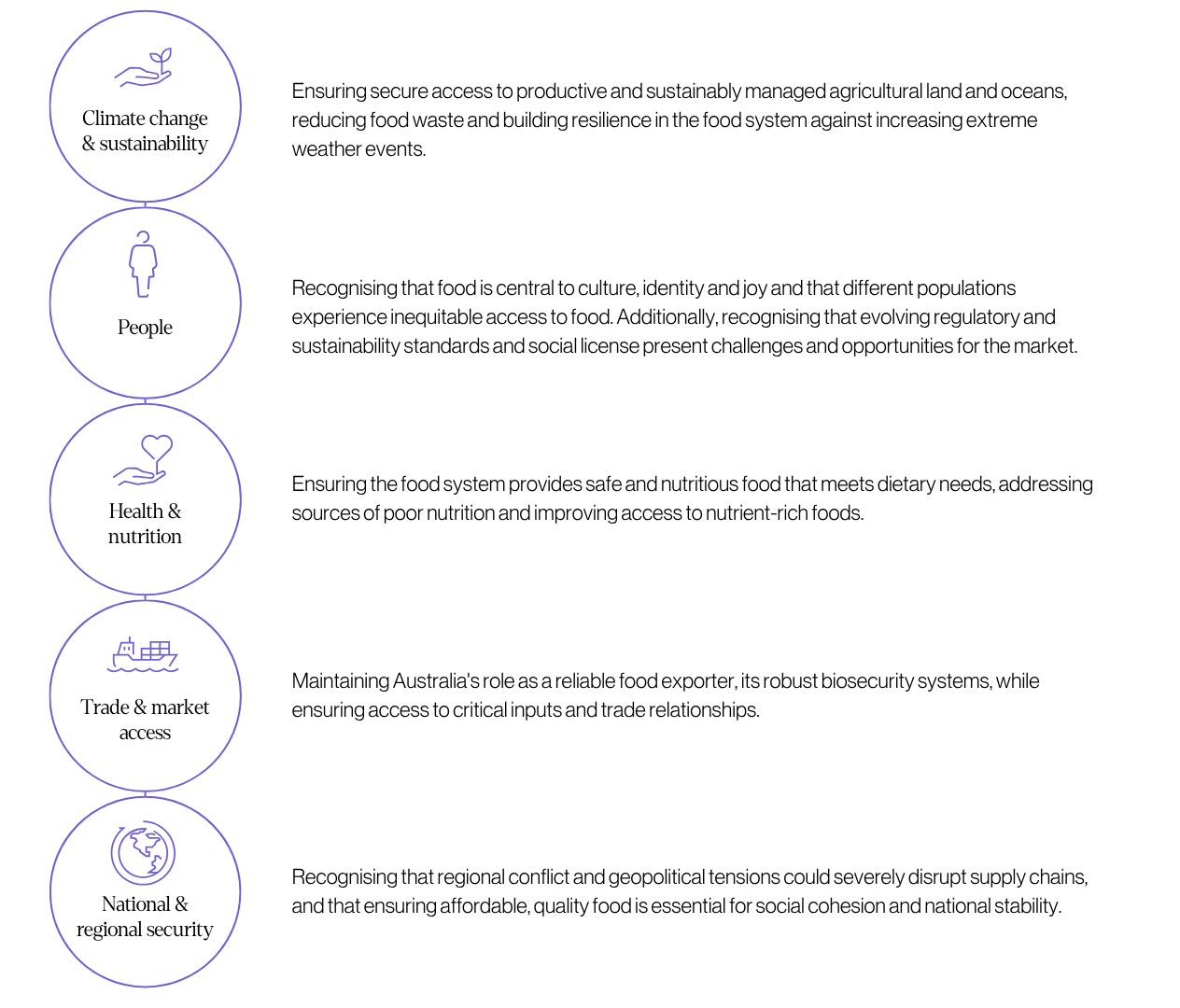
Submissions to government
The government received 318 submissions to the discussion paper (a full list of submissions is available here).
The current issues with diesel and fertiliser shortages were raised and the debate on the actions to manage them is leading the news. Leaving those issues aside, we unpack below six key themes from the submissions.

As an overall theme, the submissions point to the need to improve Australia’s agricultural productivity to maintain its competitiveness on a global stage, improve its climate resilience and protect rural livelihoods.
Improvements in productivity mean more agricultural output can be produced from the same amount of inputs, or that current outputs can be produced with fewer inputs. Importantly, this translates into lower prices for consumers and improved availability of food.
Australia has one of the most variable climates in the world. This is exacerbated by rising temperatures, changes in rainfall patterns and increased frequency of extreme weather events such as drought, floods, fire and storms. These hazards can lead to a range of impacts on the food system and submissions called for climate adaptation strategies to ensure Australia’s long-term food security.
A snapshot of the opportunities to improve climate resilience includes increased investment in climate-smart technologies, water-efficient irrigation and investment in near-real-time decision support tools. The fuel crisis has also put electrification of farming into sharper focus, with stakeholders pointing to irrigation, pumping, heating and cooling, machinery upgrades and precision agriculture as areas for lower energy use and improved productivity.
The submissions point to sustainability and productivity as complementary objectives which must be addressed through infrastructure, leveraging technology and regenerative practices.
Biosecurity is critical to Australia’s food systems, with the country’s proactive preparedness, secure borders and effective responses to biosecurity incursions predicted to save agriculture an estimated A$210 billion over 50 years. This sensational figure points to a key message that proactive strategies are critical to respond to threats to the food system. Further, multiple submissions called for regulatory frameworks that are future-ready in the face of technological advances. The submissions’ key concerns include the duplication between the Office of the Gene Technology Regulator and FSANZ, and the slow and expensive nature of the system to new entrants with technology for GM supported agriculture and novel foods.
Interestingly, submissions called out the intersection between biosecurity and regulatory reform and how Australian producers and consumers were missing out on new plant varieties due to Australia's high barriers to entry.
Sowing seeds of discontent
Australia’s biosecurity requirements for imported tomato seeds are 6-7 times more expensive than those in New Zealand. The overarching message is that prevention and preparedness are far more cost-effective than responding to established threats and that regulatory barriers are hindering innovation and market access.
Ensuring a secure, skilled and regionally distributed workforce emerged as a key concern across submissions. These observations recognise that food security depends not only on infrastructure and technology, but on the people who operate within the system.
This reinforces a critical point: if Australia is to build a digital food system that integrates technology and innovation, it must be supported by a regional workforce equipped with digital skills.
Biotechnologies present an opportunity to produce more resilient crops, diversify protein sources and reduce carbon intensity. The demand for these technologies is evident, with the CSIRO projecting 8.5 million tonnes of additional protein demand by 2030.
However, a consistent theme across submissions was the need for investment in public and commercial infrastructure to allow RD&I innovations to be commercialised into agricultural production. Submissions called for structured programs for AgTech and innovation adoption, such as demonstration farms and innovation broker models that provide structured resources connecting producers with new technologies and services, as well as investment in program delivery to ensure technologies are tested, trusted and scaled.
While these points capture the nib of innovative ideas identified in the submissions, the urgent reality that without a comprehensive National Food Security Strategy, Australia's food ecosystem will remain vulnerable to ongoing challenges and threats.
Australia has an abundant food system which masks uneven access to nutritious, affordable and culturally appropriate food, particularly in remote Aboriginal and Torres Strait Islander communities. Submissions called for community-led strategies which promote local food production and sovereignty. These strategies would be complemented by action on broader focus areas such as employment and income, the affordability of healthy food, electricity costs, transport and water quality. This work would also build on the National Strategy for Food Security in Remote Aboriginal and Torres Strait Islander Communities.
Our final thoughts
Australians are now acutely aware that our ability to produce food is dependent on the supply of critical agricultural inputs of urea, ammonium nitrate (UAN), gas, sulphur and oil. Recent and current events demonstrate that greater engagement is required between the government and key stakeholders to ensure the supply of these inputs that secure Australia’s food supply and ultimately reduce the impact on consumers.
Now that the National Food Security Strategy review is no longer just prudent planning, the current process will need more urgency and resources. While the initial focus will need to be on more resilient supply chains, for the medium-term we need to integrate and supercharge broader productivity, innovation and economic growth measures.
While the National Food Security Strategy review should consider the submissions on productivity and innovation, the government already has an economy-wide blueprint for driving innovation and productivity growth in Australia through the Ambitious Australia Strategic Re-examination of R&D report. That report presents an action plan that focuses on:
- Greater focus and scale for RD&I impact
- A world class foundational research system creating knowledge and expertise
- Incentives to build the RD&I businesses and industries of the future
- Investment and capital to fuel the innovation cycle
- Building workforce capability to power RD&I activities
- Government to lead and champion
Greater focus would allow us to define and support long-term, national RD&I goals, which will maximise the value and impact of public investment, attract private investment and foster cross-sector collaboration.
The Ambitious Australia report recommends that those efforts would focus on National Innovation Pillars:

Each anchored by a long-term and aspirational national goal to guide prioritisation, coordination and strategic focus.
The other actions would lift the overall ecosystem and incentives. They include measures to boost the R&D Tax Incentive by simplifying it, adding focus on impact areas and increasing the incentives for large corporates. We also need to better support our education and research systems and allow universities to achieve research specialisation by reforming registration requirements to reduce the condition for research breadth and enable each to build scale in areas of their competitive and comparative advantage. Other measures would support the evolution of our capital markets to unlock more investment from angels and institutional investors, including superannuation funds.
The government’s focus on managing the current crisis,together with fiscal and policy constraints, may affect the pace at which longer-term responses are implemented. However, Australia’s innovation system needs bold moves now even if they are hard.
Quoting from the report:
While our luck has given most Australians an enviable quality of life, we need to build a broader base of economic opportunities and growth or risk significant decline in living standards. Australia is ranked 105th of 145 national economies for economic complexity (Growth Lab n.d.). We derive around 50% of export revenue from selling our natural resources like iron ore, gas and coal, and our agricultural products (DFAT 2025a).
We have one of the lowest shares of manufacturing in the Organisation for Economic Co-operation and Development (OECD) (World Bank Group 2024a). And while mining contributes roughly 10% of gross domestic product (GDP) (Reserve Bank of Australia 2025) it directly employs 2% of the workforce (Jobs and Skills Australia 2025).
We cannot afford to ride this luck for too much longer. Mallesons’ experience with Australian science-based innovation through our work with CSIRO, Universities, Rural Development Corporations, Creative Destruction Lab and evokeAG has shown us that we have the innovations in Australia to better position us on food security. However, we will need to improve our innovation ecosystem to achieve that objective through supporting the recommendations in the Ambitious Australia report.
This insight focuses on the commercial, legal and regulatory implications for businesses arising from recent geopolitical developments. We recognise the broader humanitarian and societal impacts of these events, which are significant and deeply concerning, but are not addressed in this .