The appeal concerned digital mobile radios (DMRs) supplied in Australia by Hytera Communications Corporation Ltd and its local subsidiary, including the computer firmware incorporated within the devices.
Motorola had begun work on a DMR project 'in earnest' in 2003.[1] From about 2005, Hytera was also seeking to develop a DMR device.[2] Hytera recruited an engineering employee from Motorola — followed shortly thereafter by a team of 12 more engineers.
At [4].
At [5].
'There is no doubt that Hytera’s software engineers engaged in industrial scale harvesting of Motorola’s source code and that they set out to make this as difficult to detect as possible.'
Motorola Solutions, Inc. v Hytera Communications Corporation Ltd (Liability) [2022] FCA 1585 (the primary judgment or PJ) at [1576]).
The Hytera Devices were brought to market in March 2010.
- At trial, the primary judge found that Hytera had infringed Motorola’s 355 Patent, had not infringed Motorola’s 764 Patent, and that the 960 Patent was invalid.
- In respect of the claims for copyright infringement, the primary judge concluded that Hytera had infringed Motorola’s copyright in six of the eleven works (comprising computer software) in respect of which Motorola made claims.
The parties appealed, cross-appealed, and filed notices of contention.
Code & copyright on appeal
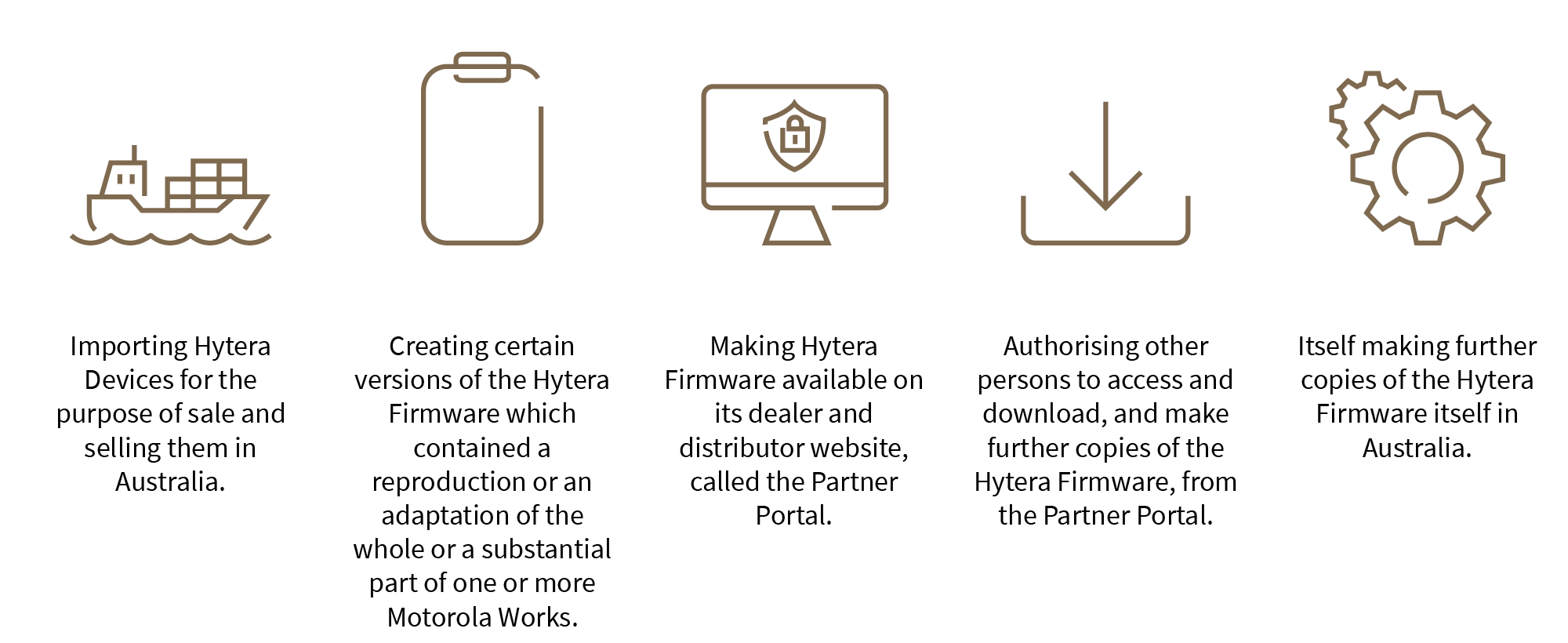
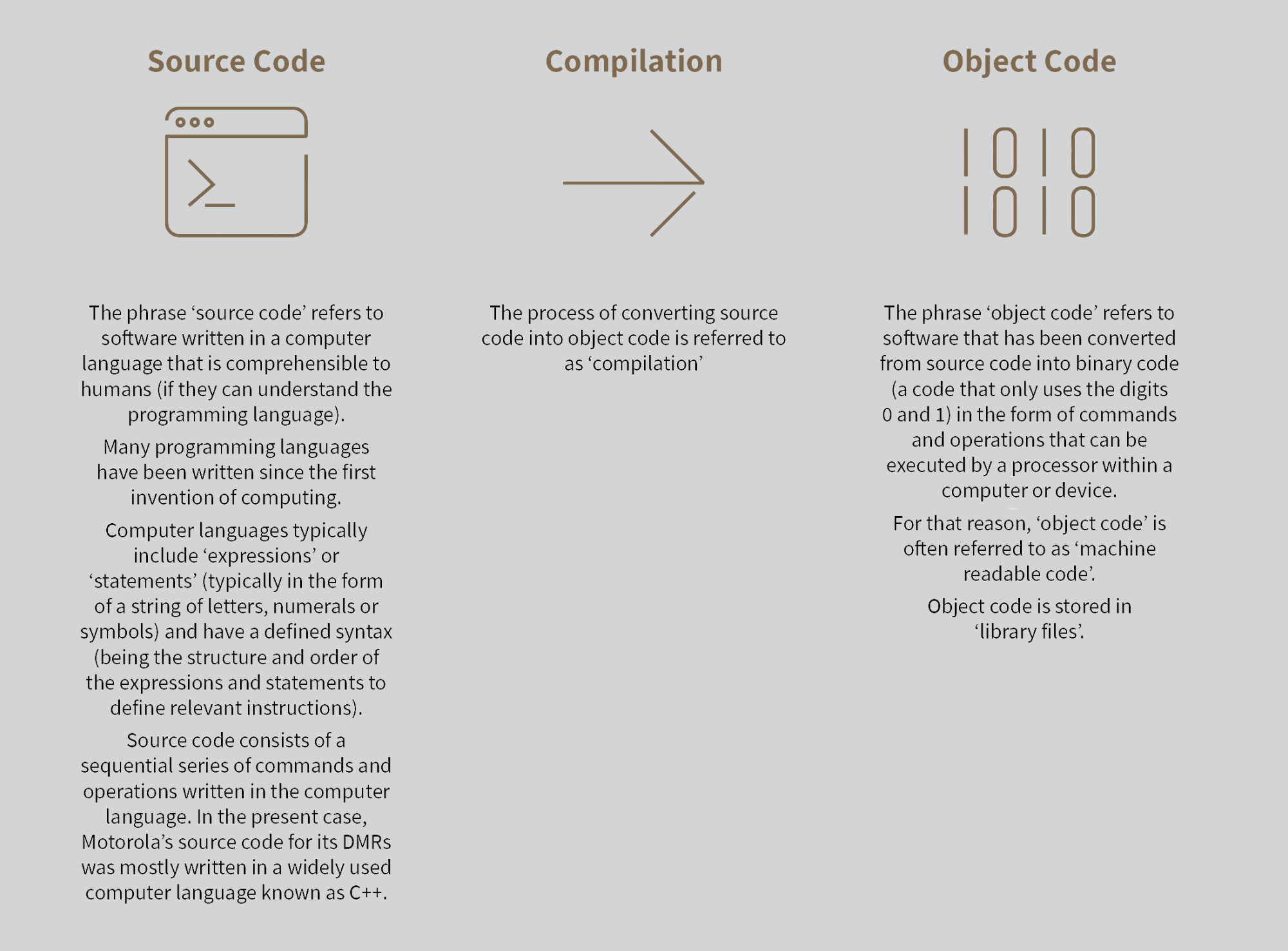
Motorola claimed that Hytera infringed its copyright by reproducing the whole or a substantial part of its source code (Motorola Works) in China when Hytera created its own source code for some of the Hytera Devices, compiled that source code into object code and installed the object code as firmware in the Hytera Devices.
This conduct was not an infringement of the Copyright Act 1968 (Cth) (Copyright Act) because the conduct was outside Australia. However, other conduct of Motorola in Australia was said to be relevant.
Motorola’s allegations of copyright infringement
Click to expand

Motorola was successful at trial.
In summary, Hytera’s appeal proceeded on four bases.
|
Issue
|
Key Findings
|
Example
uses 2
|
|
Hytera did not admit that there was objective similarity between the particularised parts of the Motorola Works and the impugned parts of the Hytera source code.[3] Hytera conceded, however, that if objective similarity was established, the Court may proceed on the basis that the objectively similar portions of the impugned Hytera source code were copied from the corresponding portions of the Motorola Works. At [799]. Also, at [794]: 'The quality of the copied code is to be assessed by reference to the importance which the code bears in relation to the work as a whole, which can also be described as the materiality of the code. But importance and materiality do not refer to the function of the code in the sense of whether the code is important or material to the operation of the computer or device in which the code is installed. Rather, importance and materiality refer to the originality with which the code expresses the functions sought to be performed by the computer or device, which includes such matters as the structure of the code and the choice and sequencing of commands.' |
The code was objectively similar. The evidence supported a finding of objective similarity. Objective similarity does not require identicality of expression. The operative lines of code, while few in number, were objectively similar. The fact that the operative lines of code were few in number is relevant to the assessment of substantial part, but does not undermine an assessment of objective similarity. Also, due to Hytera’s conduct, there was a strong inference object code library files were an adaptation of a substantial part of the source code in the Motorola Works. Hytera conceded, however, that if objective similarity was established, the Court may proceed on the basis that the objectively similar portions of the impugned Hytera source code were copied from the corresponding portions of the Motorola Works. At [799]. Also, at [794]: 'The quality of the copied code is to be assessed by reference to the importance which the code bears in relation to the work as a whole, which can also be described as the materiality of the code. But importance and materiality do not refer to the function of the code in the sense of whether the code is important or material to the operation of the computer or device in which the code is installed. Rather, importance and materiality refer to the originality with which the code expresses the functions sought to be performed by the computer or device, which includes such matters as the structure of the code and the choice and sequencing of commands.' |
Hytera conceded, however, that if objective similarity was established, the Court may proceed on the basis that the objectively similar portions of the impugned Hytera source code were copied from the corresponding portions of the Motorola Works. At [799]. Also, at [794]: 'The quality of the copied code is to be assessed by reference to the importance which the code bears in relation to the work as a whole, which can also be described as the materiality of the code. But importance and materiality do not refer to the function of the code in the sense of whether the code is important or material to the operation of the computer or device in which the code is installed. Rather, importance and materiality refer to the originality with which the code expresses the functions sought to be performed by the computer or device, which includes such matters as the structure of the code and the choice and sequencing of commands.' |
|
Hytera submitted that Motorola had failed to show that the portions of its source code which were copied into the impugned Hytera source code were original. Hytera submitted that Motorola had to demonstrate that each part of the source code which it alleged had been copied by Hytera was original, in the sense of not having been copied from elsewhere and, in particular, not copied from earlier iterations of the same source code (developed by Motorola over time). Hytera conceded, however, that if objective similarity was established, the Court may proceed on the basis that the objectively similar portions of the impugned Hytera source code were copied from the corresponding portions of the Motorola Works. At [799]. Also, at [794]: 'The quality of the copied code is to be assessed by reference to the importance which the code bears in relation to the work as a whole, which can also be described as the materiality of the code. But importance and materiality do not refer to the function of the code in the sense of whether the code is important or material to the operation of the computer or device in which the code is installed. Rather, importance and materiality refer to the originality with which the code expresses the functions sought to be performed by the computer or device, which includes such matters as the structure of the code and the choice and sequencing of commands.' |
The portions of code copied were original. A work will not be denied copyright protection on the basis of lack of originality simply because it is derived from, or based on, an earlier work. Hytera conceded, however, that if objective similarity was established, the Court may proceed on the basis that the objectively similar portions of the impugned Hytera source code were copied from the corresponding portions of the Motorola Works. At [799]. Also, at [794]: 'The quality of the copied code is to be assessed by reference to the importance which the code bears in relation to the work as a whole, which can also be described as the materiality of the code. But importance and materiality do not refer to the function of the code in the sense of whether the code is important or material to the operation of the computer or device in which the code is installed. Rather, importance and materiality refer to the originality with which the code expresses the functions sought to be performed by the computer or device, which includes such matters as the structure of the code and the choice and sequencing of commands.' |
Hytera conceded, however, that if objective similarity was established, the Court may proceed on the basis that the objectively similar portions of the impugned Hytera source code were copied from the corresponding portions of the Motorola Works. At [799]. Also, at [794]: 'The quality of the copied code is to be assessed by reference to the importance which the code bears in relation to the work as a whole, which can also be described as the materiality of the code. But importance and materiality do not refer to the function of the code in the sense of whether the code is important or material to the operation of the computer or device in which the code is installed. Rather, importance and materiality refer to the originality with which the code expresses the functions sought to be performed by the computer or device, which includes such matters as the structure of the code and the choice and sequencing of commands.' |
|
Hytera submitted that Motorola had failed to demonstrate that the portions of its source code which were copied into the impugned Hytera source code were a substantial part of the relevant Motorola Work from which the code was copied. Hytera conceded, however, that if objective similarity was established, the Court may proceed on the basis that the objectively similar portions of the impugned Hytera source code were copied from the corresponding portions of the Motorola Works. At [799]. Also, at [794]: 'The quality of the copied code is to be assessed by reference to the importance which the code bears in relation to the work as a whole, which can also be described as the materiality of the code. But importance and materiality do not refer to the function of the code in the sense of whether the code is important or material to the operation of the computer or device in which the code is installed. Rather, importance and materiality refer to the originality with which the code expresses the functions sought to be performed by the computer or device, which includes such matters as the structure of the code and the choice and sequencing of commands.' |
The portions copied were a substantial part. In the context of computer code, the question of substantial part is to be determined by reference to the originality of the code that has been copied, which requires consideration of the creative and intellectual contribution to the form of expression of the code, including such matters as the structure of the code and the choice and sequencing of commands.[4] It is 'erroneous to reduce the question of substantiality' to the significance of the copied code to the operation (or function) of the computer or device. Hytera conceded, however, that if objective similarity was established, the Court may proceed on the basis that the objectively similar portions of the impugned Hytera source code were copied from the corresponding portions of the Motorola Works. At [799]. Also, at [794]: 'The quality of the copied code is to be assessed by reference to the importance which the code bears in relation to the work as a whole, which can also be described as the materiality of the code. But importance and materiality do not refer to the function of the code in the sense of whether the code is important or material to the operation of the computer or device in which the code is installed. Rather, importance and materiality refer to the originality with which the code expresses the functions sought to be performed by the computer or device, which includes such matters as the structure of the code and the choice and sequencing of commands.' |
Hytera conceded, however, that if objective similarity was established, the Court may proceed on the basis that the objectively similar portions of the impugned Hytera source code were copied from the corresponding portions of the Motorola Works. At [799]. Also, at [794]: 'The quality of the copied code is to be assessed by reference to the importance which the code bears in relation to the work as a whole, which can also be described as the materiality of the code. But importance and materiality do not refer to the function of the code in the sense of whether the code is important or material to the operation of the computer or device in which the code is installed. Rather, importance and materiality refer to the originality with which the code expresses the functions sought to be performed by the computer or device, which includes such matters as the structure of the code and the choice and sequencing of commands.' |
|
In relation only to the importation and sale of the Hytera Devices case, Hytera submitted that Motorola had failed to make good the knowledge element of the infringement. While Hytera accepted that, if it became necessary to consider the knowledge element, the Court will have found that the ex-Motorola engineers deliberately copied a substantial part of the Motorola Works into the impugned Hytera source code, Hytera submitted that they did so without Hytera’s authority and therefore without Hytera’s knowledge. Hytera conceded, however, that if objective similarity was established, the Court may proceed on the basis that the objectively similar portions of the impugned Hytera source code were copied from the corresponding portions of the Motorola Works. At [799]. Also, at [794]: 'The quality of the copied code is to be assessed by reference to the importance which the code bears in relation to the work as a whole, which can also be described as the materiality of the code. But importance and materiality do not refer to the function of the code in the sense of whether the code is important or material to the operation of the computer or device in which the code is installed. Rather, importance and materiality refer to the originality with which the code expresses the functions sought to be performed by the computer or device, which includes such matters as the structure of the code and the choice and sequencing of commands.' |
Hytera knew! For the importation and sale provisions of the Copyright Act, you can attribute the knowledge of an employee to the corporation if the employee has responsibility for, or authority over, the making of the infringing article — or, at least the making of that part or component of the article which renders it an infringing article. Where the relevant conduct was undertaken for the benefit of, or not against the interest of, the corporation, the employee’s knowledge is still the knowledge of the corporation even when the employee is acting fraudulently or in breach of fiduciary duties. Hytera conceded, however, that if objective similarity was established, the Court may proceed on the basis that the objectively similar portions of the impugned Hytera source code were copied from the corresponding portions of the Motorola Works. At [799]. Also, at [794]: 'The quality of the copied code is to be assessed by reference to the importance which the code bears in relation to the work as a whole, which can also be described as the materiality of the code. But importance and materiality do not refer to the function of the code in the sense of whether the code is important or material to the operation of the computer or device in which the code is installed. Rather, importance and materiality refer to the originality with which the code expresses the functions sought to be performed by the computer or device, which includes such matters as the structure of the code and the choice and sequencing of commands.' |
Hytera conceded, however, that if objective similarity was established, the Court may proceed on the basis that the objectively similar portions of the impugned Hytera source code were copied from the corresponding portions of the Motorola Works. At [799]. Also, at [794]: 'The quality of the copied code is to be assessed by reference to the importance which the code bears in relation to the work as a whole, which can also be described as the materiality of the code. But importance and materiality do not refer to the function of the code in the sense of whether the code is important or material to the operation of the computer or device in which the code is installed. Rather, importance and materiality refer to the originality with which the code expresses the functions sought to be performed by the computer or device, which includes such matters as the structure of the code and the choice and sequencing of commands.' |
From these outcomes, a number of interesting issues arise for interpretation of the Copyright Act in the future.
Are adaptations of (earlier) code still original?
Can a part of the (later) copyright work that is derived from, and identical to, an (earlier) version of the work still be a 'substantial part' of the (later) copyright work?
If, in the context of an iterative work, the reproduction of parts of an earlier work could not amount to the reproduction of a substantial part of a later work, then copyright owners would be required to sue on the earlier version.
A central issue in the case was whether, if the Hytera Devices had been made in Australia, that would have involved a reproduction or adaptation of the whole or a substantial part of one or more of the Motorola Works and so been an infringement of copyright. A finding not challenged on appeal was that the Motorola Works (source code) and Hytera Firmware (object code) were not objectively similar. However, Motorola’s alternative argument was that the manufacture of the Hytera Devices involved installation of the Hytera Firmware, which involved an adaptation of the whole or a substantial part of one or more of the Motorola Works.
Hytera’s contention was that Motorola had failed to show that the portions of its source code which were copied into the impugned Hytera source code were 'original', in the sense of not having originated from earlier versions of the software.
'A further aspect of originality arises in relation to works that are derived from earlier works. In many cases, it happens that the work for which protection is claimed is only one in a series of works which have been evolved over a period of time, for example, successive drafts of a play or novel or a series of working drawings made in the process of producing a painting or engraving. Although the point is not often taken, it is clear that a work will not be denied protection on the basis of lack of originality simply because it is derived from, or based on, an earlier work of this kind. Thus, providing the later work is not a mere slavish copy, it will constitute an original work in its own right if the author has expended sufficient independent skill and labour in bringing it into material form.'
Professor Ricketson in The Law of Intellectual Property: Copyright, Designs and Confidential Information, at [733] of Hytera.
The Full Court held that the principles elucidated in Ladbroke, Data Access and IceTV recognise that, within a work in which copyright subsists, different parts of the work may have different degrees of originality. The assessment of whether a part of the work that is copied is a substantial part for the purposes of the Copyright Act will be affected by the degree of originality in that part.
Degrees of originality
|
At one end of the spectrum are copyright works that consist of a compilation of information, in respect of which (typically) there is no originality (and indeed no copyright) in the information that is compiled, and where the originality only resides in the form of compilation. In such a case, the copying of the information, but not the form of compilation, will not infringe copyright. |
At the other end of the spectrum are works that might be described as wholly original. When assessing, in such cases, whether a part of the work that is copied is a substantial part, it remains relevant to consider the degree of originality in that part; however, as explained in Data Access, originality of the part copied is assessed by reference to the essential or material features of the copyright work. |
|
Where a work has been created, in part, from a pre-existing work, two situations may be usefully distinguished from each other:
|
The first is a work which reproduces extracts from another work (such as an anthology). If the part copied did not originate with the author of the anthology, it will not be a substantial part. |
The second is a work which builds on earlier versions of itself. Provided the relevant version of the work involved sufficient intellectual and/or creative effort in reviewing and revising the work, the whole of the work will be an original work. |
|
In the case of a work that builds on earlier versions of itself, it is not necessary for the copyright owner to show that the parts of the work which were not copied from earlier iterations of the work developed over time.[5] Where successive updates of software are released, and originality is conceded for the purposes of subsistence, an argument for infringement purposes that a substantial part of a particular version of the software has been taken is not defeated by showing that the part in question derives from 'antecedent code'.[6]
Evidence concerning the making of the work has relevance to the overall assessment of originality both on the question of subsistence and the question of infringement.[7]
How should courts assess substantial part for software code?
The question is comparatively easier for prose, fiction, artistic works, or music — but given software is both functional and a literary work, how can we determine what is a substantial part of code?
In Australian copyright law, the assessment of what constitutes a 'substantial part' of a copyrighted work has long been a complex and debated issue. This is because the Copyright Act does not provide a precise definition of 'substantial part.' Instead, the courts have been left to interpret this concept, leading to a body of case law that emphasizes a qualitative rather than purely quantitative approach.
Motorola raised a number of issues on appeal concerning 'substantial part'.
At [749].
Also, at [749].
At [751].
|
Issue
|
Outcome
|
Example
uses 2
|
|
Was it incorrect to approach infringement by considering whether small segments of Hytera source code which had been copied from a Motorola Work formed a substantial part of the relevant Motorola Work, rather than considering whether all of the Motorola source code that had been copied by Hytera collectively formed a substantial part? At [783]. See above n 4. Also, at [799]. At [806]. |
Yes — in error. The question to be determined was whether, in respect of each of the Motorola Works, the totality of the Motorola source code copied by Hytera (into the impugned Hytera source code) was a substantial part of the Motorola Work. Expert evidence was highly relevant. Motorola’s appeal was upheld on this ground.[8] At [783]. See above n 4. Also, at [799]. At [806]. |
At [783]. See above n 4. Also, at [799]. At [806]. |
|
Was assessment of substantial part by exclusively focusing on the functionality of the segments of Motorola source code copied by Hytera and by failing to have regard to the originality of the Motorola source code copied by Hytera an error? At [783]. See above n 4. Also, at [799]. At [806]. |
Yes — in error. It is 'erroneous to reduce the question of substantiality' to the significance of the copied code to the operation (or function) of the computer or device. In the context of computer code, the question of substantial part is to be determined by reference to the originality of the code that has been copied, which requires consideration of the creative and intellectual contribution to the form of expression of the code, including such matters as the structure of the code and the choice and sequencing of commands.[9] Motorola’s appeal was upheld on this ground.[10] At [783]. See above n 4. Also, at [799]. At [806]. |
At [783]. See above n 4. Also, at [799]. At [806]. |
|
In light of the above, was the result that the primary judge did not have proper regard to the evidence of Motorola’s witnesses, or to Motorola’s submissions at trial, as to the significance of the Motorola source code copied by Hytera as a whole to each of the Motorola Works? At [783]. See above n 4. Also, at [799]. At [806]. |
Yes — in error. By reason of adopting an erroneous approach to the assessment of substantial part, the primary judge necessarily failed properly to have regard to the evidence of Motorola’s witnesses as to the significance of the copied code as a whole to each of the Motorola Works.[11] At [783]. See above n 4. Also, at [799]. At [806]. |
At [783]. See above n 4. Also, at [799]. At [806]. |
What happens when the source code goes missing?
A key issue was whether the object code library files were an adaptation of a substantial part of the source code of the Motorola Works.
During discovery, Hytera produced three libraries of object code — and could not produce the source code from which the object code was compiled.
Source Code vs Object Code
Click to expand
Suspicious! In fact, the primary judge had found:
- with the aid of expert evidence, it is an extraordinary step for a software company to delete the source code used to compile object code (the library files) used in devices that it continues to sell;[12]
- the source code from which the library file was compiled was deliberately deleted by or at the instigation of the ex-Motorola software engineers, much of the deleted evidence would have thrown light on the infringement suit, and the deletion was a deliberate attempt to suppress evidence which might assist in an infringement suit;
- ex-Motorola engineers took with them to Hytera all of the computer source code for Motorola’s devices to provide themselves with a resource for the purposes of writing Hytera’s source code for its devices; and
- Hytera’s software engineers engaged in industrial scale harvesting of Motorola’s source code and set out to make this as difficult to detect as possible.
In the absence of Hytera’s source code, and given the nefarious deletion, Motorola submitted at trial that the Court should infer that Hytera had copied a substantial part of Motorola’s source code in producing the Hytera source code which was compiled into the object code.
At [862]: “The evidence given by Professor Rangan explains why it is an extraordinary step for a software company to delete the source code used to compile object code (the library files) code used in devices that it continues to sell. Without the source code, the software developers would be unable to make modifications to the underlying code, whether in response to changes in processors or other parts, to fix technical bugs, or to add a feature.”
'This case is an exemplar of the circumstances in which the evidentiary principle encapsulated by the Latin maxim omnia praesumuntur contra spoliatorem (all things are presumed against the wrongdoer) may be applied. The evidentiary principle was stated by Sir Arthur Channell delivering the opinion of the Privy Council in The Ophelia (1916) 2 AC 206 (The Ophelia) at 229-230:
If any one by a deliberate act destroys a document which, according to what its contents may have been, would have told strongly either for him or against him, the strongest possible presumption arises that if it had been produced it would have told against him, ...
The principle is one of long-standing and was applied by the High Court … in Allen v Tobias (1958) 98 CLR 367 in respect of a question of fact whether the defendant had executed an agreement, copies of which were subsequently destroyed by the defendant.'
Hytera, at [860-861].
Given Hytera deliberately destroyed documents (source code) which, given their content, would have told strongly either for or against Hytera on the question of copyright infringement, a strong inference arose that the documents would have proven infringement. All other factual findings made by the primary judge were 'consistent with a conclusion' that the object code library files were compiled from source code which copied Motorola’s source code.
Their Honours considered this should be further addressed at a further hearing.
Who knows what, and when?
Did Hytera know, or ought it reasonably to have known, that if the Hytera Devices had been made in Australia, this would have constituted an infringement of the copyright in Motorola’s copyright works?
Sections 37 and 38 in the Copyright Act require proof that a person who imports an article into Australia (in the case of s 37) and a person who sells an imported article in Australia (in the case of s 38) knew or ought reasonably to have known that, if the article had been made in Australia, it would have constituted an infringement of copyright. Knowledge is of the facts from which infringement can be established — you do not need to know that there would be a contravention of the Copyright Act.[13] The relevant date for assessing Hytera’s knowledge is at the date the Hytera Devices were imported.[14]
Here, it was not Hytera itself as a corporation — but one of its employees. Could the knowledge of employees be attributed to Hytera? In contrast to competition law, the Copyright Act does not 'state any statutory rule for the attribution of knowledge to a corporation'.[15]
The Court found the applicable rule of attribution includes persons with responsibility for, or authority over, the making of the infringing article — or, at least the making of that part or component of the article which renders it an infringing article.[16]
Hytera’s submission about the employee’s lack of responsibility or authority was dismissed as 'hopeless'. A further submission that the employee’s knowledge was acquired during a fraud and a breach of his fiduciary duties was rejected because his actions were not directed against the interests of Hytera — and were partly for the benefit of Hytera.[17]
The patent appeal
Although the case is predominantly a copyright case there a couple of points to make about the patent appeal. Motorola’s two standard patents in issue on appeal were the 355 Patent and the 960 Patent. These patents related to time division multiple access (TDMA) technology which permits a frequency band within the radio spectrum (that is, a channel) to be divided into timeslots so that more than one person may use the same channel at the same time. The asserted claims of the patents involved methods which are said to improve the efficiency of TDMA.
The Full Court upheld Justice Perram’s findings in relation to the 355 and 960 Patents, dismissing both Motorola and Hytera’s appeal and cross-appeal:
- The 355 Patent was found to be valid as it comprised a manner of manufacture, involved an inventive step, was useful, and was found to be infringed, with the consequence that Motorola’s case on infringement of this patent succeeded.
- The 960 Patent was found to be invalid for lack of inventive step, but had it been valid, Hytera would have infringed certain claims by way of supply.
Nothing new on computer-implemented inventions
Notably, the Full Court (briefly) addressed the patentability of computer-implemented inventions.
At first instance, Justice Perram applied the two-step test formulated by a majority of the Full Federal Court (Middleton and Perram JJ) in Commissioner of Patents v Aristocrat Technologies Australia Pty Ltd [2021] FCAFC 202 (Aristocrat FCAFC), which asks:
- Is the claimed invention a computer-implemented invention?
- If so, can the claimed invention broadly be described as an advance in computer technology?
After Justice Perram’s decision was handed down, the High Court heard an appeal from Aristocrat FCAFC. As we have previously reported, the High Court split evenly, with 3 Justices allowing the appeal and 3 Justices dismissing it – and with each plurality providing its own criticism of the Full Court majority’s two-step test.[18] However, because the High Court’s decision was a 3:3 split, it does not create binding precedent and the Full Court majority’s decision stands as affirmed.[19] The Federal Court has continued to apply the two-step test.[20]
In upholding Justice Perram’s decision, the Full Court has endorsed the continued application of that test, despite the High Court’s criticism of it. The Full Court found that Motorola’s patents claim computer-implemented inventions which can be described as improvements to the scanning time and synchronisation of two-way radio technology. As such, they satisfy the two-step test and are patentable.
Some utile comments on utility
The Full Court also affirmed Justice Perram’s finding that Motorola’s 355 Patent is useful.
Put simply, the 355 Patent promises a more efficient method of scanning radio channels. Hytera argued that the 355 Patent fails to achieve this promise fully, because it is possible to use the method in ways that are not more efficient than previous methods.
The Full Court upheld Justice Perram’s finding that this does not deprive the claimed invention of usefulness, emphasising ‘the need for great caution’ in finding that a patent lacks utility. It is not enough for the patent to claim things that are not useful; the language of the patent claim must positively point the reader to some useless construction.
What’s next?
At [878]: “The authorities establish that the relevant knowledge is of the facts from which the finding of infringement would be made (on the hypothetical basis of the article being made in Australia), not knowledge of a contravention of the law.”
At [703].
At [882].
At [884].
At [892]: “[The employee] was responsible for and had full knowledge of the activities of the DMR team which, as found by the primary judge (at PJ 1576]), engaged in industrial scale harvesting of Motorola’s source code and which, the primary judge found (at PJ [5]), involved a “substantial industrial theft”. The motivation was to get the Hytera devices to market as quickly as possible at the lowest cost (PJ [1990(f)]). Hytera benefitted from the actions of the ex-Motorola engineers in at least two ways: it got to market with devices which were commercially competitive with Motorola’s products where otherwise it would not have done so and it got to market by no less than 15 months earlier than it otherwise would have (PJ [1992]). It is impossible for Hytera to contend, in those circumstances, that all of Mr GS Kok’s activities were directed against the interests of Hytera and not partly for the benefit of Hytera. The fraud exception has no application in this case and Hytera’s ground of appeal must be rejected”.
Judiciary Act 1903 (Cth) s 23(2)(a).
|
Copyright
|
Patents
|
Example
uses 2
|
|
Hytera has filed an application for special leave to appeal to the High Court, reportedly challenging the Full Court’s findings that Hytera copied a substantial part of the relevant Motorola Works and that Motorola did not need to prove that the parts of the works allegedly taken by Hytera were original. |
It has also been reported that Hytera is challenging the Full Court’s finding that Motorola’s 335 Patent is useful. |
|
We will continue to monitor and report — here, or on our recently re-launched blog IP Whiteboard — if special leave is granted, which in our view is more likely to arise from the copyright aspects of the case rather than any of the findings in relation to patents.