
As class action settlements require Court approval, the Court plays a crucial role in protecting group members’ interests. Rather than simply approving settlements, the Court rigorously assesses their terms for fairness and reasonableness.
In the review period, Courts have focused on several key aspects before granting approval, including:
- recoverability of solicitors’ fees and group costs orders (GCOs)
- impact of late registration applications by unregistered group members (UGMs), and
- the treatment of Calderbank offers in the class action context.
Recoverability of solicitors’ fees
Courts closely scrutinise deductions from the settlement sum, such as legal costs and funders’ commissions, to ensure they are reasonable and do not unduly erode the benefits to group members. The Court often relies on independent cost assessments and considers the proportionality of costs to the risks and effort involved in the litigation.[1]
Proportionality
Courts continue to show a willingness to reduce legal fees and funders’ commissions where the combined deductions would leave group members with an unacceptably low share of the settlement. For example, in CIMIC Group,[2] a compromise was reached between the applicants’ lawyers and funder whereby the lawyer’s fees and the funder's commission were reduced to ensure that group members received no less than 50% of the Settlement Sum. This involved both the applicants’ lawyers and the funder agreeing to a reduction of approximately $1,137,500 in legal fees and approximately $4,727,766 in funding commission respectively.[3]
The Court has also been critical of deductions for legal fees where methods adopted in administering the class actions are unnecessarily expensive, resource-intensive or otherwise inappropriate:
- In the NT Stolen Wages class action,[4] when assessing the solicitors’ fees payable to the applicant’s lawyers and declining to make the proposed cost deduction order sought, Mortimer CJ considered that the firm had applied an ‘excessive level of human resources’ to the proceeding (with 131 fee earners working on the proceeding), and applied it in a way which was ‘not conducive to the most effective and efficient conduct of the proceeding’.[5]
- In the WA Stolen Wages class action,[6] the Court was concerned by the excessive costs that had been incurred by the applicant’s law firm post-settlement. Justice Murphy considered that before the firm ‘ran up such enormous costs post-settlement’ it should have come before the Court and given notice of that proposed expense.[7] The Court indicated that the applicant’s law firm needed to give greater attention to whether there were ‘cheaper or more efficient ways of achieving a similar outcome’ and also suggested that engagement of local Indigenous representatives may have provided a more appropriate solution. Ultimately, the Court reduced the applicant’s law firm’s fees by $4m from the amount approved by the cost referee which brought the total firm’s costs and disbursements down to approximately $27.5m.
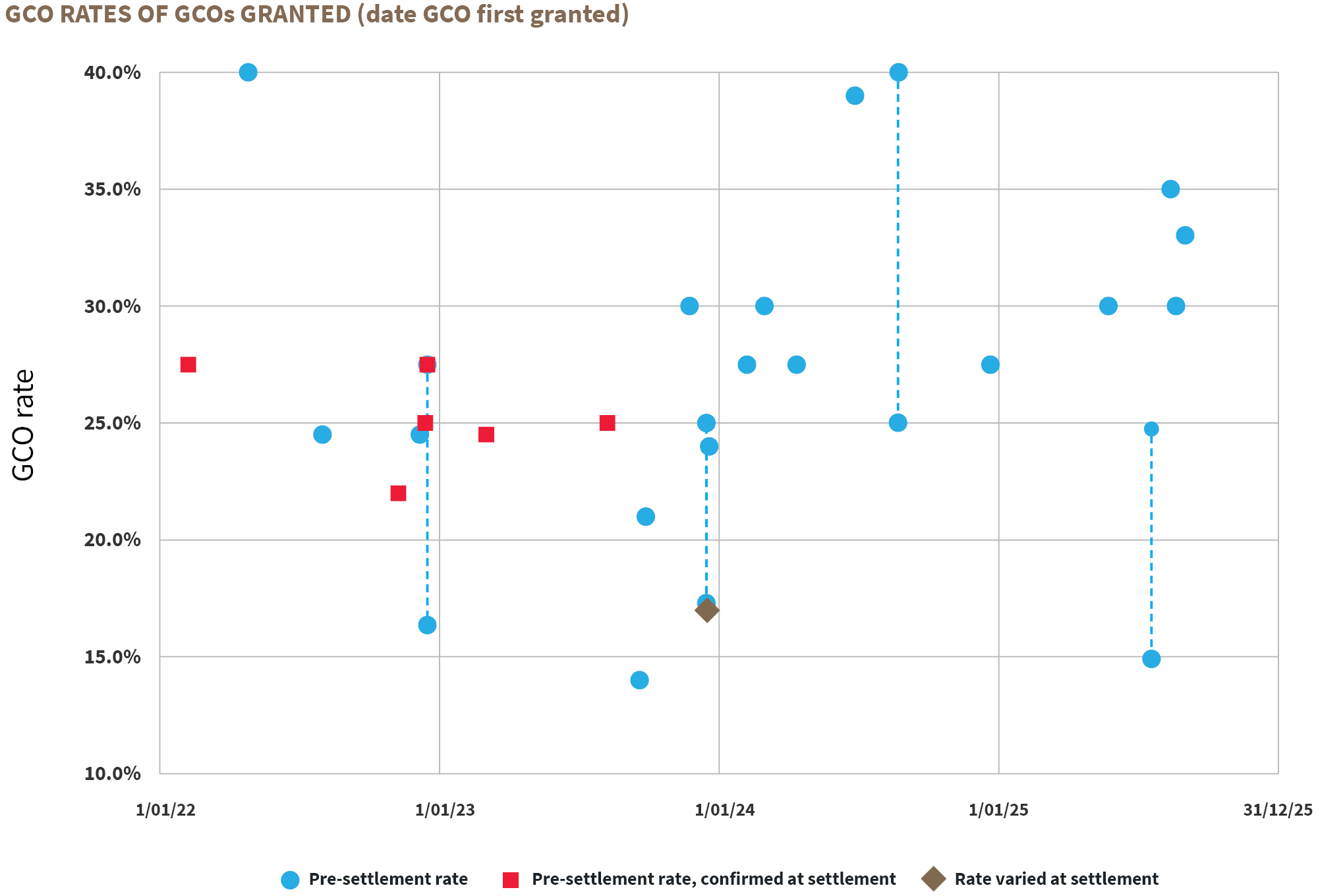
Approval of GCOs at time of settlement application
A GCO is a creature of Victorian legislation that allows law firms acting for a plaintiff to recover their legal costs as a percentage of any award or settlement in the proceeding.[8]
Section 33ZDA(3) of the Supreme Court Act 1986 (Vic) allows the Court to review the GCO rate once more information regarding the conduct and outcome of the proportionality becomes available. This ensures the rate represents an appropriate reward, considering the effort and investment of the legal practice, the duration of the proceedings and the risks undertaken under the GCO.
In the review period, the Court approved the following settlements:
- G8 Education: the settlement of $46.5m included a GCO of 27.5% (being $12,787,500)
- Allianz:[9] the settlement of $170m included a GCO of 25% (being $42.5m), and
- Noumi:[10] the settlement of $43m included a GCO of 22% (being $9.46m).
Neither the Court nor the parties in these proceedings sought to vary the GCO percentage. In G8 Education, Watson J noted that the absence of any party seeking an amendment of the GCO rate does not relieve the Court of its obligation to consider whether the rate should be amended.[11]
Indeed, just outside of the review period, Delany J determined that it was appropriate to vary the GCO percentage in the class action against Hino Motors.[12] There, the Court reduced the GCO percentage from 24.66% to 17.39% on the basis that the lower percentage would represent ‘an appropriate reward in the context of the effort and investment of the legal practice, the duration of the proceeding, and the risks which were undertaken under the GCO.’
See for example, Minnie McDonald v Commonwealth of Australia [2025] FCA 380 (NT Stolen Wages class action); Street v State of Western Australia [2024] FCA 1368 (WA Stolen Wages class action); Allen & Anor v G8 Education (No 4) [2024] VSC 487 (G8 Education).
Miciulis v CIMIC Group Limited [2025] FCA 307.
Ibid at [63]-[65].
Under the settlement, the Commonwealth will pay a sum of up to $180m in compensation and up to $22m for the applicant’s agreed costs, costs assessor’s costs and agreed administration costs: NT Stolen Wages class action at [6]-[8].
Ibid at [461].
Under the settlement deed, the State agreed to pay up to $180.4M, comprised of an amount of up to $165m in compensation and an amount of up to $15.4m in respect to the applicant’s party/party costs of the proceeding up to the date of settlement approval: WA Stolen Wages class action at [4].
WA Stolen Wages class action at [24].
Supreme Court Act 1986 (Vic) s33ZDA.
Fuller & Anor v Allianz Australia Insurance Ltd & Anor [2025] VSC 160.
Gehrke & Anor v Noumi Ltd & Anor [2025] VSC 373.
G8 Education at [62]; also cited in Allianz at [156] and [176].
McCoy v Hino Motors Ltd (No 2) [2025] VSC 553.
Late registrations
This review period has seen large numbers of applications for late registrations by unregistered group members who did not register by the court-ordered deadline. When determining whether UGMs should be permitted to participate in the settlement, the Court undertakes a delicate balancing act between fairness, procedural certainty, and efficient administration of justice.
In Uber,[13] 5,722 late applications were received (of which only 140 were approved), while in Monash IVF[14] there were 174 late applications (of which only 61 were approved). The Uber and Monash IVF class actions highlight that UGMs must satisfy a high threshold to be approved as late registrants and must sufficiently demonstrate unfair prejudice to them in the operation of the class closure order.[15]
Factors which may impact whether the Court will accept a group member’s late registration application include the:
- nature and extent of notice given to group members of the requirement to register before the deadline[16]
- extent to which the settlement sum available to group members who registered on time will be diluted[17]
- impact of the late applications; for example, if it would cause a substantial delay to the settlement approval,[18] and
- reasons (if any) given by an UGM as to why they did not register on time, and why a late registration should be approved.[19] For example, if there is persuasive evidence that the UGM did not receive the opt out or registration notice,[20] or if extraneous life circumstances provide a reasonable excuse for failure to register.[21] Where a UGM has made a considered decision not to register, and there is no evidence to show that their decision-making capacity was compromised, the Court is unlikely to grant leave to register.[22]
If a UGM misses the late registration application deadline and applies out of time, the Court will additionally consider the amount of notice given to UGMs to submit late registration applications, and whether the UGM applied to the Court for an extension.[23]
The issue of late registrants was also raised in Merivale,[24] where 788 employees registered after a settlement had been agreed. The Applicant raised concerns that these late registrations significantly diluted the value of the proposed settlement for group members. As a result, the parties agreed to increase the settlement amount from $9.4m to $19.25m, which the Federal Court approved in November 2024.
These cases demonstrate the importance of giving appropriate notice of the registration date to group members to avoid applications by UGMs delaying settlement approval and potential dilution of the settlement sum. Furthermore, these cases illustrate how registrations made prior to mediation, as well as assumptions regarding participation rates, can significantly impact settlement negotiations and outcomes.
Summary of factors for late registration applications[25]
Andrianakis v Uber Technologies Inc; Salem v Uber Technologies Inc (No 2) [2024] VSC 436 (Uber).
Bopping & Anor v Monash IVF Pty Ltd & Ors (No 2) [2025] VSC 8.
Andrianakis v Uber Technologies Inc (Settlement Approval) [2024] VSC 733 (Uber Settlement Approval) at [61]-[63].
Uber at [42].
Uber Settlement Approval at [67]; Monash IVF at [13]-[14].
Uber at [49].
Uber Settlement Approval at [99], cited in Monash IVF at [12].
Uber Settlement Approval at [65]; Monash IVF at [16].
Monash IVF at [18]-[20].
Ibid at [17].
Uber at [43]-[44].
Boulos v M.R.V.L. Investments Pty Ltd (Settlement Approval) [2024] FCA 1377.
See Uber; Uber Settlement Approval; Monash IVF; Noumi; G8 Education; Horsky v Mesoblast Ltd [2024] FCA 1509; Allianz.
|
Factors
|
Relevant
|
Insufficient
|
|
Notice
|
Failed to receive notice or the notice process was defective |
Mere unawareness of or confusion about the notice |
|
Settlement dilution
|
The number and value of late claims |
Disproportionately affecting registered members |
|
Characteristics
|
Literacy, physical or mental capacity if linked to non-registration Special vulnerabilities |
General claims of being overwhelmed |
|
Reasons
|
Mistaken belief in registration supported by persuasive and credible reasons Failure due to errors or omissions of others |
Changing of mind in absence of vitiating reasons |
|
Delay
|
Insignificant delay Intention to participate known to the parties |
Extensive delay in approaching the Court |
Calderbank offers not a guarantee for indemnity costs
Generally in commercial litigation, where a Calderbank offer is rejected by an unsuccessful party, and the offer proves to be more generous than the subsequent judgment, the Court may award costs on an indemnity basis where the offer was unreasonably rejected.
Last year, the Federal Court held that Calderbank offers can operate in class action proceedings.[26] This means that, if (for example) the applicant in a group proceeding does not accept an offer made by the respondent, and the respondent is successful at the subsequent trial, it is open to the Court to order the applicant pay the respondent’s costs on an indemnity basis from the date the offer was made. However, subsequent decisions demonstrate that there is a high threshold to meet before a Court will make such an order in a class action, even if the respondent is successful at trial.[27]
The Court may consider the following factors in the decision to award indemnity costs (or not):
- Assessment of prospects. Complex and/or novel issues which have not been the subject of judicial consideration, or unique factual contexts which make the application of otherwise-settled principles challenging, may give rise to uncertainty about the way in which the trial will resolve.[28]
- Extent of compromise. In NULIS, the offer of $11.7m was a steep compromise on the applicants’ assessment of the claim (being $181m),[29] and in Stillwater, accepting the offer ‘would have resulted in there being no return to the class members at all’.[30] It generally will not be unreasonable for a party to reject offers that are unlikely to receive Court approval.
- Factors which are peculiar to class actions, including the requirement for Court approval of settlements. As an example, in Stillwater, the applicant had been preparing for trial for close to 4 years, and the offer was made 10 days before the commencement of the trial. Practically, to obtain Court approval of the settlement, the court dates would have needed to be vacated. If the in-principle settlement then fell through, this could have led to considerable delay, inefficiencies and costs. The reasonableness of rejecting the offer was assessed in this context.[31]
Parties making a Calderbank offer should therefore consider the length of time given to the other party to consider and accept the offer, the return to group members after payment for costs, and any prospects assessments. Notably, even a seemingly generous offer may not be deemed unreasonable to refuse if the claim is novel and the offer is subjectively perceived as significantly undervaluing the claim.
Karpik v Carnival plc (The Ruby Princess) (Common Questions and Costs) [2024] FCA 57 at [18]-[20].
Brady v NULIS Nominees (Australia) Limited in its capacity as trustee of the MLC Super Fund (Costs) [2025] FCA 128 (NULIS); Stillwater Pastoral Company Pty ltd v Stanwell Corporation Ltd (No 2) [2025] FCA 316 (Stillwater).
NULIS at [26]; Stillwater at [39].
NULIS at [28]-[29].
Stillwater at [41].
Ibid at [28], [34].