In December 2025, the Government announced late-breaking changes to Australia’s new mandatory merger clearance regime, introducing new notification thresholds, filing triggers, and exemptions. Many of these changes commenced from 1 January 2026, but the Government provided a 3 month period for businesses to prepare for the changes that would bring some acquisitions within the scope of the regime (that were not captured previously).
From today, new transaction value thresholds apply to acquisitions of ‘standalone’ assets acquisitions and share acquisitions which meet new ‘bright line’ voting power tests are required to be notified to the ACCC – even if they do not result in control. We unpack the new thresholds below.
As to how the new regime is going so far - it’s far too soon to conduct any real assessment of the impact of the new regime on the economy as a whole, M&A activity generally, or even any specific industry sectors. But after a few months of the mandatory system being in place, some trends are already beginning to emerge. You can read more on those trends in our insight ‘ACCC Merger Clearance – letters from the front.’
New thresholds for share acquisitions that do not result in a change of control
The 4 new ‘bright line’ voting power thresholds are set out in the table below. Importantly, acquisitions which meet the monetary thresholds and trigger these voting power tests will need to be notified unless an exemption applies - even if the acquisition does not result in a change of control. ‘Control’ means the capacity to determine the financial and operating policy of an entity – either alone or jointly with ‘associates’ (as defined in the Corporations Act 2001, with some amendments).
Notifiable acquisitions
|
Nature of target entity
|
Pre-acquisition voting power
|
Post-acquisition voting power
|
|
1. All target entities |
Between 20% and 50%* |
50% or more* |
|
2. Widely held/Chapter 6 entities (i.e. listed entities, or entities with more than 50 members) where already controlled by the acquirer |
20% or below |
Above 20% |
|
3. Widely held/Chapter 6 entities (i.e. listed entities, or entities with more than 50 members) where NOT already controlled by the acquirer |
Below 20% |
50% or more |
|
4. Private/unlisted entities (i.e. unlisted entities and entities with less than 50 members) |
20% or below* |
Above 20%* |
|
*Note: Disregard the voting power of associates that only have “minority shareholder protection rights”. |
||
New thresholds for discrete asset acquisitions
New transaction value thresholds now apply to acquisitions of ‘standalone assets’, being those assets that do not constitute ‘all, or substantially all, the assets of a business.’
‘All or substantially all of the assets of a business’
The concept of ‘all or substantially all of the assets of a business’ is not defined – whether an acquisition meets this definition is a question of fact. The guidance provided in the Explanatory Statement to the Competition and Consumer (Notification of Acquisitions) Amendment (2025 Measures No. 1) Determination 2025 is that ‘where the asset acquisition would enable the acquirer to effectively continue operating a business that is similar to the business currently operated using the acquired assets, this would typically constitute an acquisition of all, or substantially all, of the assets of a business.’
Standalone asset thresholds
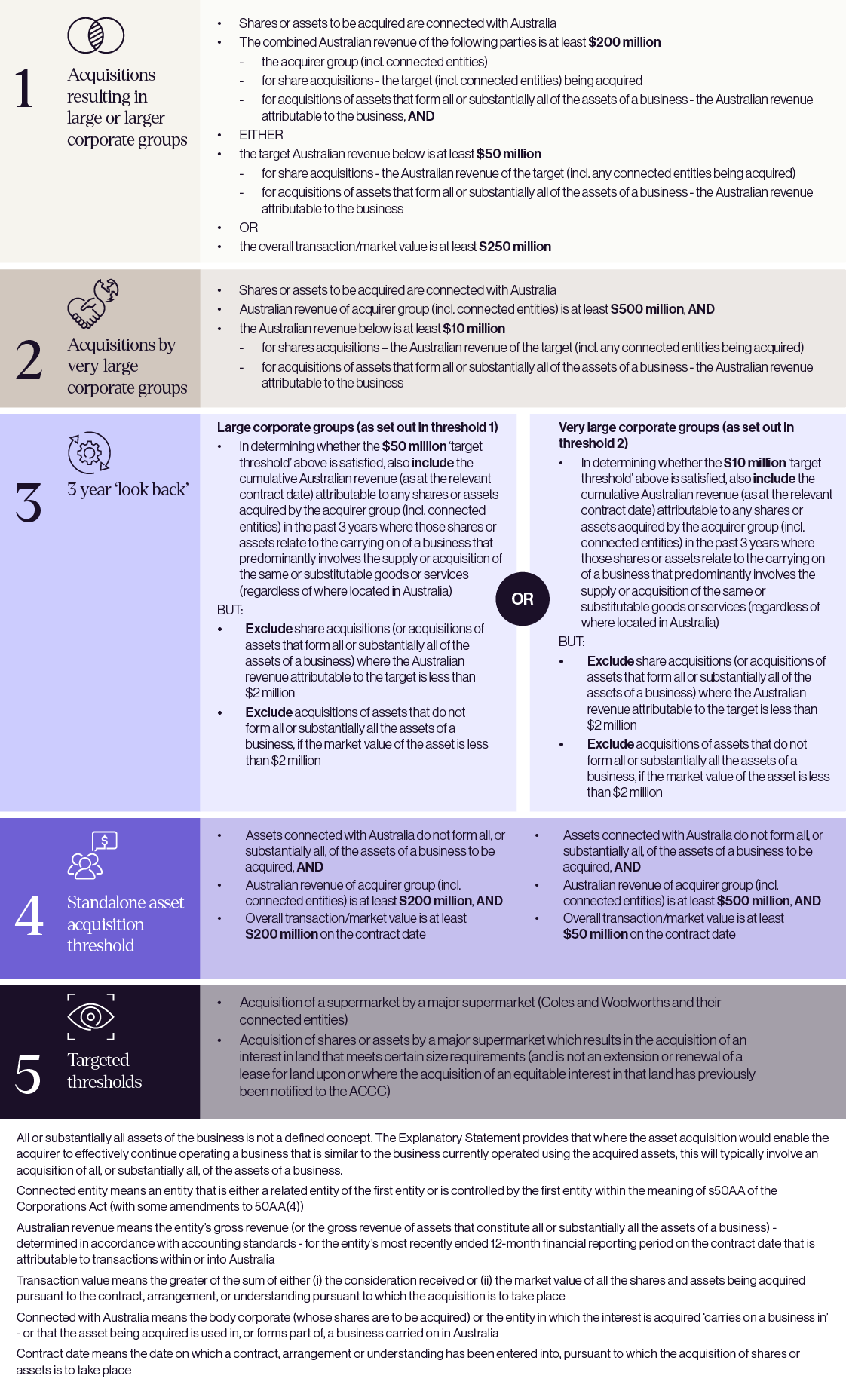
Acquisitions of standalone assets will be notifiable if they trigger one of the following monetary thresholds:
- the Australian revenue of the acquirer group (including their connected entities) is at least $200 million and the overall transaction/market value* is at least $200 million; or
- the Australian revenue of the acquirer group (including their connected entities) is at least $500 million and the overall transaction/market value* is at least $50 million.
*Note: Transaction value means the greater of the sum of either (i) the consideration received or (ii) the market value of all the shares and assets being acquired pursuant to the contract, arrangement, or understanding pursuant to which the acquisition is to take place.
Acquisitions that do involve the acquisition of all or substantially all the assets of a business will continue to be subject to the monetary notification thresholds that have been in place since the ACCC’s mandatory notification regime commenced on 1 January 2026 - see Figure 1 below for a snapshot of all of the mandatory notification thresholds.
Figure 1 – Mandatory acquisition notification thresholds
Everything you need to know about Australia’s new ACCC Mandatory Clearance Regime